Why Solving for y Is the Skill That Unlocks Graphing
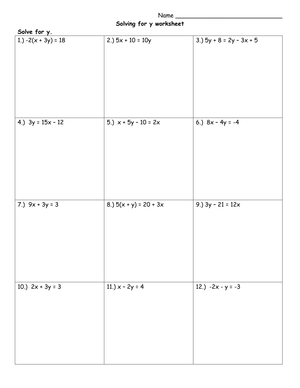
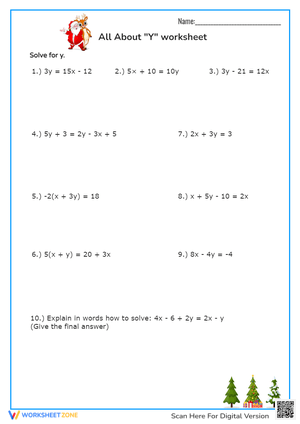
When students stall out graphing lines, the problem usually isn't the graph itself—it's the equation in front of them. A line written as 3x + y = 6 hides its slope and y-intercept until someone isolates y. That's exactly what solving for y worksheets rehearse: taking a standard-form equation and rewriting it as y = mx + b so the two numbers a graphing task needs are sitting right where students expect them.
For grades 7 through 9, this is a bridge skill. Pre-algebra and Algebra 1 students already know how to solve a one-variable equation, but solving for y asks them to hold a second variable in play while they isolate the first. That extra layer is where accuracy slips. Worksheets that drill the move turn a shaky, error-prone step into something automatic before a graphing or slope-intercept unit ever begins.
The payoff is that graphing lessons stop doubling as remediation. When students arrive already fluent at producing y = mx + b, class time goes toward interpreting slope and intercept rather than untangling the algebra that should have come first.
From Standard Form to Slope-Intercept Form
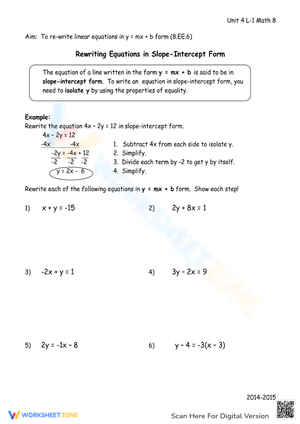
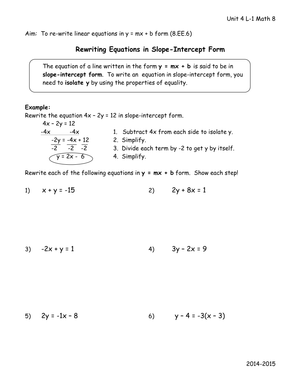
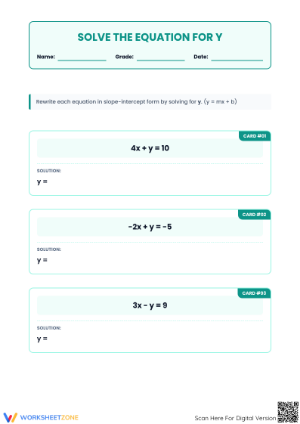
Most solving-for-y practice starts with equations in the form Ax + By = C and asks students to finish at y = mx + b. The value of a dedicated worksheet set is that it isolates one decision at a time. Students aren't graphing yet, aren't interpreting a word problem yet—they're only rewriting. That narrow focus is what makes the practice gradable, fast to check, and easy to reteach when a whole class misses the same step.
A worksheet that builds difficulty deliberately tends to move through three stages:
- Equations where the y-term already has a coefficient of 1, such as 2x + y = 8, so students practice only the move-the-x-term step.
- Equations with a positive y-coefficient greater than 1, such as 4x + 2y = 10, which add the division step.
- Equations with negative or fractional coefficients, such as 3x - 2y = 12, reserved for Algebra 1 extension and transfer.
Sequencing this way means a struggling student and an advanced student can work from the same page but stop at different rows, which keeps a mixed class on one shared task.
The Procedure Students Rehearse
Isolating y in Ax + By = C is a two-move routine, and worksheets exist to make both moves reflexive:
- Move the x-term. Subtract the x-term from both sides so the y-term stands alone: By = -Ax + C.
- Divide every term. Divide each term by B, the coefficient of y, to land on y = (-A/B)x + C/B.
The second step is where fluency pays off. A student who divides only the x-term and forgets the constant ends up with the wrong y-intercept, and the resulting line lands in the wrong spot on the grid. Repeated practice on the same structure keeps the divide-every-term habit front and center, so it survives the jump to messier coefficients later.
It also helps to have students write the slope and y-intercept next to each finished equation. That small addition turns a rewriting drill into a preview of the graphing task, and it gives you a quick way to spot who understands what m and b actually represent.
Differentiating for Grades 7-9
The same worksheet template stretches across three grade levels if you control the coefficients rather than the format:
- On-grade 8th graders: whole-number coefficients and y-terms that divide evenly, keeping the focus on the two-step structure and clean arithmetic.
- Intervention and small groups: equations where the y-coefficient is already 1, so students rehearse the sign move without the added division layer that tends to overload working memory.
- Algebra 1 extension: fractional and negative coefficients, plus literal equations such as solving A = lw for w, which carries the same reasoning into formulas.
Keeping the layout identical across all three versions matters more than it sounds. When every group works from a page that looks the same, no student can tell at a glance who has the easy sheet, which keeps intervention low-stakes and quietly builds buy-in.
Classroom Implementation
Solving for y works best as a short, high-frequency routine rather than a single day on the calendar. A few ways teachers fold it in:
- Warm-ups: three or four equations at the start of a linear-equations unit keep the skill warm across a couple of weeks without eating a full period.
- Formative check: a five-problem exit ticket the day before a graphing lesson tells you exactly who can supply their own y = mx + b and who still needs a small-group pull.
- Targeted intervention: gather the students who missed the divide-every-term step and hand them a set built entirely around that one move.
- Spiral review: drop a single solving-for-y problem into unrelated warm-ups later in the year so the skill doesn't fade before a functions unit.
Because each problem has one clean answer, these sets are quick to self-check or peer-check against a key, which keeps feedback same-day instead of next-week and lets you reteach while the mistake is still fresh. That fast loop is what turns a worksheet from a grading chore into a real diagnostic.
How the Skill Fits the Standards
Solving for y isn't an isolated trick; it sits inside two well-defined standards that span middle and high school math.
According to the Common Core State Standards, CCSS.MATH.CONTENT.8.EE.B expects eighth graders to rewrite linear equations in slope-intercept form and identify the slope and y-intercept, while HSA-CED.A.4 asks high schoolers to rearrange formulas using the same balanced-operations reasoning. One worksheet skill therefore reaches across at least two grade bands of standards.
That vertical alignment is why the move is worth over-practicing. A student who can rearrange 3x - 2y = 8 into slope-intercept form is using the exact reasoning they'll later apply to solve a science or geometry formula for a chosen variable, which makes solving for y one of the higher-leverage skills in the whole linear-equations unit.
Frequently Asked Questions
1. What grade level practices solving for y?
Solving for y typically starts in 8th-grade pre-algebra and continues through Algebra 1, roughly grades 7 through 9. Eighth graders meet it when they convert linear equations to slope-intercept form, and Algebra 1 students extend it to fractional coefficients and literal equations.
2. How does solving for y connect to graphing lines?
Graphing from slope-intercept form requires y = mx + b, where m is the slope and b is the y-intercept. Solving for y is the step that produces that form from a standard-form equation, so students can read the slope and intercept directly instead of guessing from the numbers.
3. What are the most common mistakes?
The two frequent errors are forgetting to divide the constant term by the y-coefficient and making a sign error when moving the x-term across the equals sign. Worksheets that mix coefficients and signs across the same set target both directly.
4. How can I differentiate these worksheets?
Control the coefficients. Give struggling students equations where y already has a coefficient of 1, keep on-grade learners on whole numbers, and push advanced students toward negative, fractional, or literal equations for transfer.
5. Which standards do these worksheets support?
They align with CCSS.MATH.CONTENT.8.EE.B, which covers slope-intercept form in 8th grade, and HSA-CED.A.4, which covers rearranging formulas in high school. Both rely on the same balanced-operations reasoning students rehearse here.