Once students have solved linear equations comfortably, many teachers look for a topic that stretches algebraic thinking without repeating it. Graph theory fills that gap well. It uses simple objects, dots and lines, to model relationships that students already recognize from seating charts, friendship groups, and delivery routes. Because the entry point does not require heavy algebraic manipulation, it works for enrichment groups, discrete math electives, and even a short unit inserted between algebra topics. Introduction to graph theory worksheets give you a structured way to sequence vocabulary, puzzles, and light algorithmic thinking without building a unit from scratch.
Vertices and Edges: Building the Vocabulary Students Need First
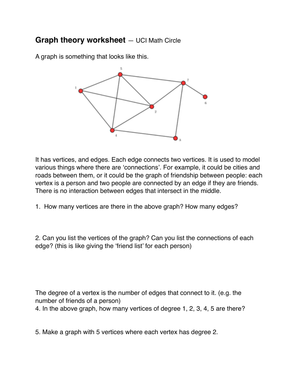
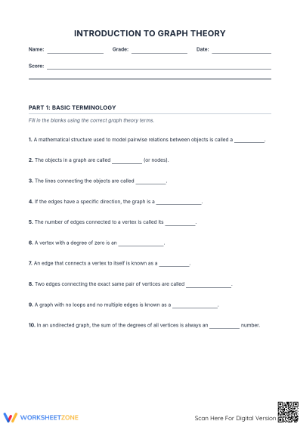
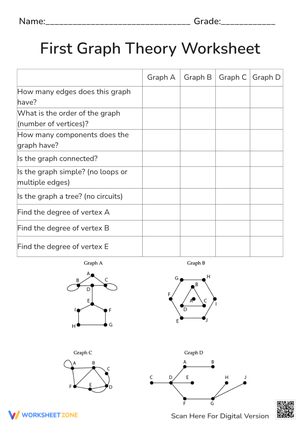
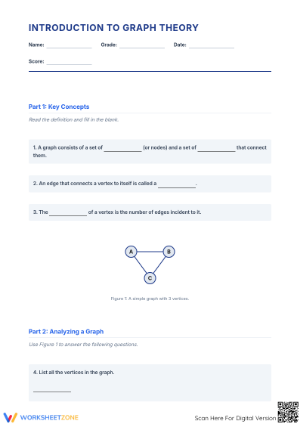
Every graph theory unit starts with two words: vertices and edges. A vertex, sometimes called a node, represents a person, place, or object. An edge represents a connection between two vertices. Students grasp this fastest through contexts they already live in. A classroom seating chart becomes a graph where each desk is a vertex and each pair of students who talk regularly is an edge. A bus route map becomes a graph where stops are vertices and roads are edges. Worksheets that open with labeling and drawing tasks, rather than definitions alone, let students build the vocabulary through repetition before they see it in a formal problem.
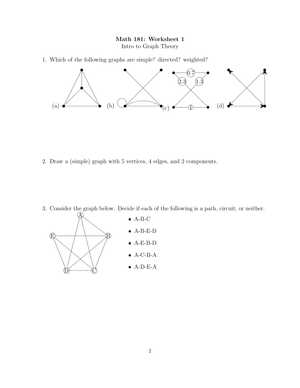
Once students can identify vertices and edges confidently, worksheets can introduce related terms such as degree, which counts how many edges touch a vertex, and path, which describes a sequence of edges connecting two vertices. Keeping this vocabulary stage short and visual matters more than covering every term at once.
Moving Toward Algorithms: Prims, Kruskals, and Beyond
Once vocabulary and puzzle-based reasoning are solid, worksheets can introduce lightweight algorithmic thinking. Prims algorithm and Kruskals algorithm both build a minimum-connecting network by repeatedly choosing the cheapest available edge, and both can be taught with weighted graphs drawn on paper rather than code. Students who enjoy optimization problems often respond well to a simplified version of the Traveling Salesman Problem, where they try to find the shortest route visiting several locations once each. The Chinese Postman Problem, which asks for the shortest route covering every edge at least once, works well as a follow-up for students ready for a slightly harder challenge. None of these topics require formal proof at the secondary level; a worksheet sequence that has students trace through the algorithm by hand on three or four small graphs builds enough fluency for classroom purposes.
Classroom Implementation
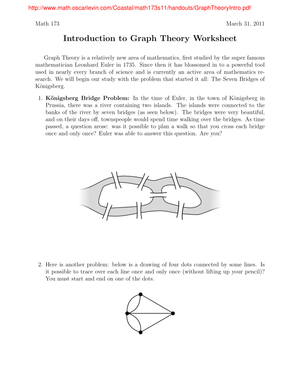
A two-to-three week introductory unit tends to work best when sequenced in this order: vocabulary and drawing tasks first, puzzle-based problems second, vertex coloring third, and a light introduction to one algorithm last. Each stage should include a worksheet that asks students to draw their own graph from a real scenario, not just label a graph you provide, since generating the model is where the concept solidifies. For small-group intervention, keep graphs small, four to six vertices, and slow the pacing on vocabulary. For whole-class enrichment after a linear equations unit, you can move faster through vocabulary and spend more time on the Konigsberg-style puzzles and the Traveling Salesman activity, since those generate the most discussion.
Research on secondary graph theory instruction, including a classroom-focused study from East Tennessee State University, points to puzzle- and game-based sequencing as more effective for vocabulary retention than starting with formal algorithmic instruction, since students who solve a puzzle before naming a rule tend to explain that rule back more accurately days later.
Frequently Asked Questions
1. What grade level is appropriate for introducing graph theory concepts?
Most teachers introduce graph theory to students in grades seven through ten, once they are comfortable with basic algebra. The vocabulary and puzzle stages work well even earlier in an enrichment context, while coloring and algorithm work fit better once students can reason through multi-step problems.
2. What prior math knowledge do students need before starting graph theory worksheets?
Students need comfort with basic problem-solving and simple counting or arithmetic. Graph theory does not require algebraic manipulation to start, which makes it a good fit right after a linear equations unit, when students want a change of pace without a large prerequisite gap.
3. How can teachers use graph theory worksheets for enrichment versus core instruction?
For enrichment, use graph theory as a standalone two-to-three week unit after core algebra content, emphasizing puzzles and open-ended modeling tasks. For core instruction or intervention, use smaller graphs, slower vocabulary pacing, and more drawn, real-world anchors like seating charts or simple maps.
4. What are simple real-world examples to explain vertices and edges to students?
A classroom seating chart, a friendship network, a bus route map, and a school hallway layout all work well. In each case, the people, stops, or rooms become vertices, and the direct connections between them become edges, giving students a familiar picture before any formal terminology is introduced.