


























Views
Downloads

Grade 6 Math: Write an Equation from a Graph — Printable
Paste this activity's link or code into your existing LMS (Google Classroom, Canvas, Teams, Schoology, Moodle, etc.).
Students can open and work on the activity right away, with no student login required.
You'll still be able to track student progress and results from your teacher account.
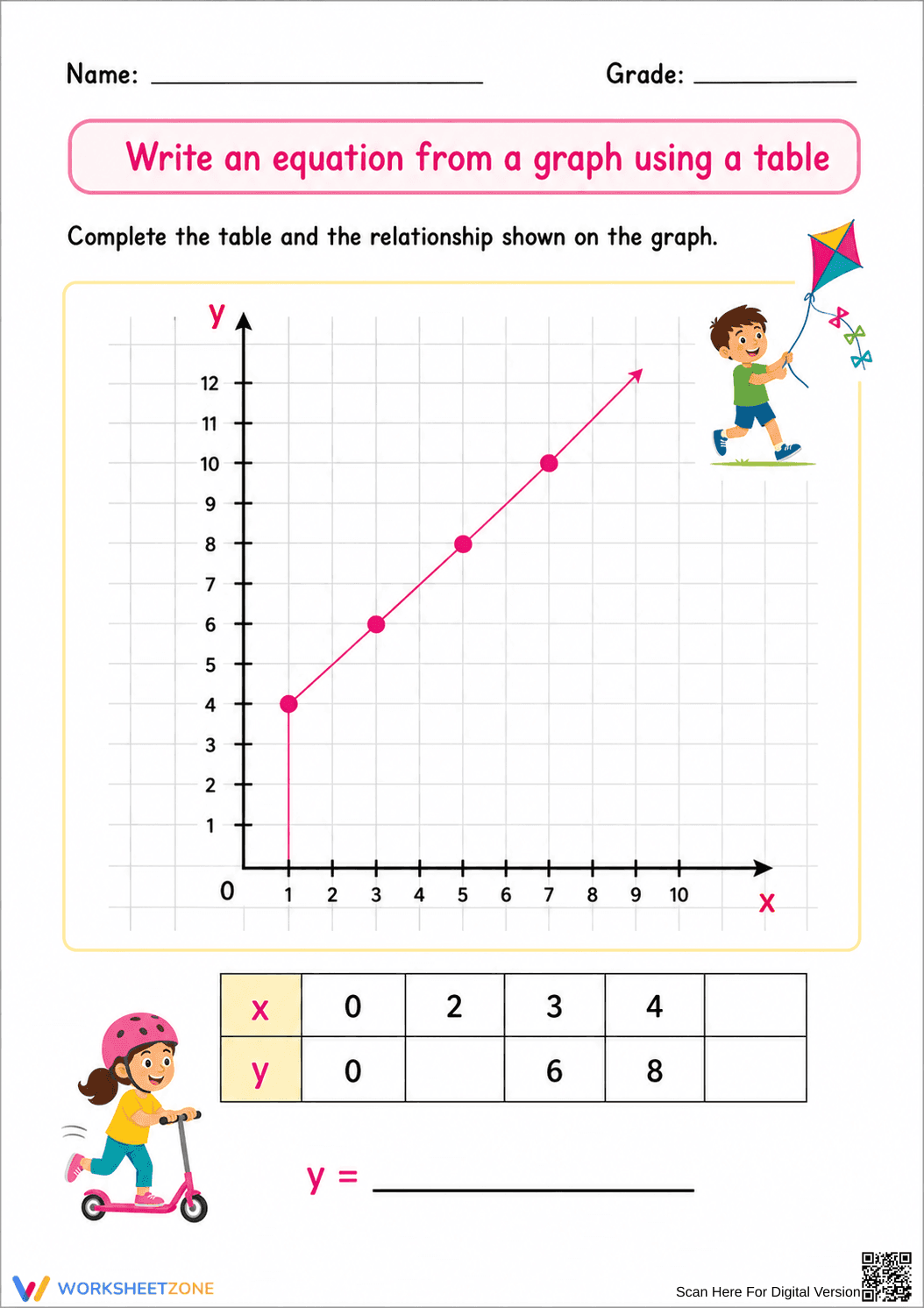
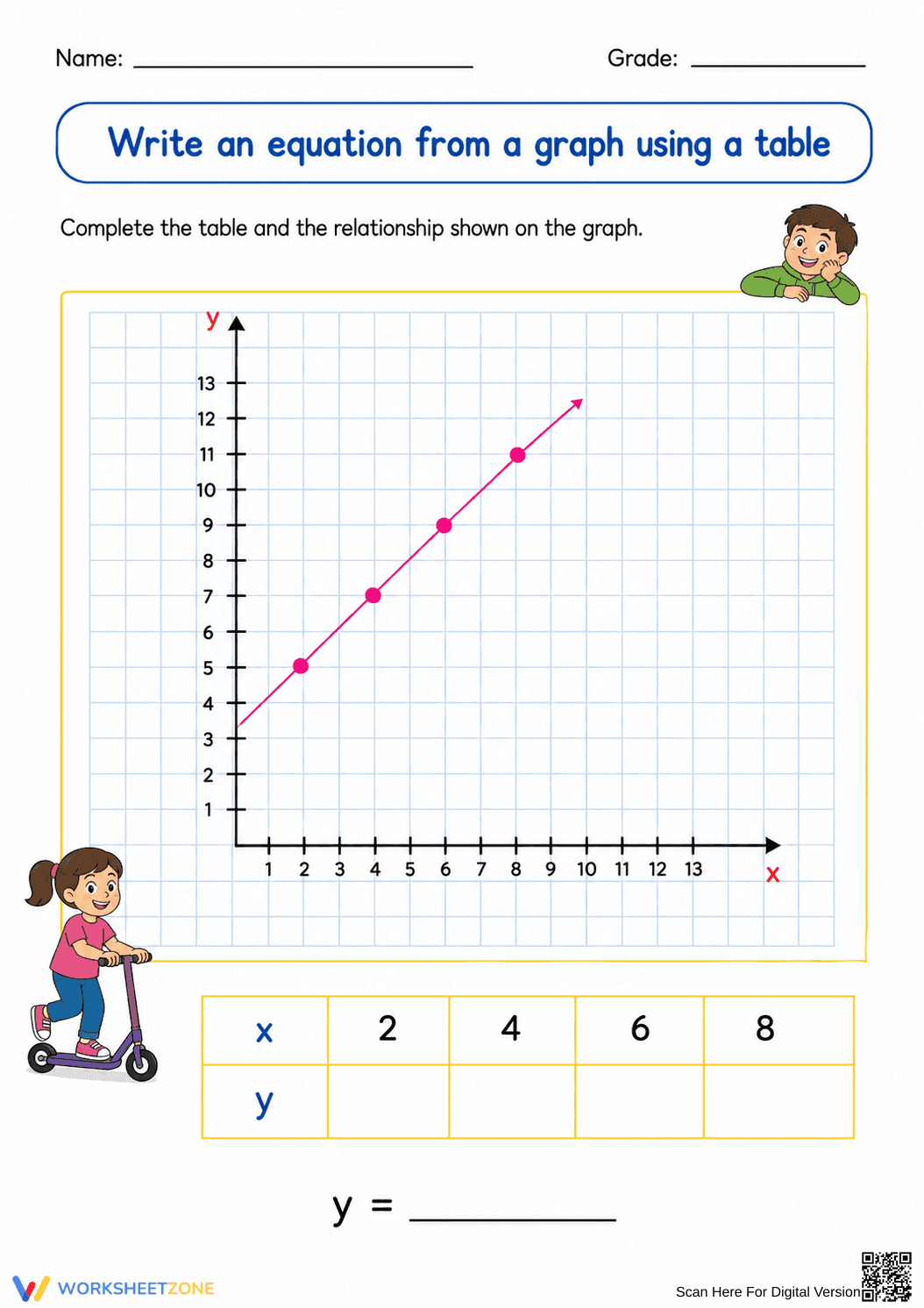
This Grade 6 math worksheet helps students transition from visual representations to algebraic expressions by writing an equation from a graph using a table. Students will extract coordinate points from a linear graph, complete a data table, and determine the underlying algebraic rule to write the final equation.
At a Glance
- Grade: 6 · Subject: Math
- Standard:
CCSS.MATH.CONTENT.6.EE.C.9— Write an equation to express one quantity in terms of another- Skill Focus: Writing equations from graphs and tables
- Format: 2 pages · 2 problems · Answer key included · PDF
- Best For: Independent practice and review
- Time: 15–20 minutes
This printable resource includes two pages, each featuring a coordinate plane with a plotted linear relationship. Below each graph, students will find a partially filled input-output table and space to write the final equation. The structured format guides them step-by-step. A complete answer key is provided for quick grading.
Zero-Prep Workflow
This worksheet is designed for immediate classroom implementation.
- Print (1 minute): Download the PDF and print the two pages.
- Distribute (1 minute): Hand out as a warm-up or independent assignment.
- Review (3 minutes): Use the included answer key to check student tables and equations.
With prep time under two minutes, this resource is highly suitable for emergency sub plans.
Standards Alignment
This worksheet is directly aligned to CCSS.MATH.CONTENT.6.EE.C.9: Use variables to represent two quantities in a real-world problem that change in relationship to one another; write an equation to express one quantity in terms of the other. Both standard codes can be copied directly into lesson plans, IEP goals, or district curriculum mapping tools.
How to Use It
Deploy this worksheet during independent practice after direct instruction on linear relationships and coordinate planes. It serves as an excellent bridge activity when teaching students how different mathematical representations connect. As a formative assessment observation tip, watch how students populate the table: if they struggle to find the y-intercept or determine the additive pattern, they may need a quick reteach on reading coordinates. Expected completion time is 15 to 20 minutes.
Who It's For
This resource is primarily designed for 6th-grade math students, though it serves as an excellent review for 7th and 8th graders beginning their algebra units. For differentiation, teachers can provide students who are below grade level with the first coordinate point already filled in the table to jumpstart their thinking. It pairs naturally with an anchor chart demonstrating the connection between a line's slope, its table of values, and its algebraic equation.
Mastering the ability to translate visual data into algebraic formulas is a critical milestone in middle school mathematics. Aligned with CCSS.MATH.CONTENT.6.EE.C.9, this resource requires students to write an equation to express one quantity in terms of another. According to EdReports 2024, instructional materials that explicitly connect multiple mathematical representations—such as coordinate graphs, input-output tables, and linear equations—significantly improve students' conceptual understanding of algebraic relationships. When learners practice extracting data points from a visual plane and organizing them into a structured table, they develop a stronger foundational grasp of dependent and independent variables. By consistently practicing these translations across different formats, learners build the cognitive flexibility and problem-solving stamina necessary for advanced high school math courses. This targeted practice ensures that foundational algebra skills are firmly established before moving on to more complex functions.


