If you teach Algebra 1 or advanced Grade 8 math, you already know that point-slope form often gets rushed. Teachers move quickly from slope-intercept form into point-slope form and then into standard form, and students end up memorizing three formats without understanding why each one exists. Point slope form worksheets that isolate this one skill give students room to practice the mechanics of y - y1 = m(x - x1) before they are asked to convert between forms. That extra practice window matters, because point-slope form is the format students reach for whenever they are given a slope and a single point, or two points and no y-intercept in sight.
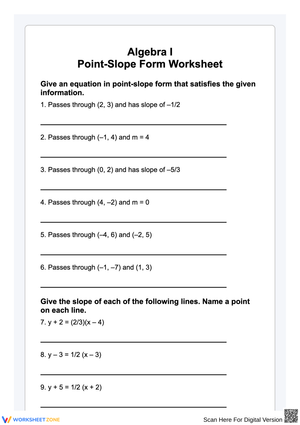
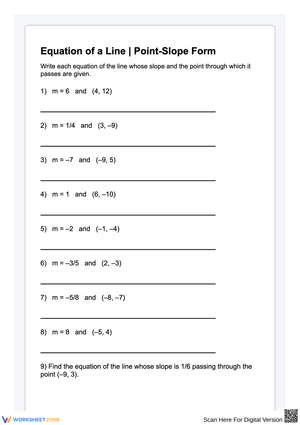
Point-slope form is written as y - y1 = m(x - x1), where m represents the slope and (x1, y1) is any known point on the line. Unlike slope-intercept form, which requires knowing the y-intercept, point-slope form works directly from whatever point a problem hands you. That flexibility is exactly why it shows up so often in real classroom tasks: rate problems, graphing tasks, and two-point scenarios almost always start with point-slope form before students simplify into y = mx + b.
Where Point-Slope Form Fits in the Algebra 1 Sequence
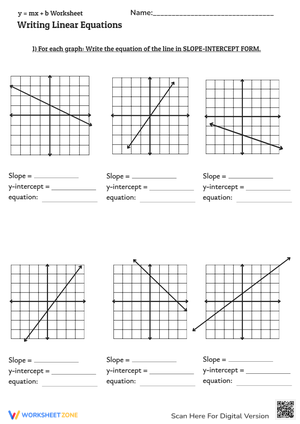
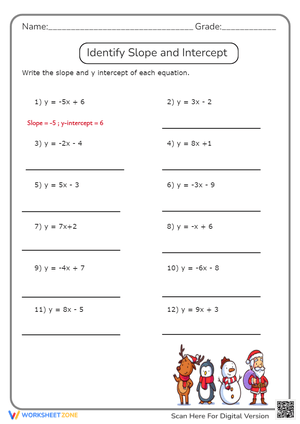
Point-slope form is most commonly introduced in Algebra 1, typically Grade 8 or 9, as a direct extension of the slope-intercept work outlined in CCSS 8.EE.B.6. That standard asks students to derive y = mx + b and to use similar triangles to explain why slope is constant between any two points on a non-vertical line. Point-slope form builds on that foundation by giving students a formula that does not require solving for b first.
Sequencing matters here. If students have not solidified slope calculation and the meaning of y = mx + b, point-slope form worksheets will feel like a new, disconnected topic rather than a natural next step. A practical sequence looks like this: slope calculation from two points, slope-intercept form with a given point and slope, then point-slope form as a shortcut that skips the extra algebra step of solving for the y-intercept. Once students see point-slope form as a shortcut rather than a fourth new formula, retention improves noticeably.
Common Substitution Errors and How Worksheets Address Them
The most persistent error in point-slope form work is a sign mistake during substitution. When a student is given the point (3, -5), they frequently write y - (-5) as y - 5 instead of y + 5, dropping the negative sign entirely. A second common error appears when converting from two points: students substitute the wrong ordered pair into (x1, y1) versus which one they use to calculate slope, producing an equation that looks plausible but graphs incorrectly. Worksheets that deliberately include negative coordinates and two-point problems in every practice set, rather than saving them for a challenge section, force students to confront these errors early instead of during a unit test.
A strong point-slope form worksheet set should mix problem types rather than presenting twenty nearly identical items. Include problems that give slope and one point, problems that give two points with no slope stated, and a few that ask students to identify errors in a worked-out example. That last format, sometimes called an error analysis item, is especially effective for catching the sign mistake described above because students have to locate the error rather than simply produce their own answer.
Differentiating Practice for Mixed-Readiness Classrooms
Most Algebra 1 classes include students at very different points in their algebra fluency, and point-slope form worksheets can be layered to meet that range without creating three separate lesson plans. For students still building confidence, worksheets with positive integer coordinates and slopes given as whole numbers let them focus purely on the substitution pattern. For on-level students, introduce negative coordinates and fractional slopes. For students ready for enrichment, ask them to write a point-slope equation from a real-world rate of change scenario, such as a plant growth rate or a mileage-and-cost table, and then convert that equation into standard form.
This tiered approach also supports small-group intervention. A teacher running a 10-15 minute pull-out group can hand struggling students a worksheet limited to whole-number substitution while the rest of the class works through a mixed-difficulty set independently. Because point-slope form worksheets are typically self-contained one-page practice sets, they slot easily into a station rotation or a Friday review block without requiring new materials each week.
Classroom Implementation
When introducing a new point-slope form worksheet set, start with a brief warm-up that reviews slope calculation from two points, since a shaky grasp of slope will undermine every subsequent step. Model one substitution problem on the board, narrating the substitution out loud, including where the negative sign goes when the given point has a negative coordinate. Then release students to a worksheet with four to six problems, circulating to catch the substitution error pattern described earlier before it becomes a habit.
For homework or independent practice, pair a point-slope form worksheet with a short answer key that shows the unsimplified point-slope equation alongside the simplified slope-intercept version. This lets students self-check both the substitution step and the simplification step separately, which makes it easier for them to identify exactly where an error occurred if their final answer does not match. Over a two-week unit, plan for at least three distinct point-slope form worksheets: one for initial practice, one for two-point problems specifically, and one spiral review set that mixes all three linear equation forms before the unit assessment.
Frequently Asked Questions
1. When should teachers introduce point-slope form relative to slope-intercept form?
Point-slope form should follow slope-intercept form instruction, once students are comfortable calculating slope from two points and understand the structure of y = mx + b. Introducing point-slope form too early, before slope fluency is solid, tends to confuse students rather than simplify their work.
2. What is the difference between point-slope form and slope-intercept form worksheets?
Slope-intercept form worksheets typically ask students to write equations when the y-intercept is known or easy to find. Point-slope form worksheets focus on situations where students are given any point on the line, not necessarily the y-intercept, along with a slope or a second point.
3. How can teachers use point-slope form worksheets for small-group intervention?
A short, focused worksheet limited to whole-number coordinates lets a small group isolate the substitution pattern without the added difficulty of negative numbers or fractions, making it easier to build accuracy before increasing complexity.
4. What visual supports pair well with point-slope form practice?
A labeled formula card showing y - y1 = m(x - x1) with color-coded spots for the point and the slope helps students see exactly where each number from a word problem or coordinate pair belongs, reducing substitution errors during independent practice.
5. How do point-slope form worksheets prepare students for standard form and graphing?
Once students can reliably write an equation in point-slope form, converting to standard form or slope-intercept form becomes an algebraic simplification task rather than a new concept. Worksheets that require both writing and converting equations reinforce that these forms describe the same line in different ways, which supports later graphing work.