


























Views
Downloads


Essential Three Forms of Linear Equations Worksheet
Paste this activity's link or code into your existing LMS (Google Classroom, Canvas, Teams, Schoology, Moodle, etc.).
Students can open and work on the activity right away, with no student login required.
You'll still be able to track student progress and results from your teacher account.
Master the transition between different representations of lines with this comprehensive linear equations practice set. Students will identify, write, and convert equations across three mathematical forms to build a deep conceptual understanding of algebraic relationships. This resource ensures learners can fluently navigate between slope-intercept, point-slope, and standard forms while applying them to real-world contexts.
At a Glance
- Grade: 9 · Subject: Algebra
- Standard:
HSA-CED.A.2— Create equations in two variables to represent relationships between quantities and graph them- Skill Focus: Converting and writing linear equation forms
- Format: 5 pages · 18 problems · Answer key included · PDF
- Best For: Algebra I unit review and mastery
- Time: 45–60 minutes
What's Inside
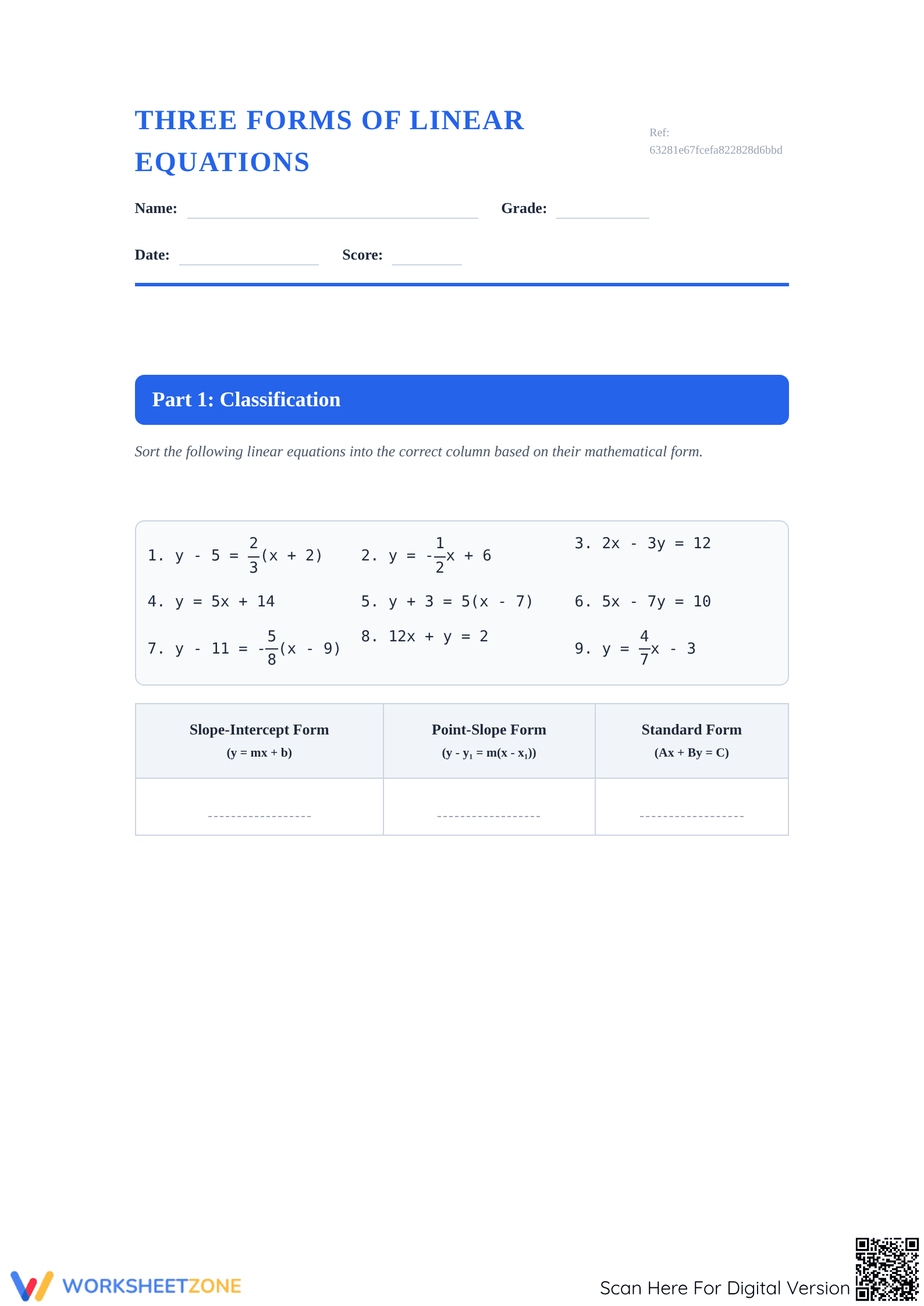
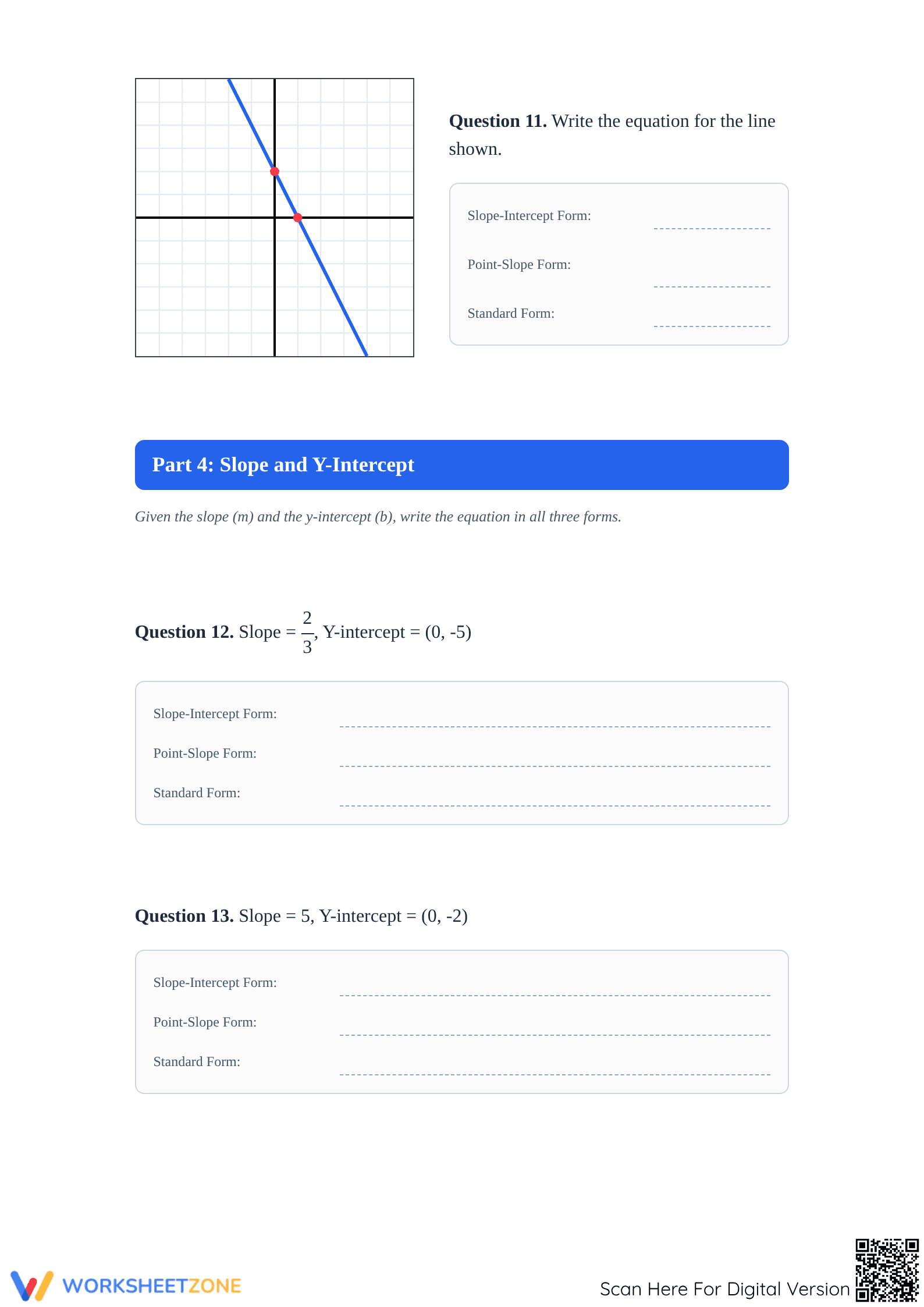
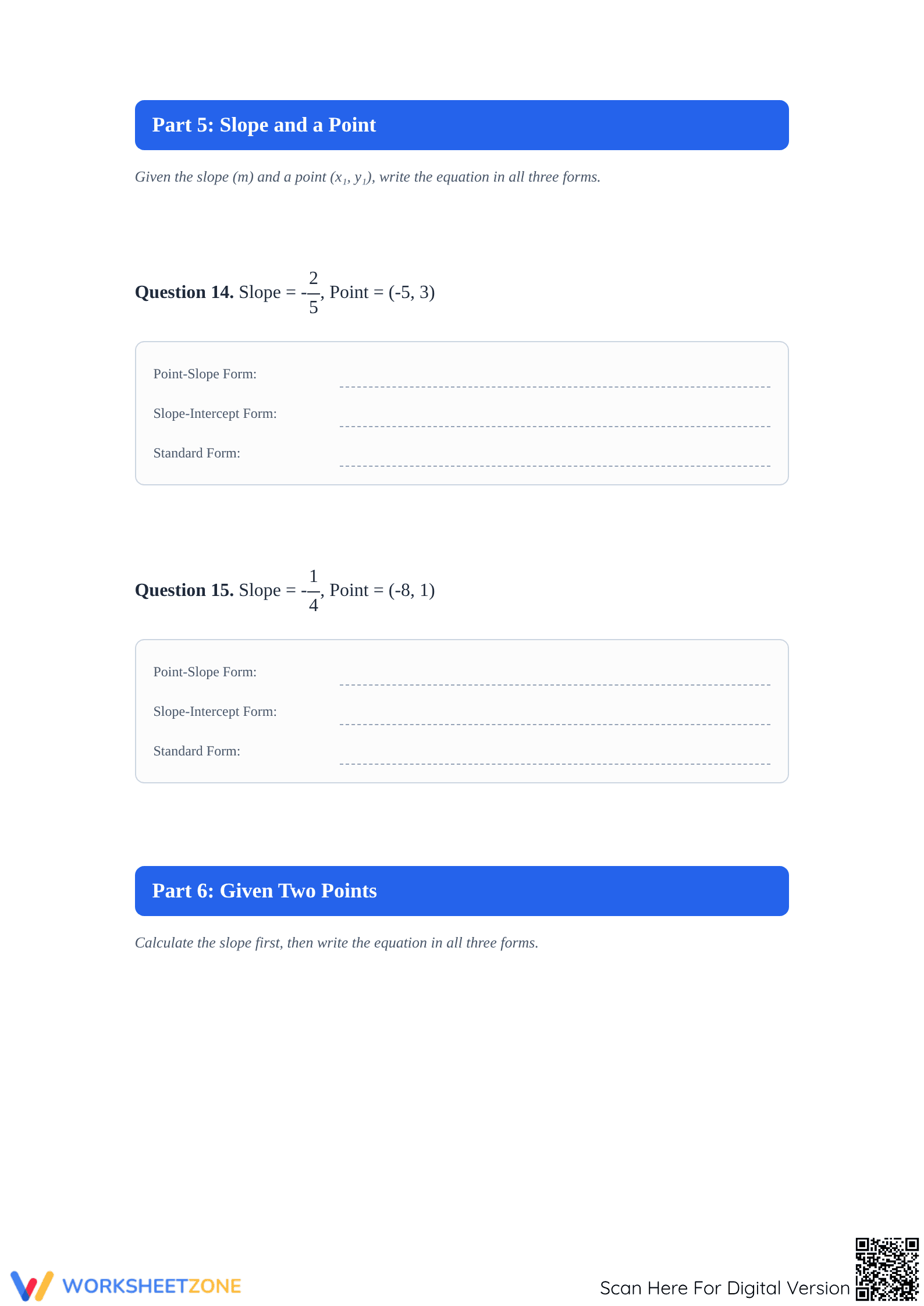
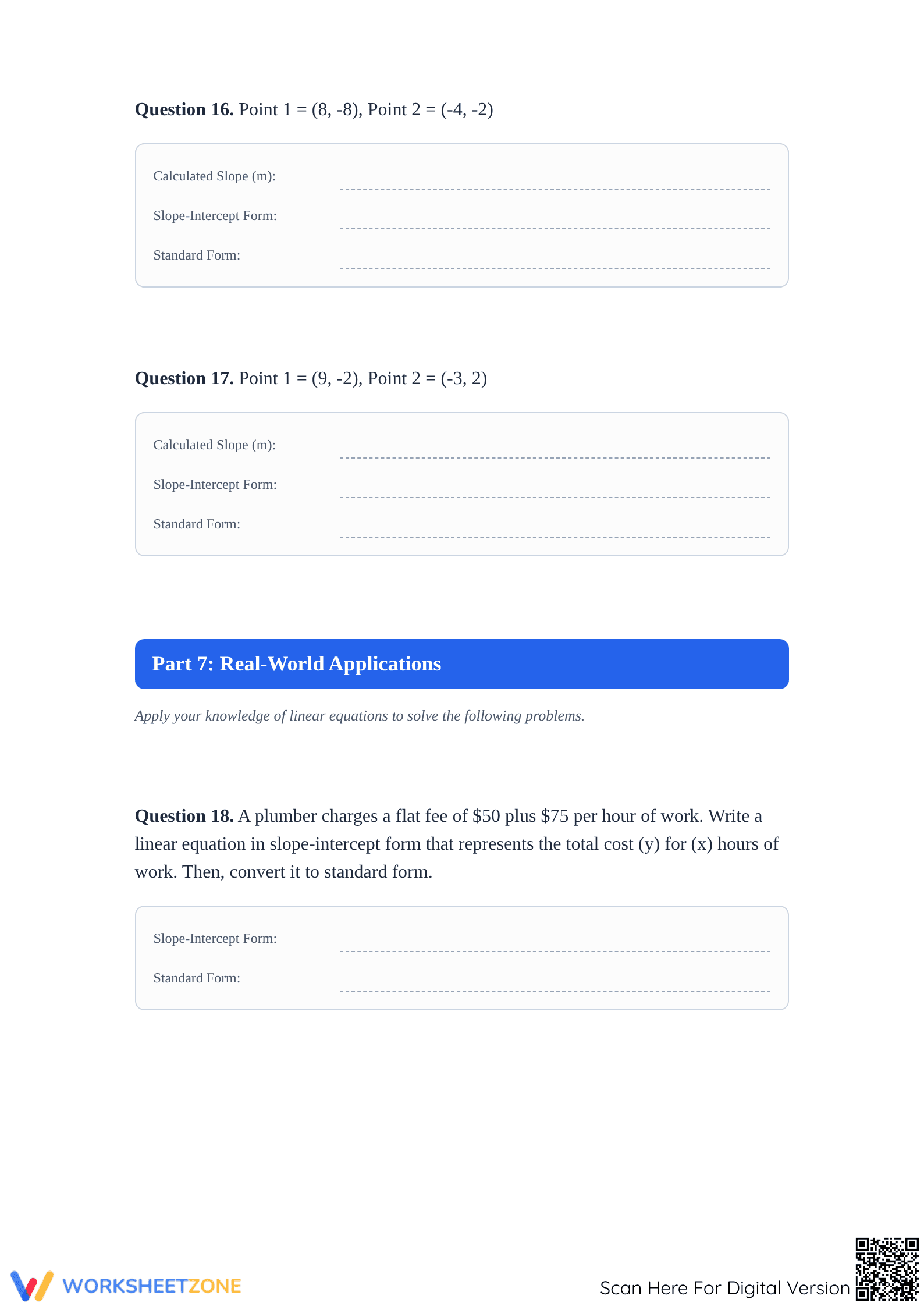
This 5-page instructional packet contains seven distinct parts designed to build algebraic fluency. It begins with a classification sort of nine equations, followed by a conceptual identification section. Students then move into graphic analysis where they derive equations from coordinate planes. The final pages cover writing equations from specific parameters including slope, intercepts, and coordinate pairs, concluding with a real-world multi-step plumber service fee scenario.
Skill Progression
The practice follows a logical gradual-release model to support student learning:
- Guided Classification: Students sort nine mixed equations into their respective forms with visual cues for each structure.
- Supported Application: Learners identify key features from graphs and points to construct equations using scaffolded templates.
- Independent Mastery: The packet culminates in 18 independent problems requiring full conversion to all three forms without prompts.
This sequence ensures students move from recognition to production within a single instructional session.
Standards Alignment
Aligned to `HSA-CED.A.2`, this worksheet requires students to create linear equations in two variables to represent relationships between quantities. It also supports `HSF-LE.A.2` by requiring the construction of linear functions given a graph or two points. Both standard codes can be copied directly into lesson plans, IEP goals, or district curriculum mapping tools.
How to Use It
Use this packet as a summative assessment at the end of a linear functions unit or as a primary resource for a multi-day sub plan. During direct instruction, teachers can observe students during the classification phase to identify misconceptions about the constants in standard form. Completion typically takes 50 minutes, making it ideal for a standard class period.
Who It's For
This resource is designed for Grade 9 Algebra I students, but it serves as an excellent refresher for Grade 10 Geometry students working on coordinate geometry. It provides clear structural headers which assist students with processing difficulties, paired naturally with a classroom anchor chart displaying the three form formulas for extra support.
The ability to translate between multiple representations of linear functions is a cornerstone of algebraic proficiency. This worksheet targets the `HSA-CED.A.2` standard by requiring students to synthesize information from graphs, coordinate pairs, and verbal descriptions into three distinct mathematical structures: slope-intercept, point-slope, and standard forms. According to Fisher & Frey (2014), the gradual release of responsibility—moving from the simple classification of existing equations to the complex creation of new ones from abstract data points—is essential for long-term retention of algebraic concepts. By providing 18 structured tasks that include both procedural drills and real-world application, this resource ensures that Grade 9 learners develop the cognitive flexibility needed for advanced mathematics. Research indicates that students who master these fundamental conversions demonstrate significantly higher success rates in subsequent units involving systems of equations and non-linear functions. This printable PDF serves as a robust tool for evidence-based instruction.


