


























Views
Downloads

Number Six Worksheet | Essential Grade K-1 Math Printable
Paste this activity's link or code into your existing LMS (Google Classroom, Canvas, Teams, Schoology, Moodle, etc.).
Students can open and work on the activity right away, with no student login required.
You'll still be able to track student progress and results from your teacher account.
Mastering the Number Six
This comprehensive number six worksheet provides early learners with a multi-sensory approach to numeral mastery. By combining visual identification, tactile tracing, and logical counting, students develop a robust understanding of the number six. The activities are designed to transition students from recognition to independent writing.
At a Glance
- Grade: Kindergarten · Subject: Math
- Standard:
K.CC.A.3— Write numbers from 0 to 20 and represent objects with numerals- Skill Focus: Numeral formation and quantity recognition
- Format: 2 pages · 5 distinct activities · Answer key included · PDF
- Best For: Early numeracy centers and morning work
- Time: 15–20 minutes
What's Inside
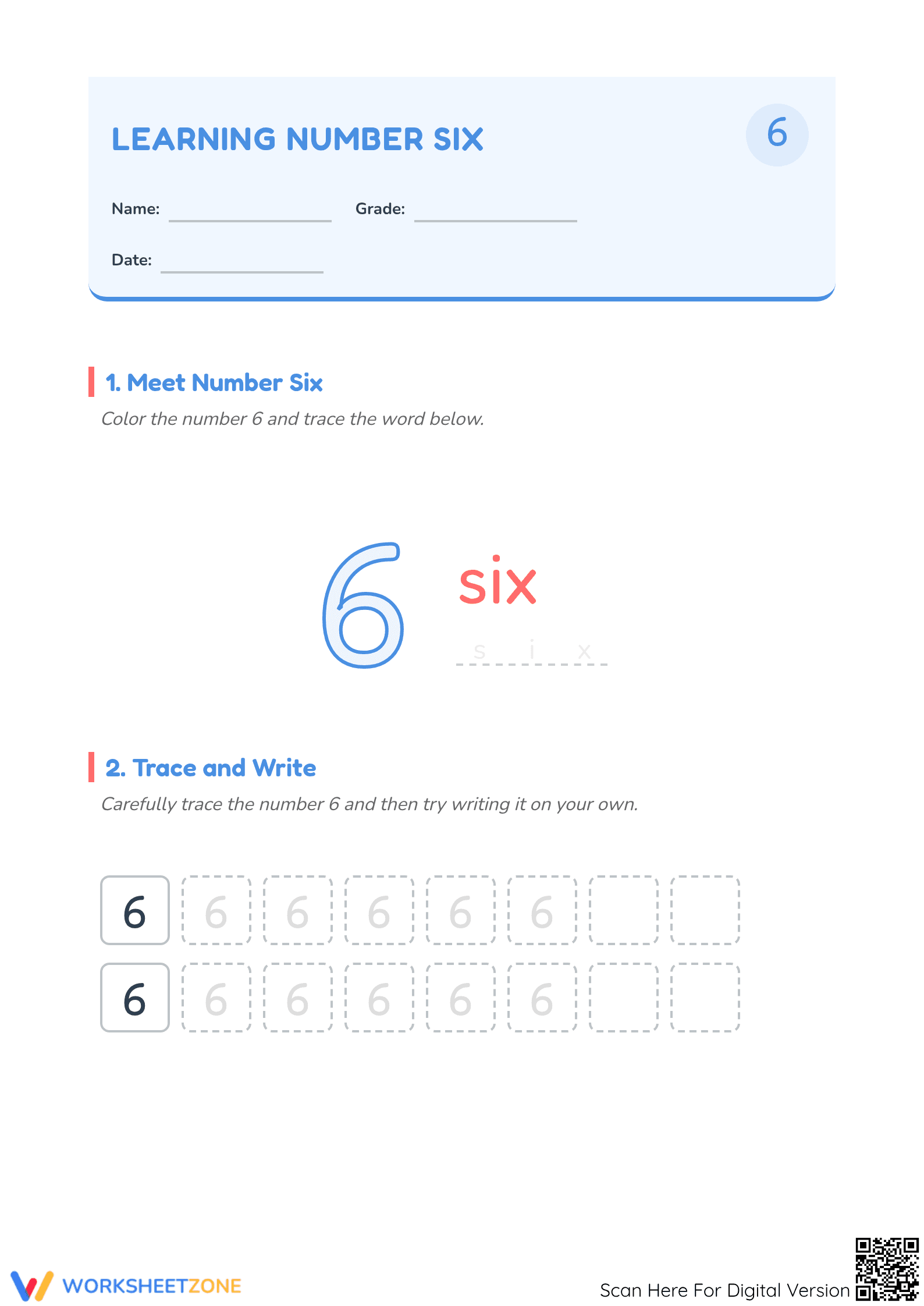
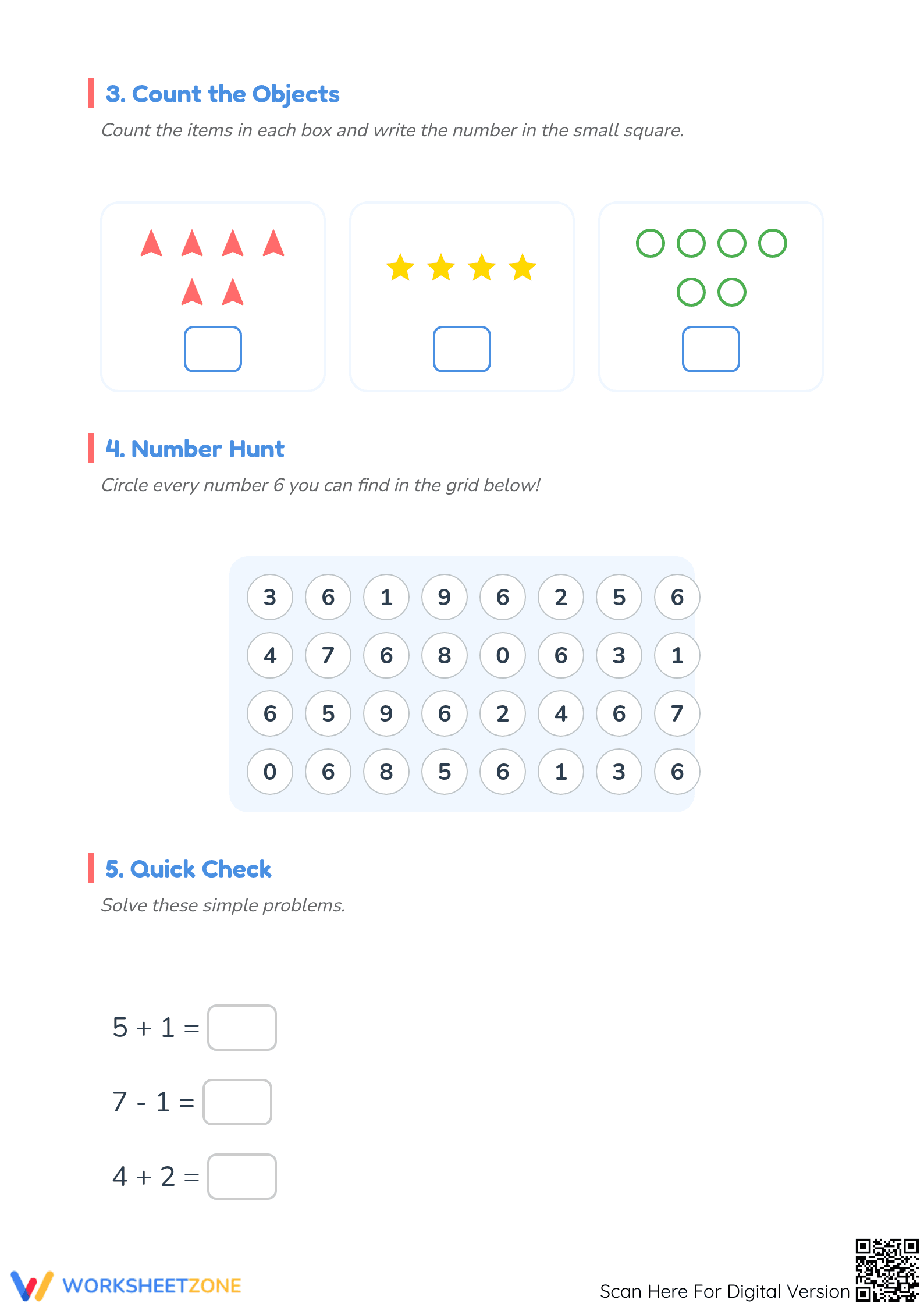
This two-page PDF includes five targeted sections: "Meet Number Six" for coloring and word tracing, "Trace and Write" for formation practice, "Count the Objects" for one-to-one correspondence, "Number Hunt" for visual discrimination in a grid, and "Quick Check" for simple arithmetic application.
Skill Progression
- Guided Practice: The first section uses large-format numerals and dashed lines to support initial hand-eye coordination for the number six and the word "six."
- Supported Practice: Students move to tracing rows of numerals in structured boxes, gradually reducing dependency before attempting four independent writes.
- Independent Application: The second page challenges students to apply their knowledge through counting three groups of objects, finding sixes in a 32-number grid, and solving three basic equations.
This "I Do, We Do, You Do" instructional framework ensures students build confidence before being asked to perform tasks without scaffolds.
Standards Alignment
The primary focus is CCSS.MATH.CONTENT.K.CC.A.3, which requires students to write numbers from 0 to 20 and represent a number of objects with a written numeral. Additionally, the counting tasks support K.CC.B.4, building the understanding that each successive number name refers to a quantity that is one larger. These standard codes can be copied directly into lesson plans, IEP goals, or district curriculum mapping tools.
How to Use It
Use this worksheet as a primary learning tool during your initial introduction of the number six. It works exceptionally well as a "morning work" activity or a station in a math workshop. For a formative assessment, observe students during the "Number Hunt" section to see if they can distinguish "6" from similar shapes like "9" or "0." The expected completion time is approximately 20 minutes.
Who It's For
This resource is specifically tailored for Kindergarten and Grade 1 students who are building their foundational number sense. It provides the necessary repetition for students who need extra practice with fine motor skills or one-to-one correspondence. Pair this worksheet with a physical "number six" anchor chart or a counting jar filled with six manipulatives for a complete instructional experience.
According to research from RAND AIRS 2024, consistent exposure to multiple representations of numbers—such as digits, words, and sets of objects—significantly improves long-term retention of mathematical concepts in early childhood. This worksheet implements this finding by requiring students to interact with the number six through coloring, writing, counting, and searching. By grounding abstract numerals in concrete visual tasks, teachers can bridge the gap between simple recognition and mathematical fluency. This evidence-based approach aligns with the ScienceDirect TpT Analysis, which highlights the efficacy of structured, predictable worksheet formats for minimizing cognitive load in young learners. The inclusion of an answer key allows for immediate feedback, further reinforcing the connection between the numeral and its value. This printable resource serves as an essential component of a balanced math curriculum, providing the repetitive practice necessary for mastery of standard K.CC.A.3.


