




























Views
Downloads
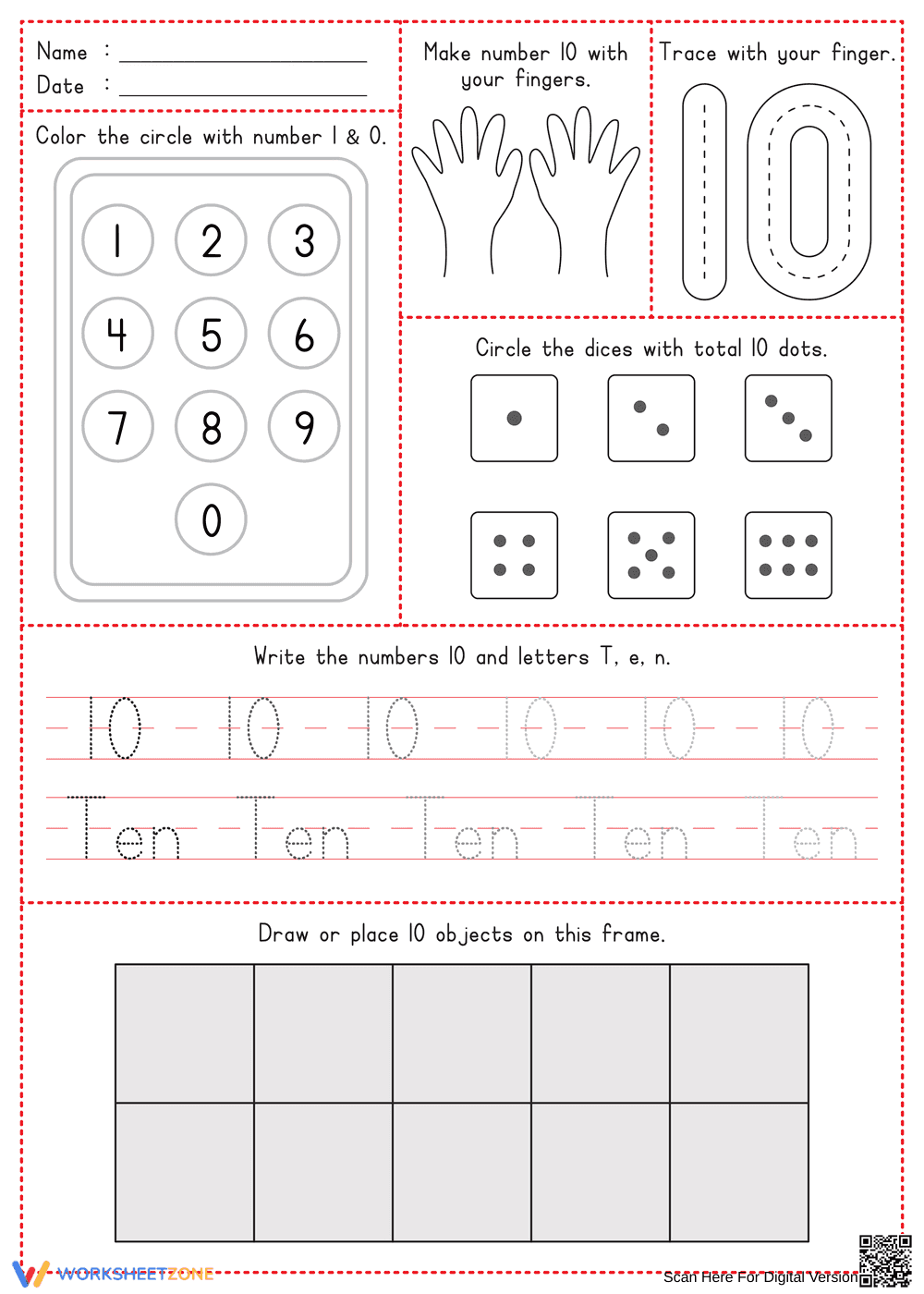

Printable Number 10 Worksheet for Kindergarten

Paste this activity's link or code into your existing LMS (Google Classroom, Canvas, Teams, Schoology, Moodle, etc.).
Students can open and work on the activity right away, with no student login required.
You'll still be able to track student progress and results from your teacher account.
This printable number 10 worksheet helps kindergarten students master number recognition, counting, and writing. By engaging with multiple sensory and visual tasks, learners build a strong foundation for early math success. Students practice identifying digits, tracing, counting dots, and using ten-frames to represent the quantity ten.
At a Glance
- Grade: Kindergarten · Subject: Math
- Standard:
CCSS.MATH.CONTENT.K.CC.A.3— Write numbers from 0 to 20 and represent count- Skill Focus: Number 10 recognition, writing, and representation
- Format: 1 page · 6 tasks · No answer key · PDF
- Best For: Morning work or independent math centers
- Time: 15–20 minutes
This single-page resource contains six distinct activities designed to reinforce the concept of ten. It includes a number identification keypad, a finger-counting prompt, a large finger-tracing guide, a dice-counting task, a handwriting practice section for both the numeral and the word, and a blank ten-frame for drawing or placing physical manipulatives.
This worksheet offers a streamlined, zero-prep workflow for busy educators. First, print the single-page PDF in under 1 minute. Next, distribute the sheets to your class, which takes less than 1 minute. Finally, review student work during independent practice or collect the sheets for a quick formative assessment. The entire setup requires less than 2 minutes of teacher preparation time, making it an ideal option for emergency sub plans or transition activities.
This activity aligns directly with the Common Core State Standard `CCSS.MATH.CONTENT.K.CC.A.3`, which requires students to write numbers from 0 to 20 and represent a number of objects with a written numeral. Additionally, it supports counting standards by helping students connect number names to quantities. Both standard codes can be copied directly into lesson plans, IEP goals, or district curriculum mapping tools.
Use this worksheet during independent practice immediately following a direct instruction lesson on the number ten. Alternatively, assign it as a morning work activity to reinforce counting skills. Teachers can conduct formative assessment observations by watching students fill the ten-frame to see if they demonstrate one-to-one correspondence. Expect students to complete the page in 15 to 20 minutes.
This resource is designed for kindergarten students, preschool learners transitioning to formal math, and first-grade students requiring targeted intervention. It pairs naturally with physical counters, ten-frame trays, or a read-aloud book about counting to ten.
According to the Fisher & Frey (2014) framework for gradual release of responsibility, multi-modal representation is vital for early childhood numeracy acquisition. This worksheet applies those principles by combining visual, tactile, and kinesthetic tasks to teach the number ten. By prompting students to trace with their fingers, count dots on dice, write the word "ten," and fill a ten-frame, the resource reinforces the connection between numeral, word, and quantity. Research from EdReports (2024) highlights that structured, single-number practice sheets help solidify early math concepts before students progress to complex operations. This resource aligns with `CCSS.MATH.CONTENT.K.CC.A.3` to ensure students meet foundational kindergarten benchmarks. Educators can confidently integrate this worksheet into their curriculum, knowing it supports evidence-based practices for early childhood math development.


