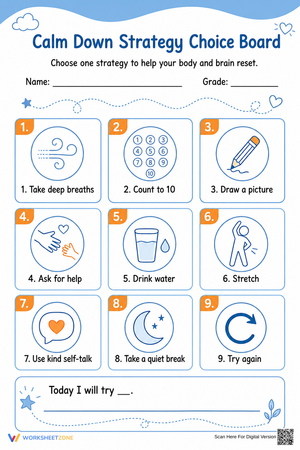
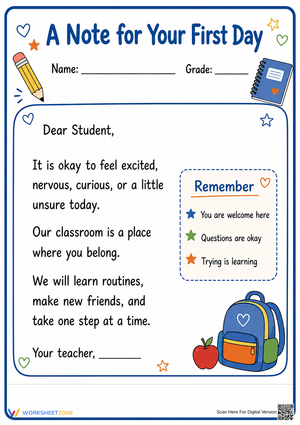
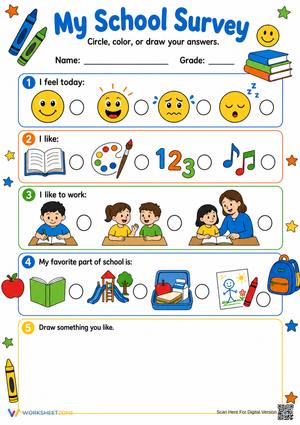
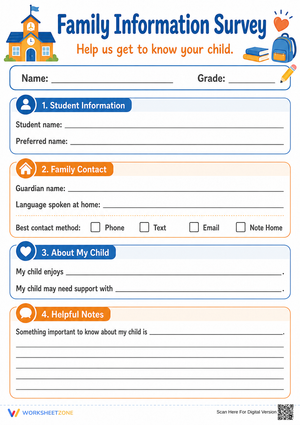
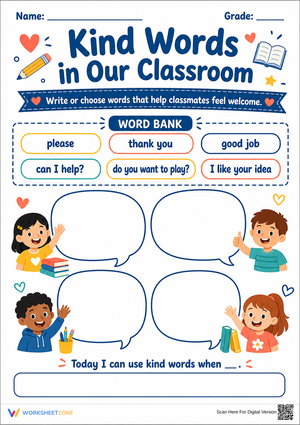
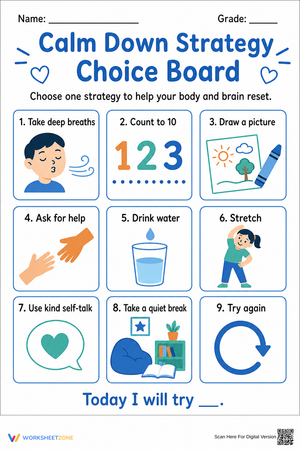
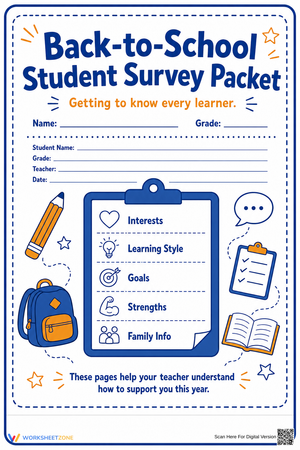
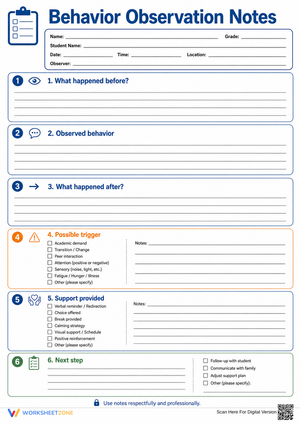
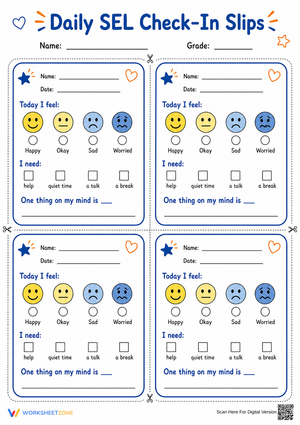
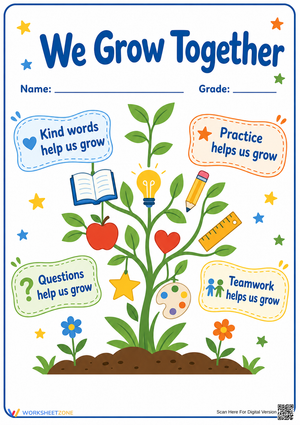
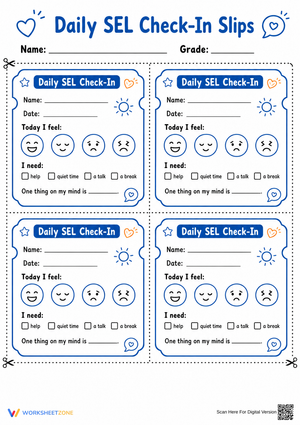
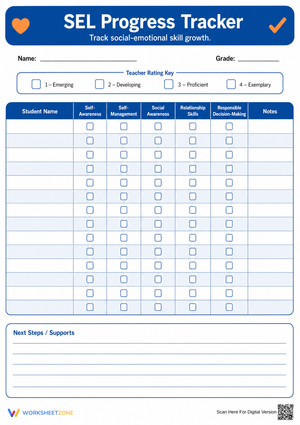
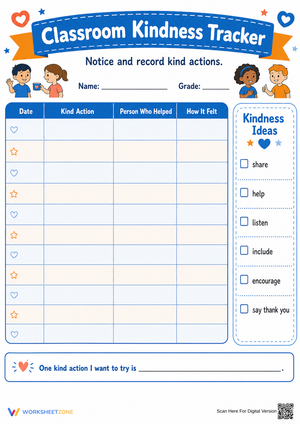
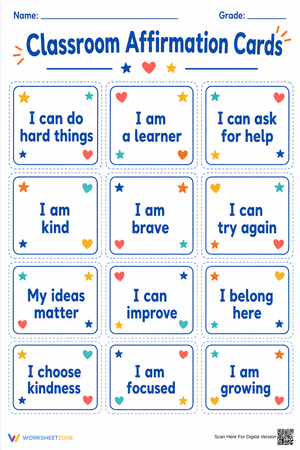
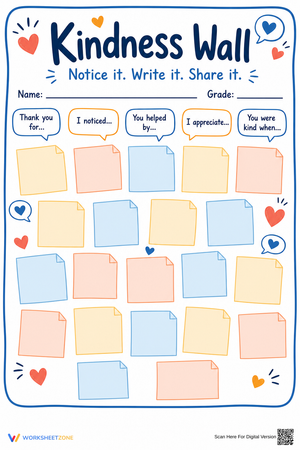
These kindergarten behavior worksheets printable resources give teachers a set of structured activities for introducing social expectations that most five-year-olds cannot absorb through verbal instruction alone. Each worksheet is built around illustrations rather than text—sorting tasks, emotion-labeling activities, classroom-rule coloring pages, and scenario-response prompts—so that students who are still developing print decoding skills engage with the behavioral content directly.
The set covers the social and emotional skills that make a kindergarten classroom actually function: personal space, turn-taking, emotion identification, classroom rule recognition, and conflict response. These aren't enrichment topics. A student who can't regulate frustration or read a peer's distress cannot fully access academic instruction, and these worksheets give teachers a concrete, repeatable way to build those capacities from the first weeks of school.
What Each Worksheet Targets
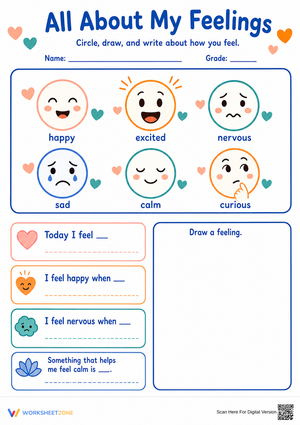
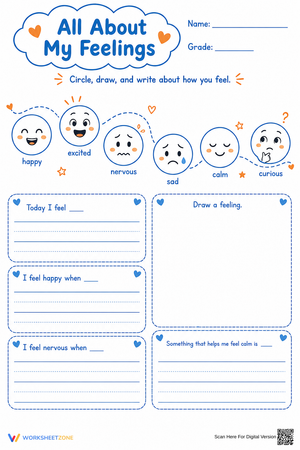
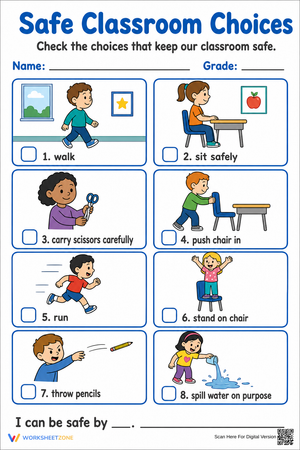
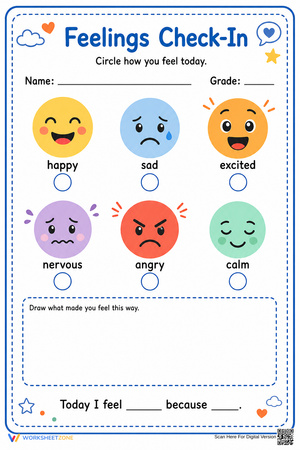
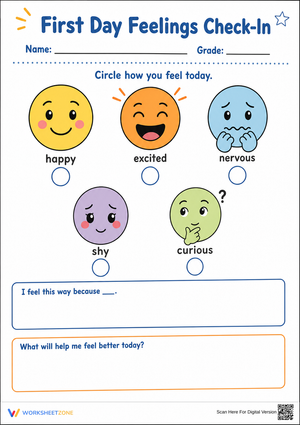
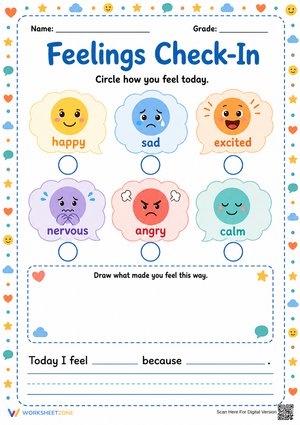
Emotion identification activities ask students to circle or color the face that shows how a character feels, then match that feeling to a depicted situation. That sequence—recognition before labeling before application—matters developmentally. Kindergartners who can point to "frustrated" on a worksheet have a word to reach for the next time frustration shows up at the block center. Classroom rule worksheets focus on a single expectation at a time—walking feet, listening ears, hands to yourself—rather than presenting a crowded list, which keeps the cognitive load appropriate for a five-year-old still working to hold multiple expectations in mind at once.
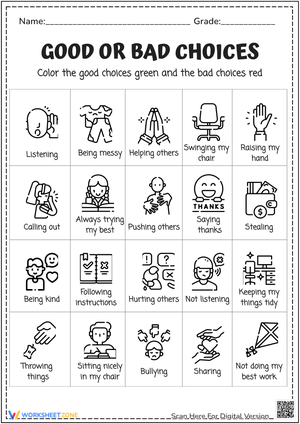
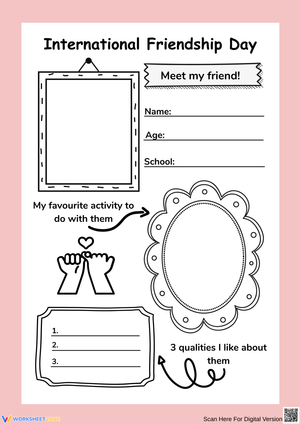
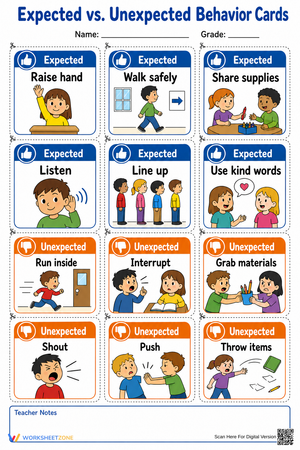
Good-choice sorting activities present pictures of common classroom moments: a student pushing to reach the water fountain first, another holding the door for a classmate. Students sort each image into two categories. Friendship scenario worksheets go a step further—they describe a situation, such as two students who both want the red crayon, and ask the student to draw or circle the kind response. That progression from recognition to judgment is where the real behavioral learning happens, and the set is built to move students through it deliberately.
Smart Ways to Build These Worksheets Into Your Week
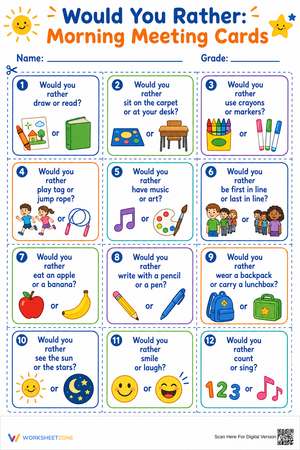
Morning meeting is the natural anchor for proactive behavior instruction. Introduce a worksheet during the group gathering, walk through one or two images as a class, then have students complete the rest at their seats. The whole sequence runs about ten minutes and moves from whole-group modeling into individual practice without losing momentum. When the activity connects to a behavioral goal the class is working on that week—kind words, personal space, asking before borrowing—it gives the daily discussion a concrete referent to return to throughout the morning.
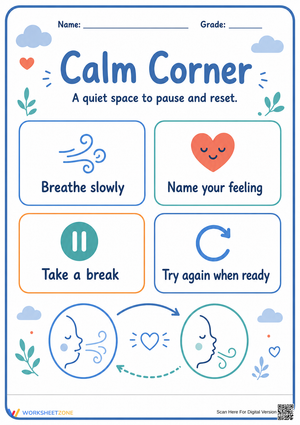
Working through a kindergarten behavior worksheets printable activity with three or four students at a table, a teacher or aide can do something a whole-class setting rarely allows: slow down on a scenario that sparks genuine disagreement. "Is it always a sad choice to say no?" That kind of question, which would derail twenty-five students but engage four, leads to the reasoning conversations that actually shift behavior over time. For students who have experienced a recent behavioral incident, the reflection-style worksheets—draw what happened, then draw what you could do differently—work well at a calm-down table rather than in an empty hallway.
One use that gets overlooked: the pre-transition worksheet. Before the first library visit or the class's initial school assembly, a simple activity showing the expected behavior in that new environment gives students a mental picture to carry with them. A child who has just colored an image of students sitting quietly in an auditorium arrives having already imagined doing it. That five-minute activity before departure consistently reduces the impulsive behavior that spikes when kindergartners step into unfamiliar spaces.
What to Watch For When Students Work Through These Activities
On sorting worksheets, the most consistent error isn't confusion about the rule—it's students sorting based on their own experience rather than the depicted action. A child who regularly pushes in line may place "pushing to be first" in the good-choice column not because they don't understand the expectation, but because the behavior feels normal and has worked for them. When you see that pattern, the worksheet has done useful diagnostic work: it has flagged that this rule needs explicit one-on-one conversation with that student, not just a corrected sort and a move-on.
Emotion-labeling activities surface a different problem. Students frequently confuse "frustrated" and "angry" because the expressive faces look similar at small print sizes, but the more interesting pattern is that many students label faces based on their own mood that morning. A child who arrived tired and upset will circle "sad" on nearly every face, regardless of the illustration. Rather than correcting the label and continuing, teachers who ask "Tell me about this face—what do you think happened to him before school today?" often get the real conversation: the student projects their own situation onto the character, which opens exactly the kind of self-awareness the activity is meant to develop.
Adjusting Each Worksheet for the Range of Learners in Your Room
For students who need the most support—due to language acquisition, developmental pace, or a specific behavioral plan—the visual design of these worksheets does most of the heavy lifting already. A teacher reads the instructions aloud, and the student points, colors, cuts, or pastes without decoding any text. A practical further step: cover the lower half of the worksheet with a sticky note and reveal items one at a time. That removes the visual overwhelm of seeing the full activity at once and lets the student work through the task steadily rather than freezing at its scope.
Students who move through quickly benefit from a sentence-frame extension: I would choose ___ because ___. Adding that line to any scenario worksheet turns a sorting or circling task into a low-stakes writing opportunity without modifying the core activity. For students with individualized behavioral goals, the kindergarten behavior worksheets printable set works best when teachers select specific activities that match the skill named in the student's plan—staying in personal space, using words to ask for a break, waiting for a turn to speak—rather than moving through the full collection in sequence.
For English language learners, the picture-first format already reduces the language demand significantly. A brief vocabulary warm-up before the activity—pre-teaching three words like "share," "turn," and "wait"—helps students connect the visual content to the concept being taught. Pairing ELL students with a bilingual peer during sorting activities tends to produce the kind of quiet, substantive side conversation that deepens comprehension more than a teacher-directed explanation would.
Frequently Asked Questions
Can these worksheets replace a dedicated SEL curriculum?
No. These are practice and reinforcement tools, not a full instructional sequence. They work best alongside a consistent morning meeting routine or a structured social-emotional learning program where teachers introduce concepts through discussion and modeling before students apply them independently. Used that way, the activities give abstract social concepts a concrete, returnable form. Used in isolation, they're likely to feel like coloring with extra steps.
How do I use reflection worksheets after an incident without making a student feel shamed?
Framing matters more than the worksheet itself. Teachers who assign a reflection activity as a visible consequence—particularly in front of peers—typically get fast, defensive completion that produces nothing useful. The worksheet works better when it has been practiced before any incident occurs: the class completes it together, the teacher models thinking aloud through it, students know what to expect. By the time a specific student needs it for a real situation, it feels like a familiar tool rather than a punishment. Sitting alongside the student during completion, rather than sending them off alone, changes the experience significantly.
How often should behavior worksheets appear in a kindergarten week?
At the start of the year, daily use builds shared language quickly. A classroom-rule activity on Monday, a sorting worksheet on Wednesday, a scenario discussion on Friday—that cadence keeps behavioral expectations visible without crowding out academic time. By October, most teachers shift to once or twice a week during a designated SEL block, plus as-needed use for individual students or upcoming transitions. The sign that you're using them too frequently: students completing the activities mechanically, without looking at the pictures. That's the signal to rotate in something different or take a two-week break.
What should I do when a student refuses to engage with the worksheet?
Refusal is often more informative than compliance. A student who pushes the activity away when asked to sort good-choice and bad-choice scenarios may be reacting to a situation depicted that connects to something recent or raw. Pressing for completion in that moment rarely produces anything worth having. A better approach: note which scenario triggered the reaction and return to it privately later. The kindergarten behavior worksheets printable activities are most productive when they open a conversation, and sometimes the most useful opening is simply: "I noticed you didn't want to do this one. Can you tell me why?"