




























Views
Downloads

Family Information Survey | Essential Grade K-5 Printable

Paste this activity's link or code into your existing LMS (Google Classroom, Canvas, Teams, Schoology, Moodle, etc.).
Students can open and work on the activity right away, with no student login required.
You'll still be able to track student progress and results from your teacher account.
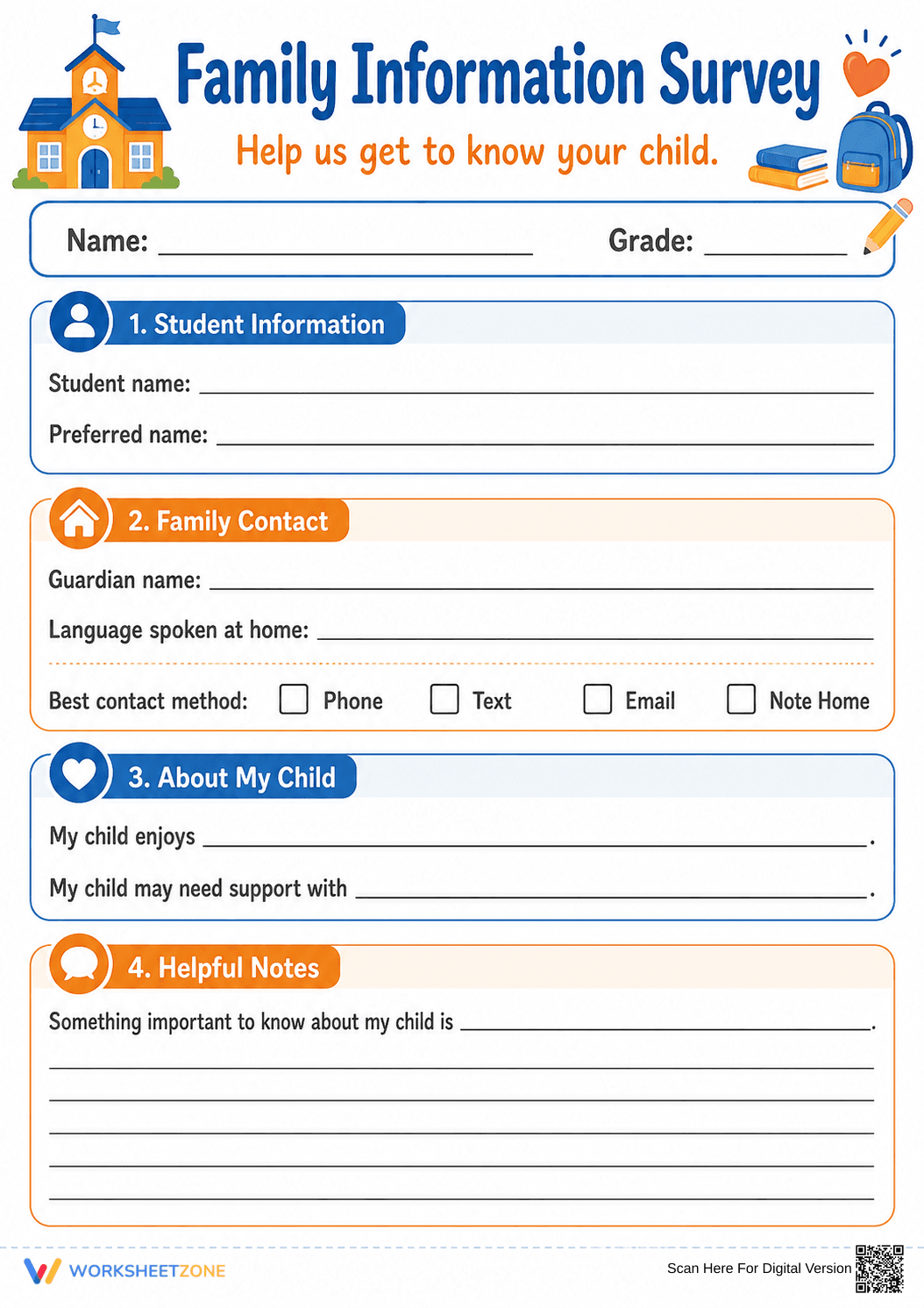
This Family Information Survey provides a professional and welcoming way for teachers to gather critical student data during the first week of school. By streamlining the collection of contact details and personal interests, educators can establish a strong home-school connection immediately. This resource ensures that every guardian has a clear voice in their child's transition.
At a Glance
- Grade: K-5 · Subject: Classroom Management
- Standard:
CCSS.ELA-LITERACY.SL.1.1— Participate in collaborative conversations with diverse partners about grade-level topics- Skill Focus: Home-School Communication
- Format: 1 page · 10 fields · No answer key needed · PDF
- Best For: Back-to-school night or first-day folders
- Time: 5–10 minutes
The worksheet features four distinct sections designed for clarity and ease of use. It includes dedicated spaces for student names, preferred nicknames, and primary languages spoken at home. The Family Contact area utilizes checkboxes for preferred communication methods like text or email. Additionally, the About My Child and Helpful Notes sections provide open-ended lines for parents to share strengths, support needs, and unique personal insights.
Teachers can implement this survey with less than 2 minutes of preparation. First, print the single-page PDF for your entire class roster. Second, distribute the forms during Meet the Teacher night or place them in student take-home folders on the first day. Third, review the returned forms to identify immediate needs, such as language barriers or specific student interests, and file them in a communication binder for year-long reference.
This resource aligns with `CCSS.ELA-LITERACY.SL.1.1`, which emphasizes participating in collaborative conversations with diverse partners. While primarily an administrative tool, it facilitates the exchange of information necessary for effective classroom discourse and partnership. Both standard codes can be copied directly into lesson plans, IEP goals, or district curriculum mapping tools.
Use this survey as a proactive communication tool before the first full day of instruction. It serves as an excellent icebreaker for parents who may feel overwhelmed by school paperwork. As a formative assessment of the home environment, teachers should look for patterns in preferred contact methods to ensure equitable outreach. Completion typically takes parents 5 to 10 minutes at home.
This survey is designed for elementary teachers in Grades K-5 who prioritize inclusive classroom environments. It is particularly helpful for students requiring differentiated support, as it allows parents to flag specific needs early. Pair this resource with a Welcome to Class letter or a classroom newsletter template to create a cohesive introductory package.
Effective home-school communication is a cornerstone of student success, as highlighted by Fisher & Frey (2014) in their research on building intentional classroom communities. This Family Information Survey addresses the need for structured data collection that respects the diverse backgrounds of families. By aligning with CCSS.ELA-LITERACY.SL.1.1, the tool ensures that the initial contact between home and school is focused on collaborative information sharing. Research from the NAEP suggests that students whose families are actively engaged in the school community show higher levels of academic persistence. This printable resource provides the necessary framework for teachers to capture qualitative data that standard gradebooks often miss. Using a clear, 1-page format reduces the cognitive load on parents while maximizing the utility of the information for the educator. It is a foundational component for any comprehensive classroom management plan.


