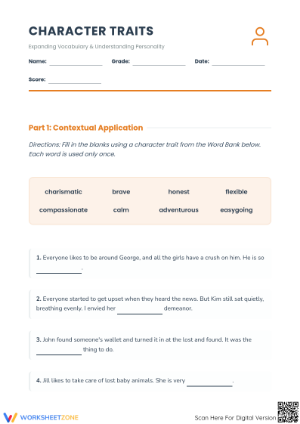
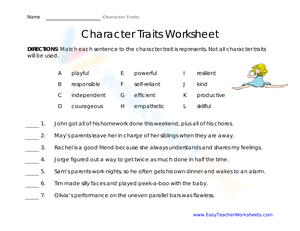
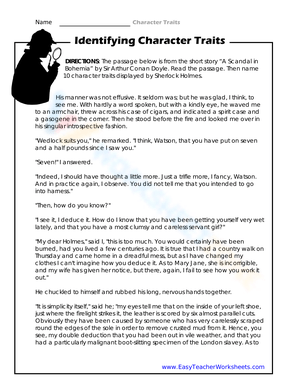
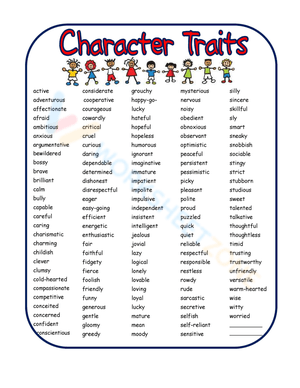
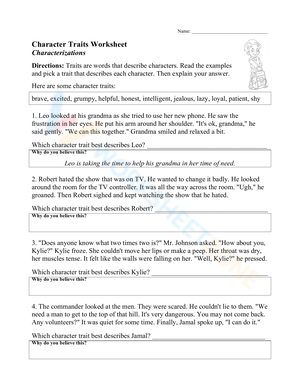
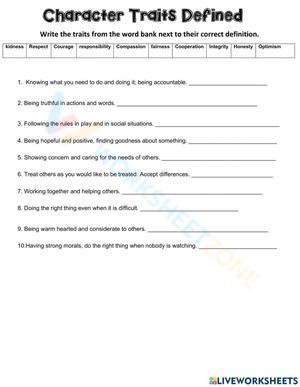
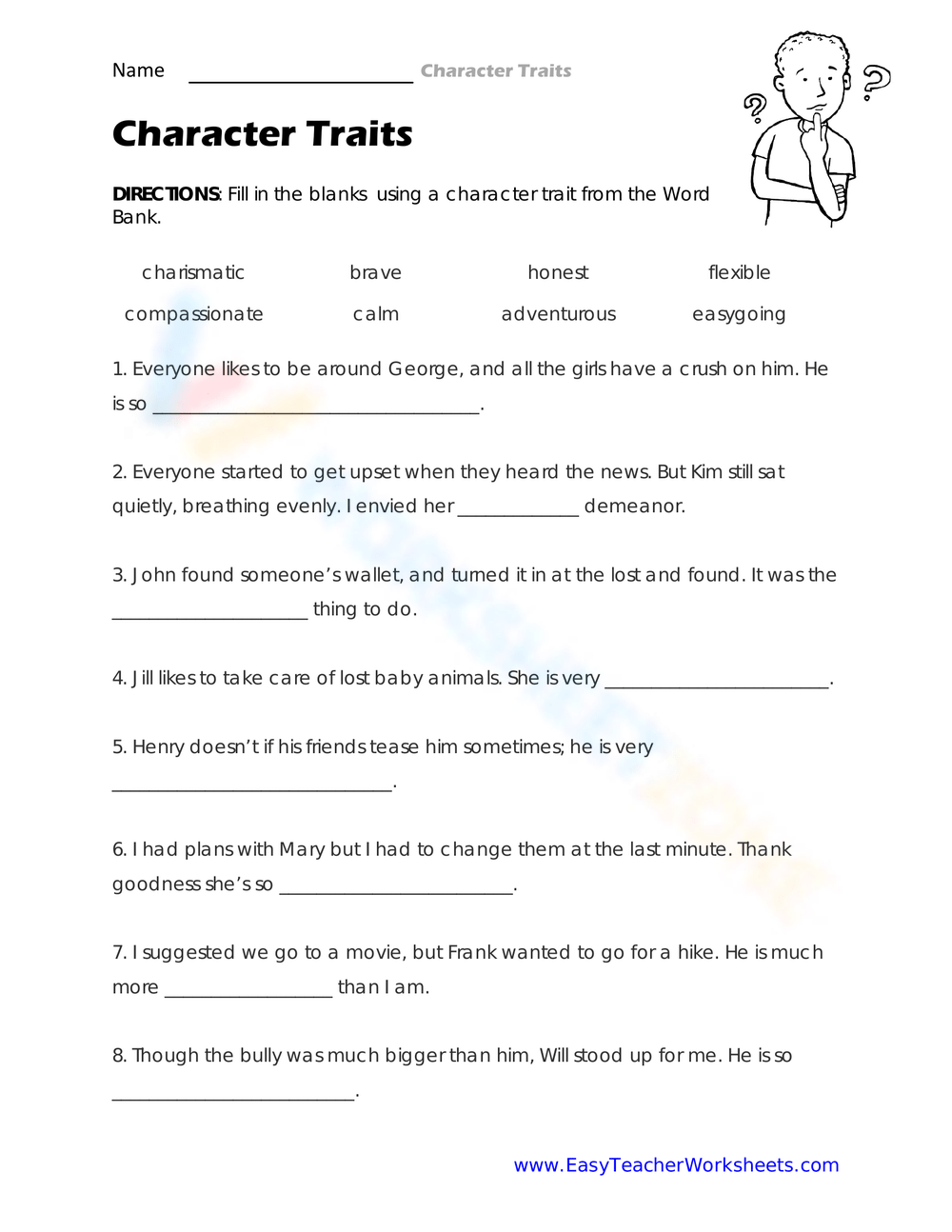
These character traits worksheets pdf for kindergarten give teachers a picture-based entry point into social-emotional learning at the moment five-year-olds are beginning to name what they see in each other's behavior. Each worksheet targets one trait — kindness, honesty, respect, responsibility, perseverance — and uses visual scenes that non-readers can interpret with minimal teacher support. The set moves from recognition to application: students first identify a trait, then mark which pictured behavior demonstrates it.
What Students Practice Across the Set
The activities are picture-driven by necessity. Five-year-olds are pre-abstract thinkers; asking them to define "respect" in words produces blank stares, but showing them two children — one listening while the other speaks, one interrupting — and asking which is being respectful gets real, considered answers. That gap between verbal definition and visual recognition is exactly where these worksheets operate.
Depending on the worksheet, students will:
- Color the scene that shows a named trait while leaving the contrasting image uncolored — a binary choice that forces a real judgment
- Sort drawn scenarios into two columns: "shows kindness" and "doesn't show kindness"
- Complete a sentence frame like I show responsibility when I ___ and illustrate it
- Match a facial expression or body-language clue to the corresponding trait word
- Draw themselves performing a specific behavior, then label it using a teacher-provided word bank
Each worksheet focuses on a single concrete behavior within a trait rather than the trait in the abstract. A worksheet on honesty doesn't ask what honesty is — it shows a child who broke a crayon choosing to tell the teacher versus hiding it behind a book, and asks students to mark what the child did and what they would do. That scene-level specificity is what makes the concept workable for this age group.
Building These Worksheets Into the Week Without Losing Instructional Time
The most consistent use teachers report is as a read-aloud follow-up. Read a picture book where a character wrestles with a trait — Enemy Pie for kindness, The Empty Pot for honesty — then distribute the matching worksheet while the book is still visible. Students are already inside the character's choices; the worksheet gives them a structured way to process what they heard. This pairing typically takes 10 to 12 minutes total, which sits comfortably at the close of morning meeting before centers begin.
Character traits worksheets pdf for kindergarten also fit naturally inside literacy centers when the activity reinforces a letter-sound connection alongside the trait. A worksheet where students circle every image that shows kindness and then write the letter K beside each circled picture handles phonics and SEL in the same seven minutes. Students take the content more seriously when it's embedded in a familiar center routine rather than announced as a special lesson.
For a "trait of the week" structure, introduce the concept whole-group on Monday — a brief discussion, an anchor chart with two or three examples — then use the worksheet on Wednesday as a mid-week check. Close with a short oral debrief on Friday. That three-point rhythm keeps the trait in view all week without requiring a daily standalone lesson block.
Student Responses That Reveal Gaps Worth Addressing Early
The most common error in early kindergarten character work isn't a wrong answer — it's the automatic right answer. A student circles "kind" on every choice activity because they've already learned that kindness is what teachers want. When asked to explain why a picture shows kindness, they say "because she's being nice" without connecting the label to the actual behavior shown. These worksheets help surface that gap because the activities require choosing between two scenes rather than simply labeling a single image. Within a week, you can see which students are reading the picture and which are guessing.
A second pattern: students will mark both images in a comparison activity because, at this point in their moral reasoning, they don't want to say anyone is being unkind. This is a developmental stage, not a comprehension failure, but it signals that the student hasn't yet separated "describing behavior" from "judging a person." The brief discussion after the worksheet — "we're not saying this child is bad; we're asking if this one action was kind" — is where the real teaching happens, and the worksheet is what prompts it.
Honesty activities also reliably produce an unexpected confusion between honesty and tattling. A student who sees a picture of a child telling the teacher that someone else broke a classroom rule will often refuse to mark it as "honest" because they've internalized that reporting others is wrong. Naming that distinction directly before the worksheet goes out prevents the confusion from settling into a lasting misconception.
Adjusting the Set for a Wide Range of Learners
For students functioning above grade level socially and linguistically, the extension is almost always discussion rather than a harder activity. After completing the worksheet, ask them to come up with a scenario not pictured — a time they showed perseverance or honesty — and draw it in the white space at the bottom. That open-ended addition turns a recognition task into a generative one without requiring a separate resource.
Students who need more support do better when an adult reads the scenario aloud and waits before the student responds, rather than having them work independently. Some students also manage more easily when only part of the worksheet is visible at once — covering half the page with a blank sheet of paper reduces visual load without changing the task. For students with limited English, adding a home-language label under each trait word, even by hand, helps them access the vocabulary while completing the same activity as their peers.
Standard Alignment
These worksheets connect to the CASEL Core Competencies, specifically Self-Awareness (identifying personal traits and emotional responses) and Social Awareness (recognizing the perspectives and behaviors of others). At the kindergarten level, these competencies appear in the opening units of widely used SEL programs including Second Step and Responsive Classroom, making these worksheets a natural supplement to — or a standing replacement for — materials in those introductory units.
In states that have adopted standalone K–12 SEL standards, character traits instruction most commonly aligns to standards in the self-management and interpersonal skills strands. Naming conventions vary: some states use "relationship skills," others use "social competence" or "prosocial behavior." Check your state's SEL standards document for the specific code and strand language before noting alignment on lesson plans or family communications.
Frequently Asked Questions
Can students who don't read yet complete these worksheets without help?
The core tasks — coloring, circling, drawing, and matching — rely on picture interpretation, not decoding. Where a trait word appears as text, it functions as a reference label rather than a reading demand. Reading the directions aloud once before students begin is enough for most kindergartners to proceed independently through the rest of the activity.
How much introduction does a trait need before I hand out the worksheet?
A two-minute verbal preview is usually sufficient. Name the trait, give one concrete example ("showing responsibility means putting your materials away when I say cleanup"), then ask one or two students for another example before the worksheets go out. Over-explaining before the activity removes the productive thinking the pictures are meant to prompt — students should still be doing some of the work of connecting the concept to what they see.
Do these work as an assessment tool, or just for practice?
These character traits worksheets pdf for kindergarten function most reliably as formative tools. A completed worksheet tells you whether a student recognizes a trait in a pictured scenario at that moment — it doesn't tell you whether they'll apply it in the hallway during transition. Treat them as documentation of where a student is in their understanding and as a conversation-starter, not as evidence of mastery. A student who marks every scenario identically regardless of content is telling you something more useful than any correct answer would.
Is one worksheet per trait enough, or should I follow up immediately with more on the same concept?
For most traits, one worksheet paired with a discussion is enough to introduce the concept. Retention comes from daily reinforcement — noticing kind behavior during line-up, naming honest moments in read-alouds, acknowledging perseverance during centers — not from stacking paper activities on the same topic. Returning to the same character traits worksheets pdf for kindergarten two or three weeks later as a brief review is more effective than immediately repeating the exercise, and it gives you a cleaner picture of whether the understanding has held.












 Interactive Worksheet Maker
 Quiz Maker
 Word Search Maker
 Crossword Puzzle Maker
 Word Scramble Generator
 Sentence Scramble Generator
 Handwriting Worksheet Generator
 Name Tracing Generator
 Fill In The Blank Generator