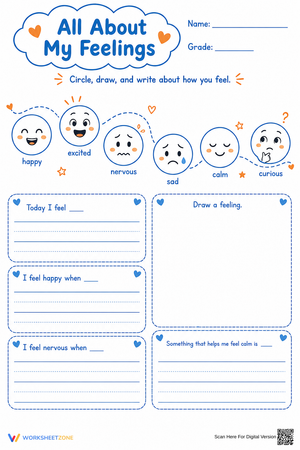
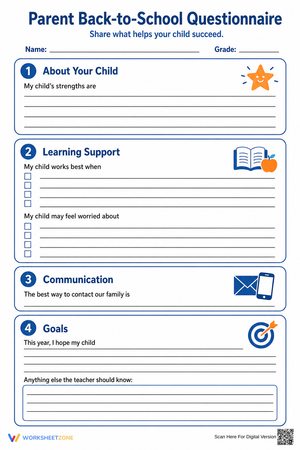
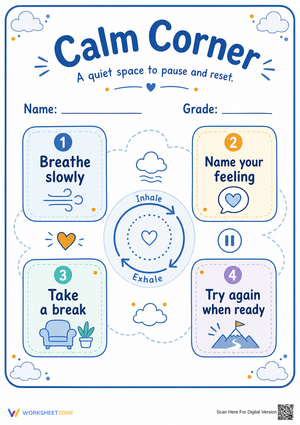
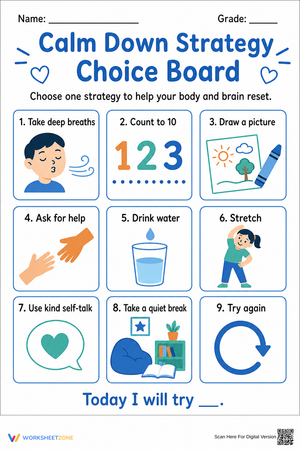
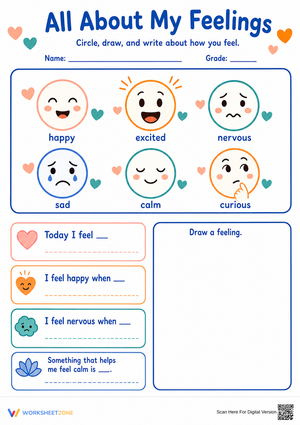
These emotions and feelings worksheets for kindergarten give teachers a set of printable activities for building emotional vocabulary with 5- and 6-year-olds — covering facial expression recognition, feeling intensity, perspective-taking, and the early language students need to communicate what's happening inside them. Individual worksheets drop into morning meetings, calm-down corners, or read-aloud follow-ups without requiring a separate unit plan.
Skills Targeted Across the Set
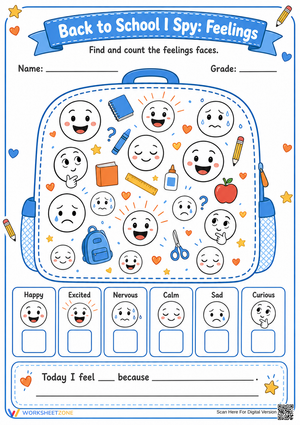
The resources build emotional literacy from identification through application. At the recognition end, students match illustrated faces to vocabulary labels, learning to read the angle of eyebrows and the set of a jaw alongside the more obvious cues of a smile or tears. Further along, the work shifts to perspective-taking: illustrated scenarios ask students to draw or write how a character might feel in a given moment, which is a genuinely challenging task for a brain still figuring out that other people have internal states at all.
- Expression-to-word matching — students draw lines connecting specific visual cues to labeled emotion words, building both receptive vocabulary and visual literacy simultaneously
- Body language identification — activities extend emotion reading beyond the face to posture, hand position, and overall body stance
- Feeling intensity scales — emotion thermometer activities teach students to distinguish between a little nervous and completely overwhelmed, which is the foundation of self-regulation
- Scenario-based drawing prompts — present a situation and ask students to draw the character's probable feeling, requiring perspective-taking rather than simple recognition
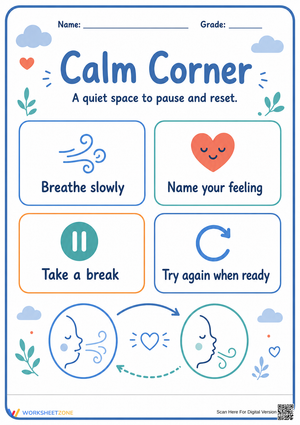
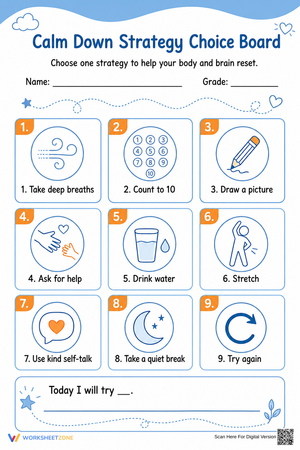
- Calm-down strategy choice boards — give students a concrete menu of regulation tools they can use independently when feelings escalate
- Positive emotion vocabulary — explicit practice with words like proud, curious, and content, which rarely surface in daily classroom conversation without direct instruction
Student Error Patterns Worth Catching Early
Teachers who have used emotions and feelings worksheets for kindergarten across multiple class groups see the same error surface consistently: students collapse negative emotions into two categories. Everything unpleasant is either "sad" or "mad," and the finer distinctions — scared versus worried, frustrated versus angry, lonely versus sad — get assigned to whichever big bucket feels closest. On a matching worksheet with eight expressions, students typically nail "happy" and then overapply "sad" to five or six remaining faces. This isn't carelessness; it's a vocabulary gap. Students can't reach for words they've never been taught.
On "draw the face" prompts, the scared face and the disappointed face look nearly identical in student drawings — and honestly, those expressions do share features. Rather than marking these wrong, use the drawing as an entry point: hold it next to a picture of each expression and ask, "Which one does yours look more like?" That comparison takes two minutes and builds more durable understanding than a correction mark ever will.
A third pattern appears less often but is worth noting: students who circle the emotion they're currently feeling rather than what the character on the worksheet is showing. At age 5, decoupling personal state from external perception is still a developing skill. When it happens repeatedly, treat it as useful data. The student who marks "scared" on every activity for two weeks is communicating something about their own experience.
Building These Worksheets Into the Flow of Your Week
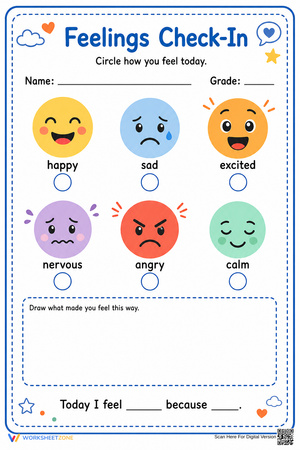
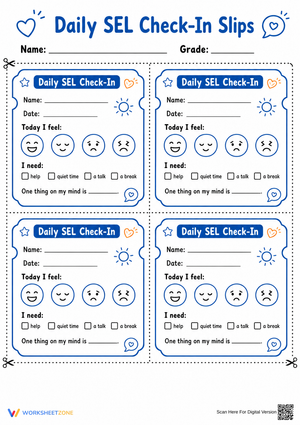
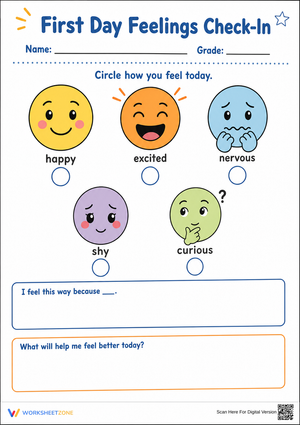
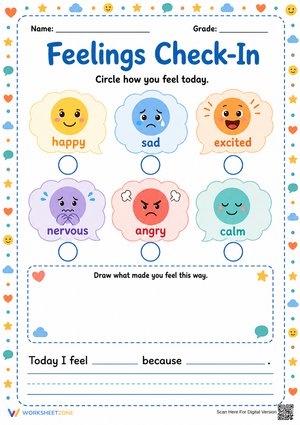
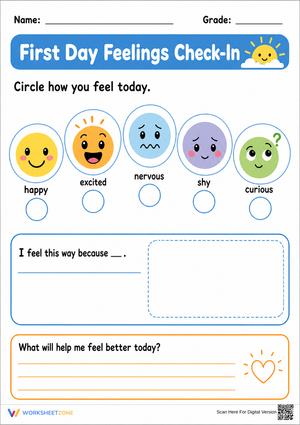
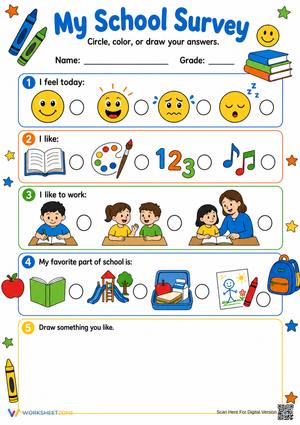
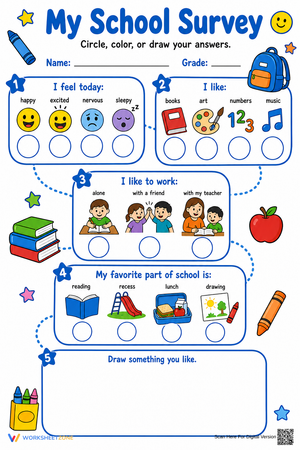
The most practical entry point is the morning check-in. As students hang up backpacks and settle in, a brief worksheet where they circle their current feeling gives the teacher a fast read of the room — and gives students a daily habit of pausing to notice their internal state before the school day accelerates. The whole process takes under four minutes. It doesn't need to become a discussion; sometimes the teacher just scans the circles and files the information.
The emotion thermometer works better as a standing classroom tool than a one-time activity. Laminate one for each student, store them near the calm-down corner, and let students retrieve their own when they feel themselves rising. This removes the cognitive work of a struggling student having to generate regulation options from a flooded brain — the choices are already printed. The same logic applies to calm-down choice boards: most useful as a permanent resource, not a worksheet that gets handed in and forgotten.
After a read-aloud — Grumpy Monkey, In My Heart, The Way I Feel — pairing the discussion with one worksheet from these emotions and feelings worksheets for kindergarten gives students a structured place to record character feelings at different story moments. This doubles as a comprehension activity aligned to RL.K.3, so teachers get SEL and literacy practice within the same instructional block without adding minutes to the schedule.
Standard Alignment
These worksheets address the Self-Awareness and Social Awareness competencies within the CASEL framework, the most widely adopted structure for SEL implementation in U.S. K–12 schools. The emotional identification and vocabulary activities map directly to CASEL's early childhood Self-Awareness benchmark: students recognize and accurately label their own emotions and the emotions of others. State SEL standards in Illinois, California, and Massachusetts — all derived in part from CASEL — include kindergarten-level benchmarks in exactly this strand, typically coded under emotional literacy or self-awareness domains.
The scenario-based worksheets also connect to ELA standard RL.K.3, which asks students to identify characters in a story and describe key details, including how those characters feel. Using a feelings worksheet as a structured read-aloud follow-up satisfies both a literacy standard and an SEL benchmark within the same activity.
Adjusting the Set for a Range of Learners
The visual format of emotions and feelings worksheets for kindergarten makes them accessible across a wide readiness range without significant modification. Students who are still building print awareness — English learners, students with autism spectrum disorder, students new to formal schooling — can engage fully with the expression-matching and drawing activities because the tasks don't depend on reading. Laminating these worksheets and adding dry-erase markers lets students repeat the same activity multiple times, which builds fluency more effectively than moving too quickly to a new skill.
Students who can reliably name six to eight core emotions are ready to work with nuance. Pair them with the scenario worksheets that require a written or drawn response instead of a multiple-choice match, and push the vocabulary toward finer distinctions: nervous versus scared, disappointed versus sad, irritated versus furious. For students with fine motor difficulties, accepting a verbal response recorded by a partner or aide maintains access to the cognitive work without the physical barrier getting in the way.
Frequently Asked Questions
How many new emotion words should I introduce at once?
Two or three per instructional cycle, especially in the first half of kindergarten. Introducing eight emotion words in a single lesson triggers cognitive overload — students anchor to the familiar ones and let the rest go. Start with happy, sad, and scared. Once students use those reliably in conversation, layer in angry, surprised, and worried. Reserve words like frustrated, proud, and nervous for later in the year, when students have a stable vocabulary base to compare new words against.
What do I do when a student becomes upset during one of these activities?
It happens regularly, and it's not a problem. Talking about feelings can surface them, and a student already carrying anxiety can find a worksheet about fear or sadness genuinely activating. Keep the response low-key: name what you see, offer the calm-down choice board, and let the student step away from the activity without consequence. Returning to the worksheet the next day, when the student is regulated, produces far better learning than pushing through. The activation itself is evidence the SEL work is connecting to something real.
My students do fine on the worksheets but don't use this vocabulary during actual conflicts. What's missing?
Transfer is the hardest piece of any early vocabulary work, and emotional language is no different. Completing a matching activity and spontaneously naming your own emotion in the middle of a recess argument are two separate cognitive tasks, and the gap between them is real. The bridge is live adult narration during actual emotional moments: when a student is crying at the lunch table, the teacher saying "You look really disappointed that you didn't get to finish your game" does more to wire that word into active use than any paper activity. Worksheets build recognition; in-the-moment narration builds expression. Both are necessary.