


























Views
Downloads

Ecosystems & Biodiversity — Printable Grade 7 Worksheet
Paste this activity's link or code into your existing LMS (Google Classroom, Canvas, Teams, Schoology, Moodle, etc.).
Students can open and work on the activity right away, with no student login required.
You'll still be able to track student progress and results from your teacher account.
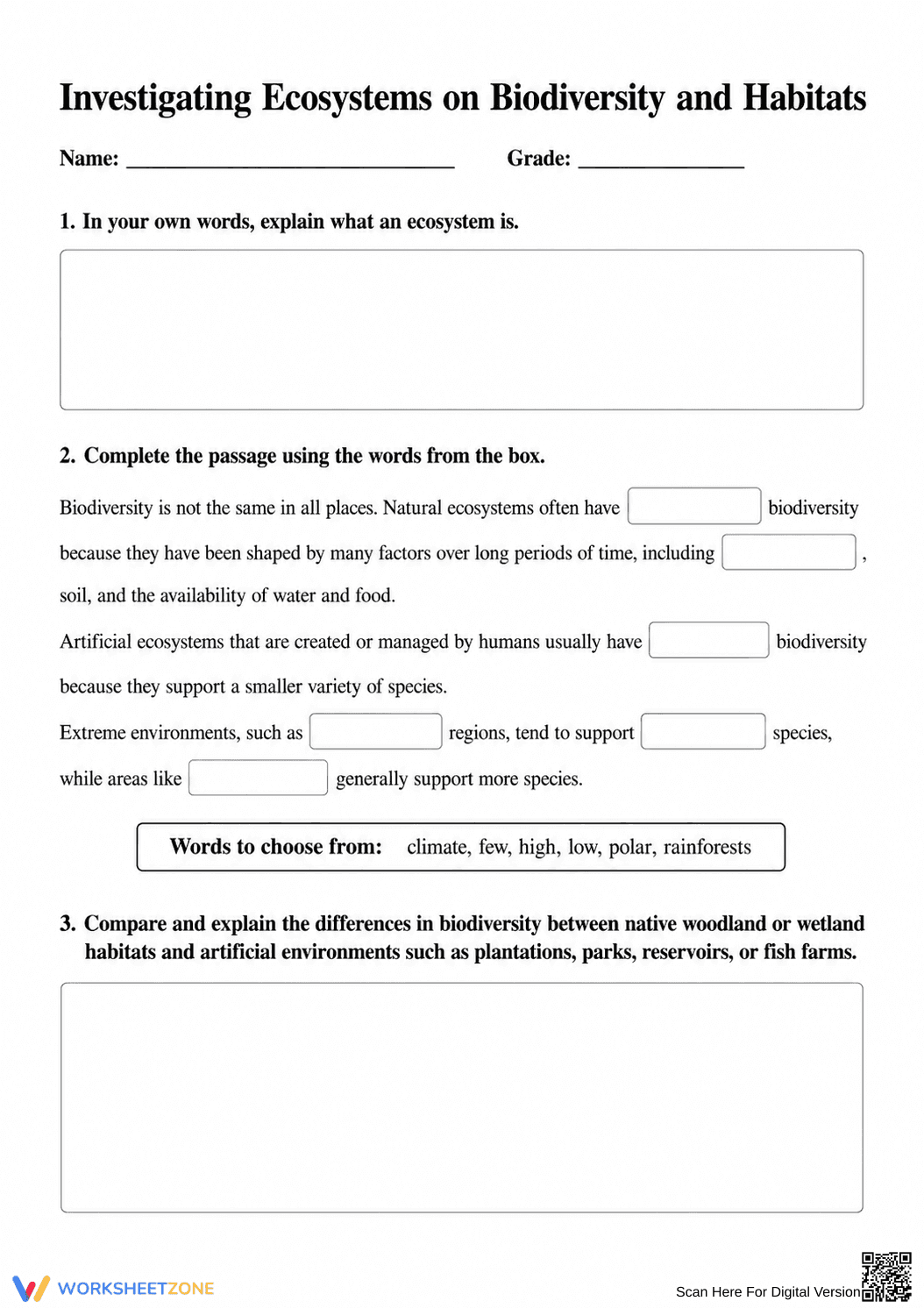
This middle school science worksheet helps students define ecosystems and analyze the factors that impact biodiversity. By comparing natural habitats like woodlands to artificial environments such as plantations, learners build a foundational understanding of ecological health and species variety.
At a Glance
- Grade: 7 · Subject: Science
- Standard:
MS-LS2-4— Analyze how changes to an ecosystem affect populations- Skill Focus: Comparing biodiversity in habitats
- Format: 1 page · 3 problems · Answer key included · PDF
- Best For: Independent practice or review
- Time: 15–20 minutes
This single-page resource features three distinct task types to assess student comprehension. It begins with a short-answer definition prompt, followed by a six-blank cloze passage equipped with a convenient word bank to reinforce key vocabulary like "climate" and "rainforests." The worksheet concludes with a comparative short-response question where students must articulate the differences between native and artificial environments. A complete answer key is provided to streamline grading.
Zero-Prep Workflow
This resource is designed for immediate classroom implementation with minimal teacher setup:
- Print (1 minute): Generate copies of the single-page PDF for your entire class.
- Distribute (1 minute): Hand out the worksheet as a bell-ringer, homework assignment, or independent practice activity.
- Review (3 minutes): Use the included answer key to quickly check student responses or facilitate a whole-class discussion.
With under two minutes of total prep time, this worksheet is an excellent, self-explanatory option for emergency sub plans.
Standards Alignment
This worksheet aligns with Next Generation Science Standards, specifically focusing on MS-LS2-4: Construct an argument supported by empirical evidence that changes to physical or biological components of an ecosystem affect populations. By evaluating how artificial environments support fewer species than natural habitats, students engage directly with this core ecological concept. Both standard codes can be copied directly into lesson plans, IEP goals, or district curriculum mapping tools.
How to Use It
Post-Instruction Review: Assign this worksheet immediately following a direct instruction lesson on ecosystems. It serves as an effective formative assessment, allowing you to observe whether students can accurately apply vocabulary words like "climate" and "polar" in context.
Emergency Sub Plan: Because the instructions are clear and the word bank provides built-in scaffolding, substitute teachers can easily administer this activity. Students should be able to complete the three sections independently within a 15 to 20-minute timeframe.
Who It's For
This resource is primarily designed for middle school students in grades 6 through 9 studying life science or biology. The inclusion of a word bank provides necessary differentiation for English Language Learners and students needing vocabulary support. It pairs perfectly with an introductory anchor chart on natural versus artificial habitats.
Understanding the delicate balance of our natural world requires explicit instruction and structured practice. This worksheet directly supports MS-LS2-4 by asking students to analyze how changes to an ecosystem affect populations, specifically comparing native woodlands to artificial plantations. According to a recent ScienceDirect TpT Analysis, providing students with scaffolded vocabulary exercises, such as cloze passages with word banks, significantly improves their ability to articulate complex scientific comparisons. By requiring learners to synthesize their knowledge in a final short-response question, this resource moves beyond rote memorization into higher-order application. Educators can rely on this targeted practice to build foundational ecological literacy, ensuring students recognize the critical importance of biodiversity in maintaining healthy, resilient environments across the globe. This approach fosters a deeper appreciation for environmental conservation.


