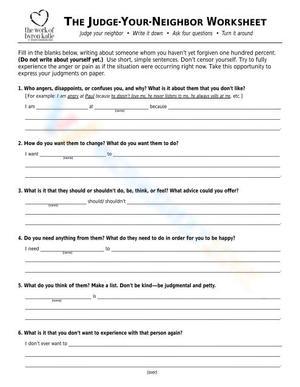
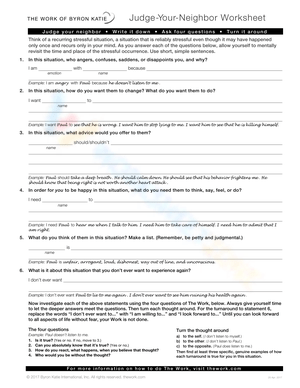
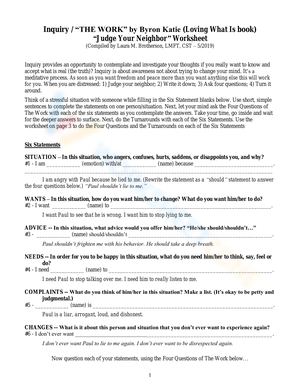
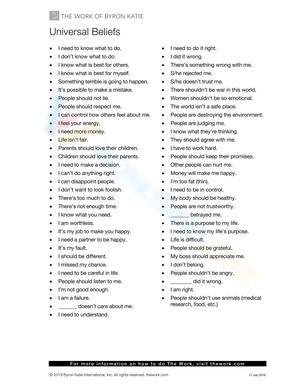
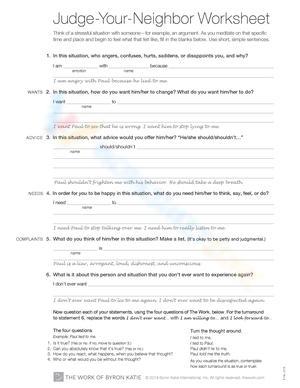
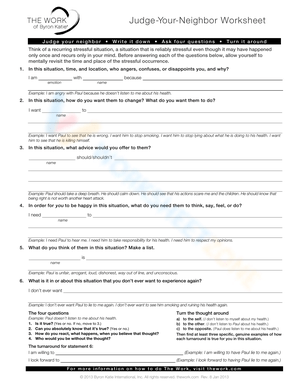
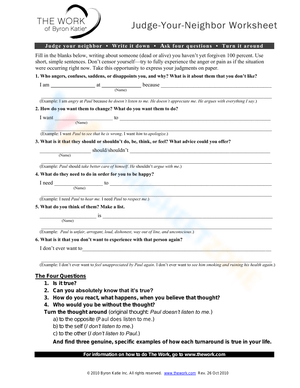
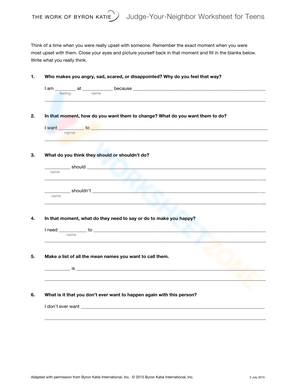
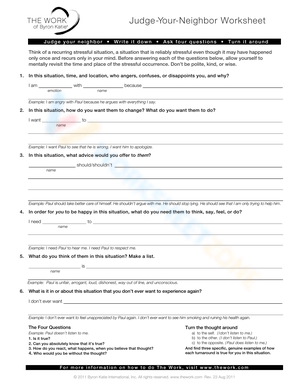
9th grade judge your neighbor printable worksheets give students a structured method for examining the stressful thoughts they hold about peers — and they do it through writing, not talking. Each worksheet walks a student through a specific interpersonal frustration: they write down unfiltered judgments about another person, then apply four guided questions that move them from emotional reaction toward something closer to clarity. Teachers in advisory periods and health classes have found this format especially useful because it turns a private grievance into a private inquiry, with no group disclosure required.
What the Inquiry Process Asks Students to Do
The method draws from Byron Katie's self-inquiry framework, and the sequence matters. Students begin by identifying one specific, recent moment — not a pattern, not a general feeling, but a single situation: the friend who talked over them during group work, the teammate who took credit for their idea in front of the class. From there, they write their judgments about that person as directly as they actually feel them. The four questions then follow in order:
- Is it true?
- Can you absolutely know that it is true?
- How do you react — what happens — when you believe that thought?
- Who would you be without the thought?
The final step is the turnaround: students restate their original judgment with the subject and object reversed, or shift the direction of the accusation entirely. If a student wrote "She never listens to me," one turnaround reads "I never listen to her." The inquiry does not ask students to accept that statement as true — it asks them to find at least one specific instance where it might apply. That distinction matters enormously for ninth graders, who tend to read the turnaround as an attack on their credibility rather than a thought experiment worth testing.
What separates 9th grade judge your neighbor printable worksheets from generic journaling prompts is the structure itself. The four questions are not interchangeable, and the order is not arbitrary. The first two ask students to slow down and test the factual claim. The third does the real emotional work — students notice what their body does, what they say, how they treat the other person when they hold that thought. The fourth opens a small door. By the time students reach the turnaround, most have loosened their grip on the original judgment enough to engage honestly.
How to Build These Worksheets Into Your Lesson Plans
9th grade judge your neighbor printable worksheets work best when students have already seen the full process modeled with material that carries no personal stakes. Before distributing each worksheet for individual use, walk through the entire sequence using a fictional scenario — a scene from a class novel, or a hypothetical: "Jamie feels completely ignored after a close friend walks past them in the hallway without saying hello." Running all four questions and a turnaround together as a class lets students understand the mechanics before the process asks anything vulnerable from them.
Advisory periods are a natural fit, particularly during the first semester of ninth grade when social hierarchies are still settling and tensions run highest. A 15-to-20-minute block once a week gives students enough time to work through each worksheet without rushing. Privacy is non-negotiable here: students need to know their completed worksheets will not be collected or read. Offering participation credit for the act of completing the activity — without requiring submission of the written content — removes any incentive to self-censor. Health class units focused on relationships or conflict resolution give the worksheets a clear curricular home when advisory time is limited.
One practical note on the printed format: for this particular exercise, paper works better than a screen. When students are sitting with a sensitive peer conflict, a notification pulling their attention to another app undoes the reflective state the questions are trying to build. Keeping a stack of each worksheet in a designated classroom spot also lets students pick one up independently — during a calm moment before the day starts, or in the last few minutes before dismissal when a frustration is still fresh.
Where Ninth Graders Stall — and What It Reveals
The turnaround phase is where most students shut down. A student writes "He left me out of the group text on purpose," reaches the turnaround, and stops — because "I left him out on purpose" feels like a confession to something they did not do. The problem is that they are reading the turnaround as a verdict rather than a hypothesis. Reframing it as a scientific test — "Just find one time, even a small one, where this might have been true for you" — lowers the resistance noticeably. The analytical framing bypasses the defensiveness that asking for empathy directly never gets past with this age group.
A second pattern to watch: students answer question one ("Is it true?") with a confident yes and move on without actually sitting with it. Question two — "Can you absolutely know that it is true?" — exists specifically to interrupt that momentum. Students who rush through question two almost always produce shallow, dismissive turnarounds. A quick check-in while circulating — asking only "what did you write for question two?" — surfaces whether a student engaged or just filled in a box and moved forward.
Adjusting the Worksheets for a Range of Learners
For students who freeze in front of open-ended prompts, the initial judgment section feels deceptively unstructured. Providing one sentence starter — "I'm angry at ___ because..." or "I think ___ is being unfair because..." — gives those students a way in without changing what the worksheet is asking them to do. Students who need extended processing time can be encouraged to write two or three separate judgments about the same situation and apply all four questions to each one independently. That approach often produces far more nuanced turnarounds than a single run-through.
Students who finish quickly and spend the remaining time looking around the room benefit from a written extension: after completing the turnaround, ask them to list three specific, observable moments that support the turnaround statement. This keeps the exercise from becoming a box-checking task and pushes toward the concrete self-examination the process is built for. For students referred by counselors for ongoing interpersonal difficulties, the same worksheet format translates well to a one-on-one setting, where an adult can help a student sit with question three long enough to actually feel the answer — not just write something plausible and move on.
Frequently Asked Questions
Do students have to share what they write on these worksheets?
No, and they should not be required to. The honesty the inquiry depends on disappears the moment students believe someone else will read their judgments. Teachers can circulate and offer support during the activity — asking "Which question are you working on?" keeps students on task without compromising the privacy the exercise requires.
What if a student's written reflections suggest something more serious — repeated targeting, or a safety concern?
This is worth thinking through before introducing the activity. One straightforward approach: let students know at the outset that if anything they write involves their physical safety or the safety of someone else, you would want them to speak with you directly rather than leave it on the paper. This maintains the trust the activity depends on while keeping the teacher's duty-to-report obligations intact.
Can these worksheets replace a conversation with the school counselor?
The 9th grade judge your neighbor printable worksheets are a self-reflection tool, not a clinical intervention. They help students process ordinary peer friction — the daily misreadings and irritations that make ninth grade feel socially exhausting. When a situation involves repeated targeting, significant distress, or mental health concerns, a counselor referral is the right move. These worksheets work alongside those support structures, not instead of them.
How many times does a student need to complete the process before it starts to feel natural?
Most students need four to six repetitions before the four questions begin functioning as an internal sequence rather than a form they are filling out. Weekly use across a single semester tends to produce that shift — students start catching themselves applying the first question without being prompted. At that point, the printed worksheet has done its job.












 Interactive Worksheet Maker
 Quiz Maker
 Word Search Maker
 Crossword Puzzle Maker
 Word Scramble Generator
 Sentence Scramble Generator
 Handwriting Worksheet Generator
 Name Tracing Generator
 Fill In The Blank Generator