Teaching Communication Skills PDF Worksheets for 9th Grade
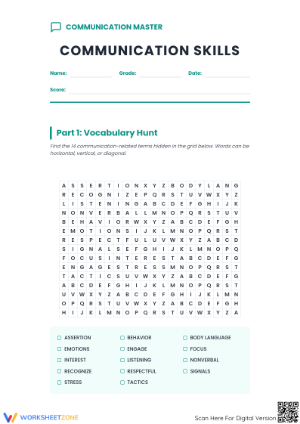
These teaching communication skills pdf worksheets for 9th grade give teachers a set of downloadable, ready-to-use resources targeting the exact communication gaps that appear when students move from middle school into high school. Each worksheet focuses on a distinct skill — active listening, assertiveness, non-verbal cues, or professional digital communication — so teachers can assign them in sequence or pull individual worksheets to address specific gaps as they emerge during the school year.
The Specific Skills Covered in This Set
The shift into 9th grade changes the communicative demands on students in concrete ways. Freshmen are suddenly expected to advocate for themselves with teachers and administrators, manage group work with near-strangers, and correspond in writing with a level of professionalism their middle school experience rarely required. The worksheets in this set address four interconnected areas:
- Active Listening: Paraphrasing spoken content accurately, asking clarifying questions, and demonstrating engagement through body posture and eye contact rather than just silence.
- Non-Verbal Communication: Reading facial expressions, tone shifts, and physical proximity — and understanding how these signals can contradict the literal content of what someone says.
- Assertiveness and Conflict Resolution: Distinguishing between passive, aggressive, and assertive communication styles, using "I" statements to express needs, and working through a structured sequence for de-escalating disagreements before they become hallway incidents.
- Digital Professionalism: Writing formal emails with clear subject lines, proper salutations, and professional closings — and recognizing the difference between a text to a friend and a message to a teacher about a missed deadline.
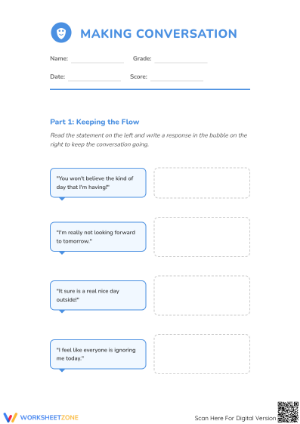
Teachers who pull teaching communication skills pdf worksheets for 9th grade into a group-project unit will find that the scenarios stay grounded in situations freshmen actually face: asking a teacher to reconsider a grade, disagreeing with a group member during a lab, or navigating a scheduling conflict with a coach. Students practice the specific social moves that high school expects from them, not invented situations lifted from a textbook.
Frequent Student Errors Worth Anticipating Before These Lessons
The most persistent error on active listening worksheets is surface paraphrasing. A student who heard "I'm upset because my partner didn't do any of the work on our project" writes back "she said her partner didn't help." The event is captured; the emotional content is gone. That gap — between information transfer and genuine understanding — is exactly what the paraphrasing exercises push students to notice in their own responses, often for the first time.
Assertiveness is the concept that generates the most confusion at this grade level. Most 9th graders, when asked to describe an assertive response, describe what is actually an aggressive one. They conflate directness with force. The worksheets address this by placing all four communication styles side by side with the same scenario — so students can compare passive, aggressive, passive-aggressive, and assertive responses and explain what makes the fourth one different. Without that direct comparison, the distinction stays abstract no matter how many times it appears on a slide.
In the email etiquette worksheet, the subject line is almost always blank or treated like a text message opener — "Hey" or "Question." Even students who nod along during a lesson will revert to habit when typing. The most effective exercise asks students to rewrite four real examples of emails that teachers have actually received, with identifying details removed. Students engage differently when they recognize the problem as real rather than contrived.
Fitting These Worksheets Into Existing Classroom Routines
These resources fit into existing routines without requiring a standalone unit. An ELA teacher can use the active listening worksheet as a warm-up in the 10 minutes before a Socratic Seminar — the paraphrasing work students do on paper directly mirrors the seminar norms they'll need to follow. A science teacher launching a multi-week group project can assign the conflict resolution worksheet during kickoff week, when students are still making plans together rather than managing grievances.
Advisory period is the most consistent home for these worksheets across a grade-level team. A Monday routine that runs 12–15 minutes works well: students read a scenario, mark their response, share with a partner, and briefly debrief as a group. Using teaching communication skills pdf worksheets for 9th grade as a shared resource across the whole advisory team — rather than individual teacher choice — pays off in vocabulary consistency. When every room uses the same terms ("I statements," "active listening posture," "assertive vs. aggressive"), students internalize the language faster and are more likely to reach for it outside of class.
One structured monthly addition worth building in is a Communication Audit. Students look back at three to five of their sent emails or reflect on a specific group interaction, then self-assess against the rubric from whichever worksheet is most relevant. It takes about 15 minutes and transforms "improve your communication" from a vague directive into something students can identify and act on concretely.
Standard Alignment
These worksheets align to the CASEL Relationship Skills domain, specifically the indicators covering clear communication, active listening, and constructive conflict resolution. In classroom terms, that means the materials fit any course where students work collaboratively, present, or advocate for themselves — ELA, group-based science or social studies units, and most elective courses at the 9th-grade level. Schools using a formal SEL framework will find that these worksheets map directly onto the Relationship Skills strand without requiring teachers to create supplemental documentation or adapt activities to fit the language of the framework.
Differentiating These Worksheets Across Ability Levels
The most practical support adjustment is reducing the number of scenarios per worksheet from four to two, giving students who process more slowly enough time to work through one situation with genuine thought rather than rushing through all four. Students who struggle to generate written responses independently often benefit from talking through their thinking with a partner before writing — which doesn't require changing the worksheet itself, just the routine around it.
For students who move through the material quickly, the extension is analysis rather than more practice. After completing the email etiquette worksheet, a student can take the same email and change one variable — the sender's relationship to the recipient, the urgency of the request, or whether the email is addressed to a teacher versus a potential employer — and explain how that shift would change the appropriate tone or format. That conditional reasoning pushes well past surface rule-following and closer to how professional communication actually works.
Students with IEPs that include goals around self-advocacy, turn-taking, or reading social cues will find that the worksheets in this set address all three areas directly. They serve as both instructional tools and documentation of targeted practice, which proves useful during progress-monitoring conversations with case managers or families.
Frequently Asked Questions
Can these worksheets be used in content-area classes, not just ELA or advisory?
Yes. Science and social studies teachers running group projects find the conflict resolution and active listening worksheets useful at the start of a collaborative unit. The email etiquette worksheet is particularly relevant in classes where students contact outside community partners or submit formal project proposals to an audience beyond the classroom teacher.
How much class time does each worksheet typically require?
Most worksheets take 15–25 minutes to complete independently. Teachers who build in a pair-share or full-group debrief should plan for 30–35 minutes total. The email rewriting exercises tend to run slightly longer because students need to read the original message, identify specific problems, and produce a revised version — three cognitively distinct steps.
Do these worksheets challenge students who are already strong communicators?
Communication competence and academic performance in ELA don't move in lockstep. Some of the most capable student writers in a room are also the ones who default to passive or passive-aggressive responses under social pressure. The worksheets challenge all students at the analysis layer — the extension moves in the differentiation section push strong students toward conditional reasoning rather than straightforward rule application.
Are these materials suitable for a school counselor running a small group?
Each worksheet holds up well in groups of four to eight students. Counselors who use teaching communication skills pdf worksheets for 9th grade in a pull-out or lunch-bunch setting typically assign one worksheet per session and spend the remaining time on role-play and structured reflection — both of which the scenario-based format in each worksheet supports directly.
Clear All