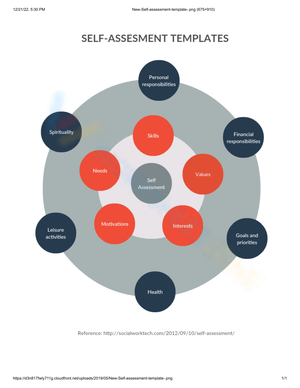
Self care assessment worksheets printable for 9th grade give health educators and school counselors a structured, screen-free way to open an honest conversation about student wellness during one of the most disorienting years in K-12. Ninth grade tends to compress a lot of life changes into a very short window — heavier academic loads, more complex social terrain, and the early rumblings of college and career planning — and most fourteen-year-olds have never been asked to step back and take stock of how they're actually doing. These worksheets put that reflection on paper, in their hands, in their own words.
What Each Worksheet Actually Targets
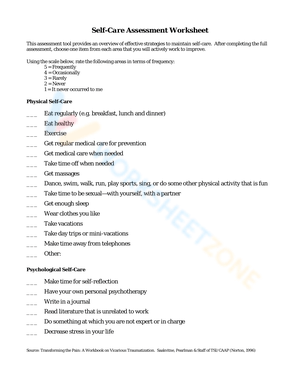
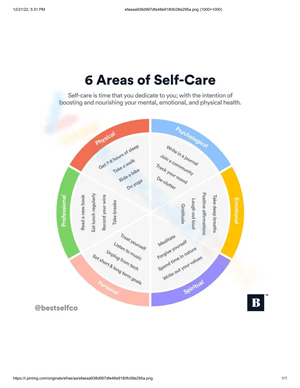
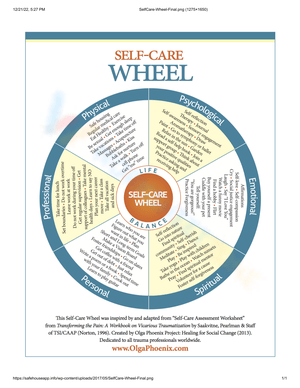
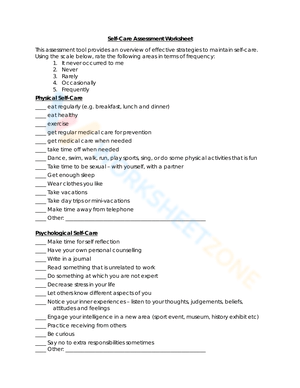
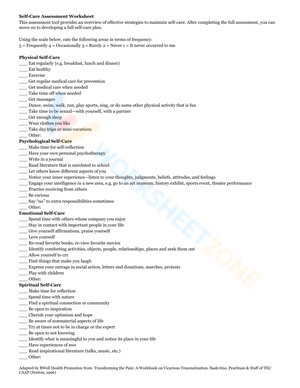
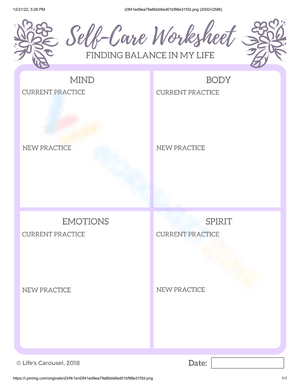
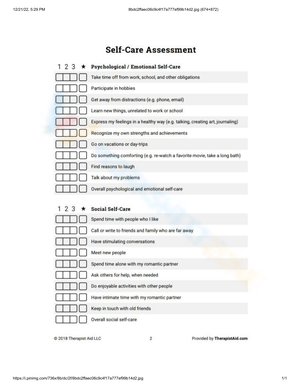
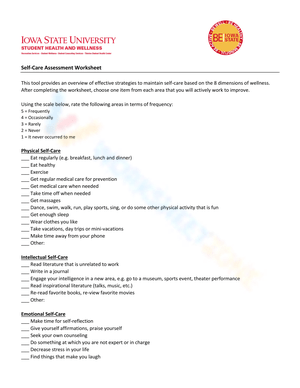
The set covers four core domains: physical well-being, emotional health, social connections, and academic balance. Each area gets its own section rather than being folded into one catch-all rating scale, because a student can score very high on sleep habits and extremely low on emotional regulation — and a combined score would hide that gap entirely.
- Physical well-being: Students track sleep hours, hydration, movement, and meal patterns. Many freshmen are genuinely surprised to discover they're averaging five or six hours of sleep on school nights once they count backward from when they actually put the phone down.
- Emotional health: Each worksheet asks students to name their current stress triggers and describe what they actually do with those feelings — write, talk to someone, distract themselves, or push it down. That last option appears in student responses far more often than most teachers expect.
- Social connections: Prompts move past "do you have friends" into whether those relationships feel draining or restorative. Ninth graders navigating new social hierarchies often need that distinction articulated before they can recognize it in their own lives.
- Academic balance: Students rate their ability to ask for help, break large assignments into smaller pieces, and protect personal time outside school. This is where students who look fine on the surface — high achievers carrying too much — often reveal early warning signs of burnout.
Fitting These Worksheets Into a Real School Week
Advisory periods and homeroom blocks are the most natural fit. Each worksheet takes roughly twelve to fifteen minutes to complete thoughtfully, which fits cleanly into the advisory window most schools already protect. Health class is an obvious second home, especially when paired with a brief lesson on the stress-sleep-performance connection — students engage more seriously with the physical well-being questions when they understand the biology behind sleep deprivation's effect on memory consolidation.
One classroom practice worth adopting: introduce the first worksheet in late September rather than the opening week of school. Students who complete it during day three of ninth grade don't yet know what their workload actually feels like. By late September, they have four weeks of data living in their bodies — first exams, first late nights, first times they skipped lunch to finish an assignment. The assessment means something different when students have that context behind them. Running the set again in January and in May gives students a genuine before-and-after picture of how their habits shift across the year.
When distributing the worksheets, tell students plainly that these will not be graded and will not be read by anyone unless they choose to share. Modeling honesty helps: briefly describing a moment when you recognized your own need for rest or social connection — and what you actually did about it — drops the defensiveness that typically greets wellness activities in secondary classrooms.
Patterns in Student Responses Worth Watching For
The most consistent finding: students rate emotional self-care far higher than their descriptions of their coping behaviors actually support. A student who circles "I handle stress well" and then writes "I play games until 2 AM and sleep through first period" is not reading the gap between self-perception and behavior. These worksheets surface that mismatch because the domain-based format asks students to both rate and describe — and descriptions don't lie the way ratings can.
Academic balance prompts reveal a second reliable pattern. High-achieving students, particularly girls in ninth grade, routinely underreport academic stress in the rating sections but write significantly more in open-response prompts when given space to explain. What looks like a 4 out of 5 on "I manage my workload well" is often followed by a written description of someone doing everything themselves, refusing to ask for help, and staying up past midnight regularly. These worksheets help teachers and counselors identify the students who present as fine but are functioning at a pace that won't hold.
Standard Alignment
These worksheets align directly with the CASEL framework's core competencies of Self-Awareness and Self-Management. Completing each worksheet is an applied exercise in Self-Awareness: students identify their emotions, articulate their stress patterns, and compare their habits against what they know supports their well-being. The follow-up goal-setting component shifts the work into Self-Management territory, where students practice regulating responses, building routines, and developing the internal accountability that CASEL describes as central to social-emotional development. Most state health education standards at the ninth-grade level include wellness benchmarks around identifying personal health behaviors and setting measurable goals — this set addresses both within a single activity structure.
Adjusting the Set for Students at Different Starting Points
Self care assessment worksheets printable for 9th grade work across a range of readiness levels without heavy modification, but a few deliberate adjustments increase their reach. For students who struggle with open-ended reflection — often English language learners or students with language processing challenges — reduce the written prompts to sentence frames: "When I feel stressed, I usually ___. One thing I could try instead is ___." That structured sentence frame removes the blank-page freeze without removing the cognitive work of self-reflection.
For students who are already self-aware and looking for something beyond the baseline prompts, add a goal-tracking component where they commit to one specific behavior change, record it daily for two weeks, and return to a brief written reflection comparing what they predicted against what actually happened. Ninth graders who are academically motivated tend to engage seriously with anything that looks like data collection. Students dealing with significant stress or mental health concerns may find some prompts activating rather than reflective — having a counselor available the same period students complete the worksheets is a reasonable precaution, particularly in schools where the student population has experienced elevated trauma.
Frequently Asked Questions
Do these worksheets only work in health or advisory, or can core academic teachers use them too?
They work in both settings. An English teacher can use the emotional health prompts to front-load a personal narrative unit — students who have just written about their actual stress patterns have significantly more to draw on. A biology teacher covering the nervous system can use the physical well-being section to make the science of sleep and stress feel personal. The self care assessment worksheets printable for 9th grade are not inherently a health-class tool; they're a reflection tool that can serve almost any teacher who builds ten minutes of space for it.
What's the right way to handle a student who discloses something serious on a worksheet?
Before distributing any wellness-related worksheet, clarify your mandatory reporting obligations with your school counselor or administrator and communicate your school's protocol to students in advance. Tell students explicitly: most of what you write stays private, but if something you share suggests you or someone else might be in danger, you'll be asked to speak with a counselor. That transparency isn't a deterrent — it's the honest version of safety, and students respond to it as such.
Can a counselor use these in a small-group setting rather than a whole-class assignment?
Yes, and in some cases that setting works better. Small counseling groups allow for richer discussion after the written reflection is complete, and students in that context have often already opted into a degree of self-disclosure that makes the prompts feel less abrupt. The self care assessment worksheets printable for 9th grade translate easily into a four-session series: one domain per session, each worksheet completed individually first and then discussed as a group at whatever depth the group is ready for.
How can teachers protect student privacy while still following up appropriately on what students write?
A practical approach: ask students to place a colored dot sticker or a simple checkmark on the front of their worksheet if they'd like a private conversation with you or the counselor about something they noticed. This keeps the worksheet private but gives students a low-stakes way to signal that they want follow-up — without having to say so out loud in a room full of their peers.












 Interactive Worksheet Maker
 Quiz Maker
 Word Search Maker
 Crossword Puzzle Maker
 Word Scramble Generator
 Sentence Scramble Generator
 Handwriting Worksheet Generator
 Name Tracing Generator
 Fill In The Blank Generator