


























Views
Downloads

Reflection Across Axes Worksheet | Grade 8 Printable
Paste this activity's link or code into your existing LMS (Google Classroom, Canvas, Teams, Schoology, Moodle, etc.).
Students can open and work on the activity right away, with no student login required.
You'll still be able to track student progress and results from your teacher account.
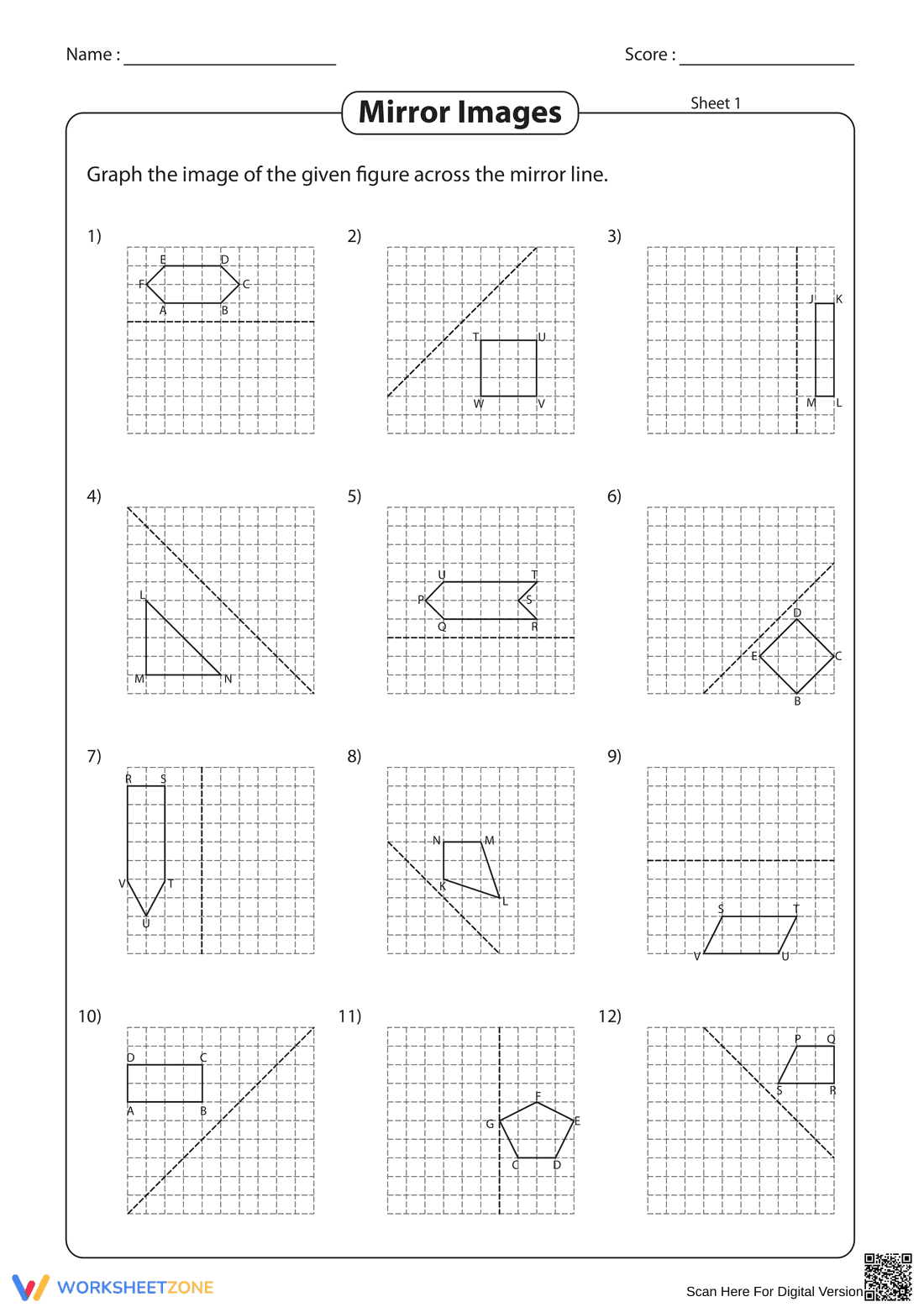
This Grade 8 geometry worksheet provides focused practice on graphing reflections across a mirror line. Students will analyze twelve distinct polygons on grid paper and accurately draw their reflected images. This targeted exercise builds spatial reasoning and foundational transformation skills required for advanced high school mathematics.
At a Glance
- Grade: 8 · Subject: Math
- Standard:
CCSS.MATH.CONTENT.8.G.A.3— Graph reflected images of polygons across a line- Skill Focus: Geometric Reflections
- Format: 1 page · 12 problems · Answer key included · PDF
- Best For: Independent practice
- Time: 15–20 minutes
This single-page resource features twelve coordinate grid problems. Each task presents a pre-drawn geometric figure, such as a triangle, rectangle, or irregular polygon, alongside a dashed mirror line. The mirror lines vary in orientation, including vertical, horizontal, and diagonal axes, challenging students to apply reflection rules dynamically. A complete answer key is provided to facilitate quick grading and immediate feedback.
Zero-Prep Workflow
- Print (1 minute): Generate copies of the single-page PDF for the entire class.
- Distribute (1 minute): Hand out the worksheets alongside rulers or straightedges for precise graphing.
- Review (3 minutes): Use the included answer key to quickly verify student accuracy or project it for self-correction.
Total teacher preparation requires under two minutes. The straightforward instructions make this an excellent resource for emergency sub plans or independent math centers.
Aligned to CCSS.MATH.CONTENT.8.G.A.3: Describe the effect of dilations, translations, rotations, and reflections on two-dimensional figures using coordinates. This worksheet specifically targets the visual and spatial execution of reflections before moving to coordinate mapping. Both standard codes can be copied directly into lesson plans, IEP goals, or district curriculum mapping tools.
Deploy this worksheet immediately following direct instruction on geometric transformations to reinforce the concept of mirror images. Alternatively, assign it as a focused homework task to maintain skill retention. While students work, observe whether they count grid units perpendicularly from the mirror line to each vertex; this serves as a quick formative assessment of their spatial understanding. Expect completion within fifteen to twenty minutes.
This resource is designed for eighth-grade math students mastering initial transformation concepts. It also serves as an effective review tool for high school geometry students needing foundational reinforcement. For students requiring additional support, pair this worksheet with a transparent mirror tool or patty paper to physically model the reflection process before drawing.
Mastering geometric transformations, specifically the ability to graph reflected images of polygons across a line, is a critical component of middle school mathematics. Alignment with CCSS.MATH.CONTENT.8.G.A.3 ensures students develop the spatial reasoning necessary for higher-level geometry and calculus. According to a recent EdReports 2024 analysis of middle school math curricula, students who engage in repeated, visual practice with transformations demonstrate a significantly higher retention rate of geometric properties compared to those who only memorize coordinate rules. Providing structured tasks where students physically count units and plot reflected vertices solidifies their conceptual understanding of congruence and symmetry. This targeted practice bridges the gap between abstract algebraic rules and concrete visual representation, ultimately fostering greater mathematical fluency and confidence in spatial problem-solving environments.


