


























Views
Downloads

Coordinate Reflections Worksheet | Grade 8 Essential
Paste this activity's link or code into your existing LMS (Google Classroom, Canvas, Teams, Schoology, Moodle, etc.).
Students can open and work on the activity right away, with no student login required.
You'll still be able to track student progress and results from your teacher account.
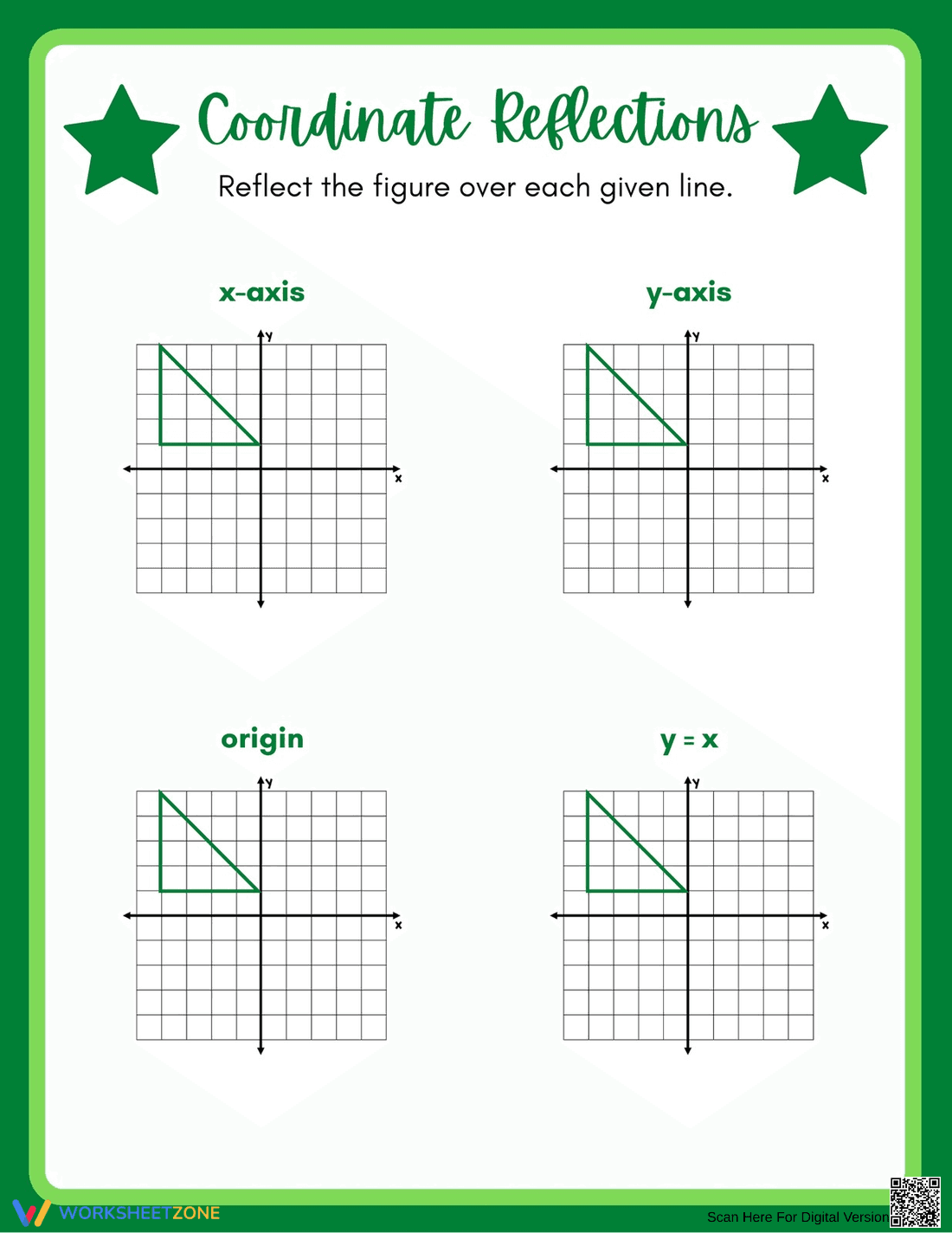
This Grade 8 math worksheet helps students master geometric transformations by reflecting figures across the coordinate plane. Students will apply reflection rules to map a triangle over the x-axis, y-axis, origin, and the line y=x. This targeted practice ensures learners understand how coordinates change during rigid motions to maintain congruence.
At a Glance
- Grade: 8 · Subject: Mathematics
- Standard:
CCSS.MATH.CONTENT.8.G.A.3— Describe the effect of reflections on 2D figures using coordinates- Skill Focus: Coordinate Plane Reflections
- Format: 1 page · 4 problems · Answer key included · PDF
- Best For: Independent practice or formative assessment
- Time: 15–20 minutes
This single-page PDF features four distinct coordinate grids, each containing a pre-drawn right triangle in the second quadrant. Students are tasked with performing reflections across four specific lines: the x-axis, the y-axis, the origin, and the diagonal line y=x. The clear layout provides ample space for students to plot new vertices and draw the resulting image accurately.
Skill Progression
- Guided Practice: Students begin with axial reflections (x and y axes), which involve simple sign changes for one coordinate.
- Supported Practice: The third task introduces reflection through the origin, requiring students to negate both the x and y values.
- Independent Practice: The final challenge involves the line y=x, where students must swap coordinate positions to find the new vertices.
This progression follows a gradual-release model, moving from high-frequency axial flips to more complex diagonal transformations.
Standards Alignment
The primary standard addressed is `CCSS.MATH.CONTENT.8.G.A.3`, which requires students to describe the effect of reflections on two-dimensional figures using coordinates. By physically plotting the reflected points, students internalize the algebraic rules associated with each transformation. This standard code can be copied directly into lesson plans, IEP goals, or district curriculum mapping tools.
How to Use It
Use this worksheet as a mid-lesson check for understanding after introducing the algebraic rules for reflections. Teachers can observe students as they work to identify common misconceptions, such as confusing the x and y axis rules. It is also an excellent exit ticket; expect students to complete all four transformations within 15 to 20 minutes of focused work time.
Who It's For
This resource is designed for 8th-grade math students or high school geometry learners needing a refresher on rigid transformations. It is particularly helpful for visual learners who benefit from seeing the physical flip of the shape. Pair this with a coordinate plane anchor chart or a digital transformation tool for a comprehensive lesson on symmetry.
Geometric transformations serve as a foundational bridge between visual spatial reasoning and algebraic manipulation. According to the RAND AIRS 2024 report on mathematics instruction, providing students with structured coordinate plane tasks significantly improves their ability to internalize abstract mathematical functions. This worksheet specifically targets CCSS.MATH.CONTENT.8.G.A.3, focusing on the skill of reflecting figures across various lines of symmetry. By requiring students to map vertices across the x-axis, y-axis, origin, and the line y=x, the resource reinforces the specific coordinate changes (such as (x, y) to (-x, y)) necessary for mastery. Research indicates that hands-on plotting of these transformations helps solidify the concept of congruence, as students see that the shape's dimensions remain unchanged despite its new orientation. This printable resource provides the exact repetition needed to move from guided instruction to independent fluency in middle school geometry.


