




























Views
Downloads

Reflection across the Axes | Grade 8 Essential Math

Paste this activity's link or code into your existing LMS (Google Classroom, Canvas, Teams, Schoology, Moodle, etc.).
Students can open and work on the activity right away, with no student login required.
You'll still be able to track student progress and results from your teacher account.
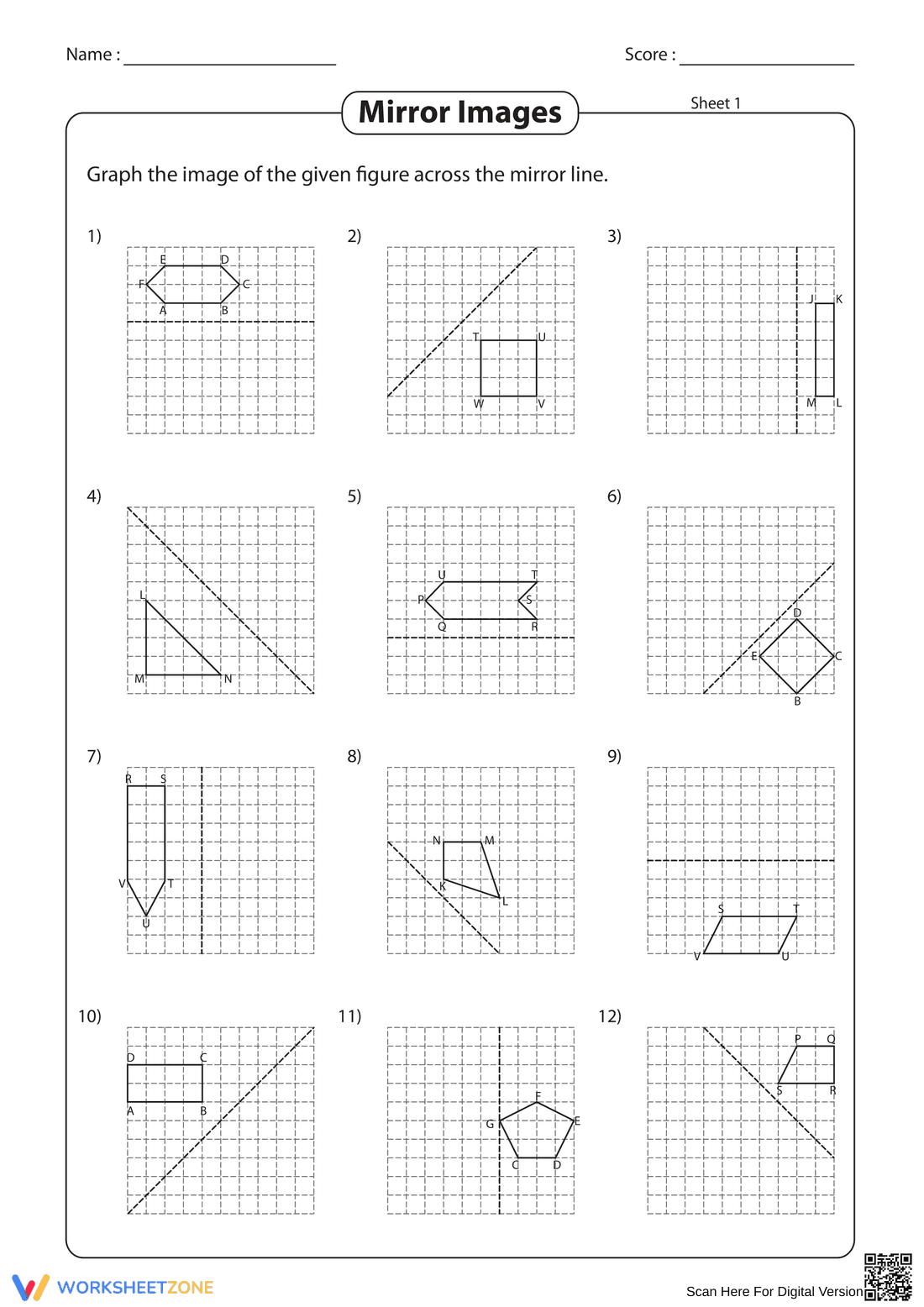
This Grade 8 geometry worksheet helps students master reflections by graphing 2D figures across various mirror lines on a grid. Students develop spatial reasoning and coordinate geometry skills by accurately plotting reflected vertices. It provides immediate practice for identifying transformation properties and maintaining congruence in geometric shapes while reinforcing visual-spatial relationships.
At a Glance
- Grade: 8 · Subject: Geometry
- Standard:
CCSS.MATH.CONTENT.8.G.A.3— Describe the effect of reflections on two-dimensional figures using coordinates- Skill Focus: Reflecting shapes across mirror lines
- Format: 1 page · 12 problems · Answer key included · PDF
- Best For: Independent practice or homework assignments
- Time: 15–25 minutes
This single-page PDF contains 12 distinct graphing tasks. Each problem features a unique polygon—ranging from simple rectangles to complex pentagons—positioned on a grid with a designated dashed mirror line. The worksheet includes horizontal, vertical, and diagonal reflection lines to challenge student understanding. A comprehensive answer key is provided for rapid grading and student self-correction.
Zero-Prep Workflow
- Print: Select the single-page PDF and print enough copies for your class in under 1 minute.
- Distribute: Hand out the sheets as a bell-ringer or independent practice session requiring zero teacher setup.
- Review: Use the included answer key to provide instant feedback or allow students to self-correct their work in less than 5 minutes.
Standards Alignment
The primary focus is `CCSS.MATH.CONTENT.8.G.A.3`, which requires students to describe the effect of reflections on two-dimensional figures. This resource also supports 7.G.A.2 by asking students to draw geometric shapes with given conditions. Both standard codes can be copied directly into lesson plans, IEP goals, or district curriculum mapping tools.
How to Use It
Assign this worksheet during the independent practice phase of a lesson on transformations. It works exceptionally well as a formative assessment after students have learned the rules for reflecting across the x and y axes. Observe if students are counting units from the mirror line or applying coordinate rules to ensure accuracy. Expected completion time is 15 to 25 minutes.
Who It's For
This resource is designed for 8th-grade math students, though it serves as excellent enrichment for 7th graders or review for high school geometry. It is particularly helpful for visual learners who benefit from seeing the physical flip of a shape. Pair this with a coordinate plane anchor chart for maximum instructional support.
According to the RAND AIRS 2024 report, high-quality visual aids in geometry instruction significantly improve student retention of transformation concepts. This worksheet targets CCSS.MATH.CONTENT.8.G.A.3 by requiring students to perform reflections across multiple axes, a foundational skill for understanding congruence and similarity. By engaging with 12 varied problems, students move beyond rote memorization to a functional understanding of how reflections preserve the size and shape of a figure while changing its orientation. Research from Fisher & Frey (2014) emphasizes that independent practice with immediate feedback—facilitated here by the included answer key—is critical for moving students toward mastery of geometric transformations. This resource provides the structured repetition necessary for students to internalize the relationship between a pre-image and its reflected image on a coordinate-style grid, ensuring they are prepared for more complex spatial reasoning tasks in higher-level mathematics.


