


























Views
Downloads

Printable Reflecting in Diagonal Lines Worksheet | Grade 8
Paste this activity's link or code into your existing LMS (Google Classroom, Canvas, Teams, Schoology, Moodle, etc.).
Students can open and work on the activity right away, with no student login required.
You'll still be able to track student progress and results from your teacher account.
Master the complex skill of reflecting geometric shapes across diagonal lines with this comprehensive transformation packet. Students will transition from basic y=x reflections to shifted linear equations, building a deep conceptual understanding of coordinate changes. This resource ensures learners can accurately map vertices and visualize symmetry across non-axial lines of reflection.
At a Glance
- Grade: 8 · Subject: Geometry
- Standard:
8.G.A.3— Describe the effect of reflections on two-dimensional figures using coordinates- Skill Focus: Diagonal Line Reflections
- Format: 5 pages · 18 problems · Answer key included · PDF
- Best For: Geometry transformation units and coordinate mastery
- Time: 45–60 minutes
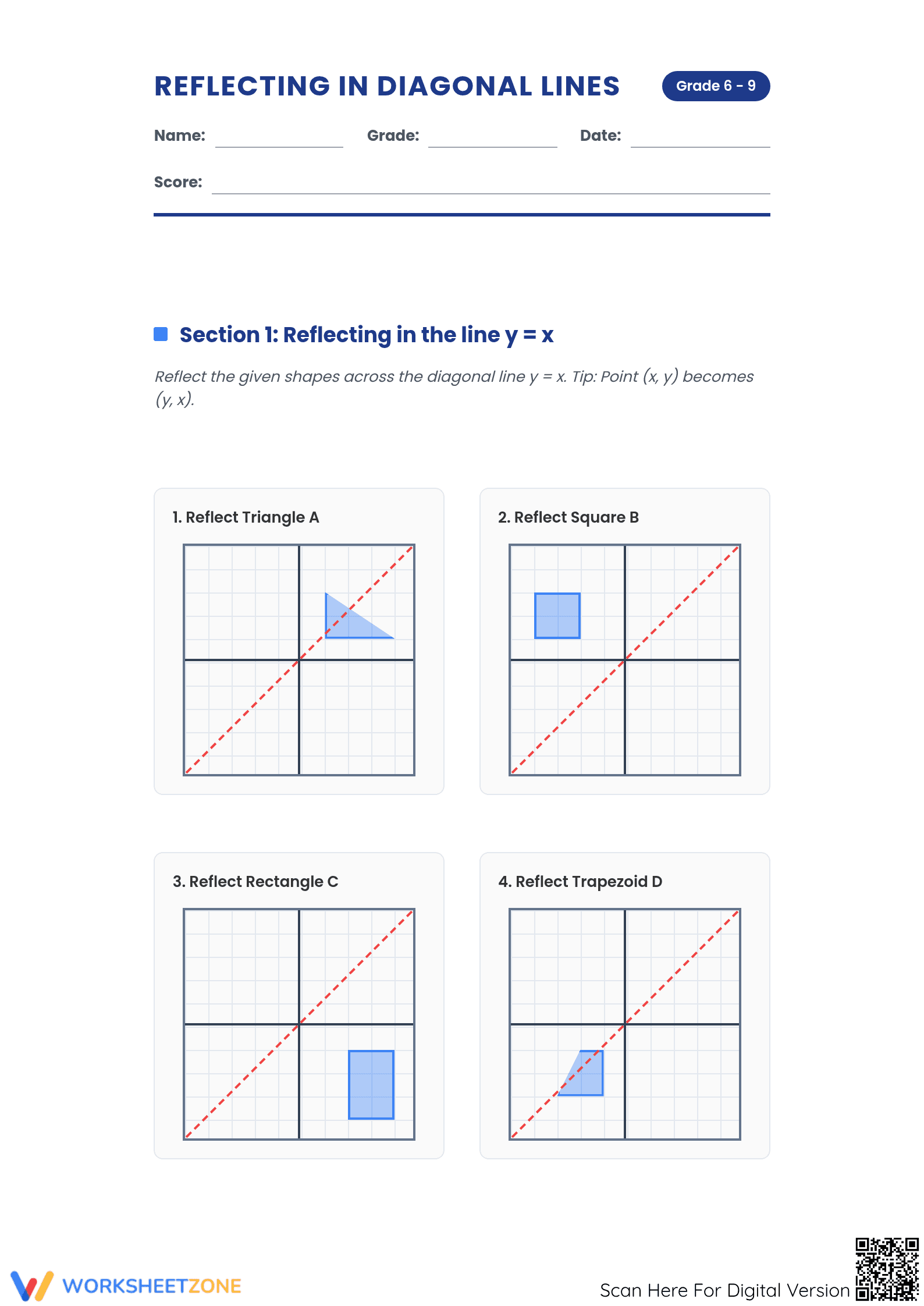
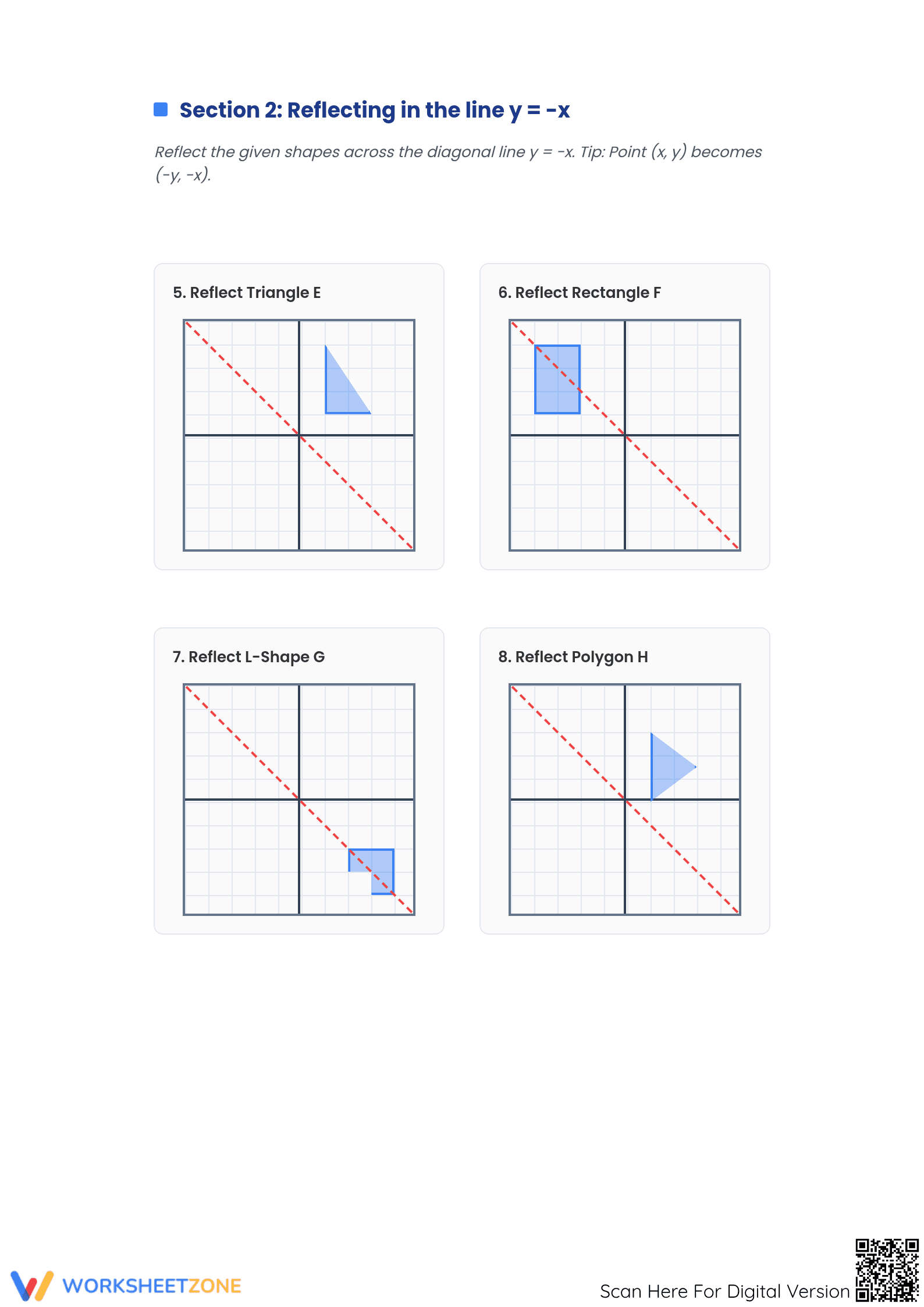
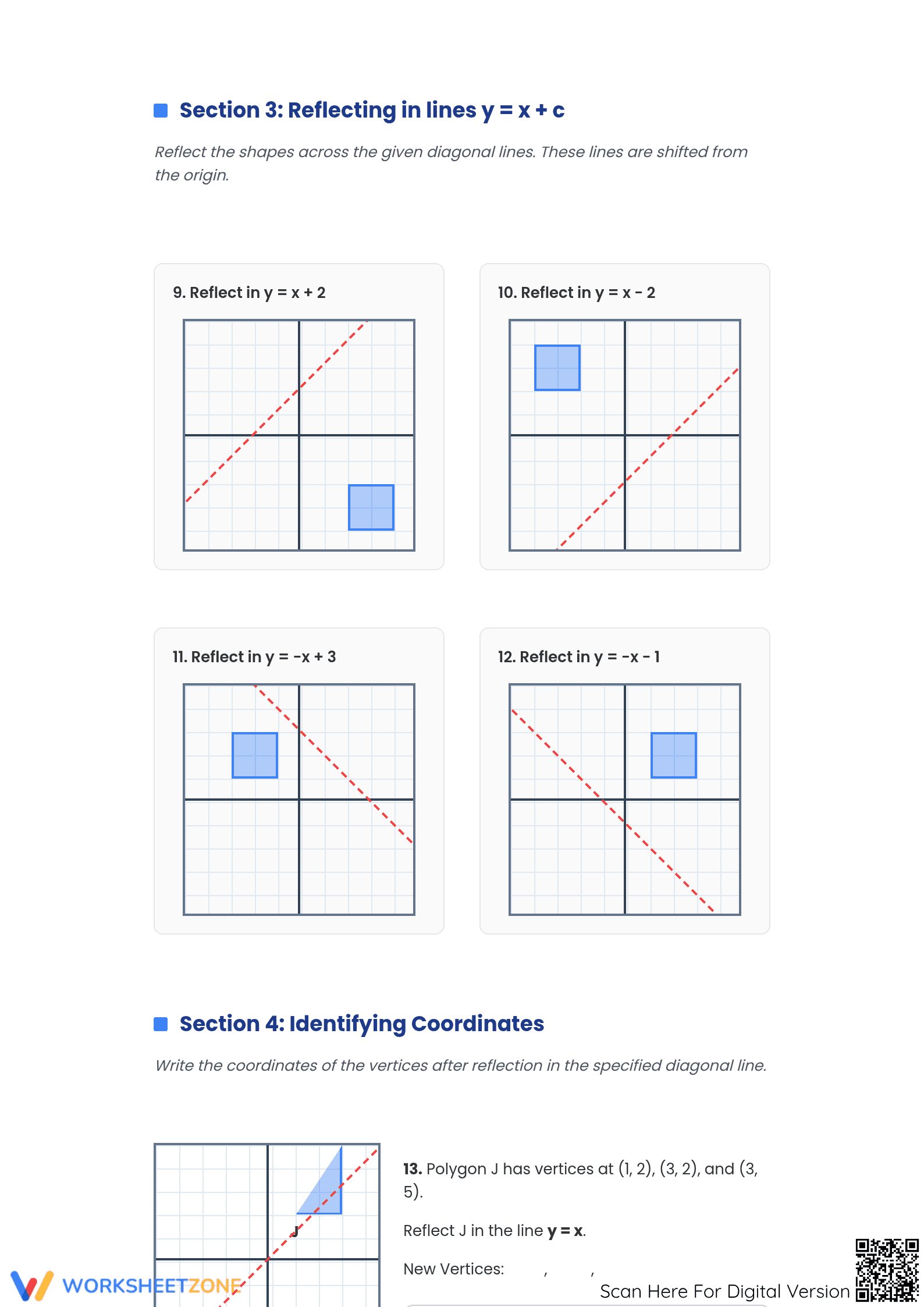
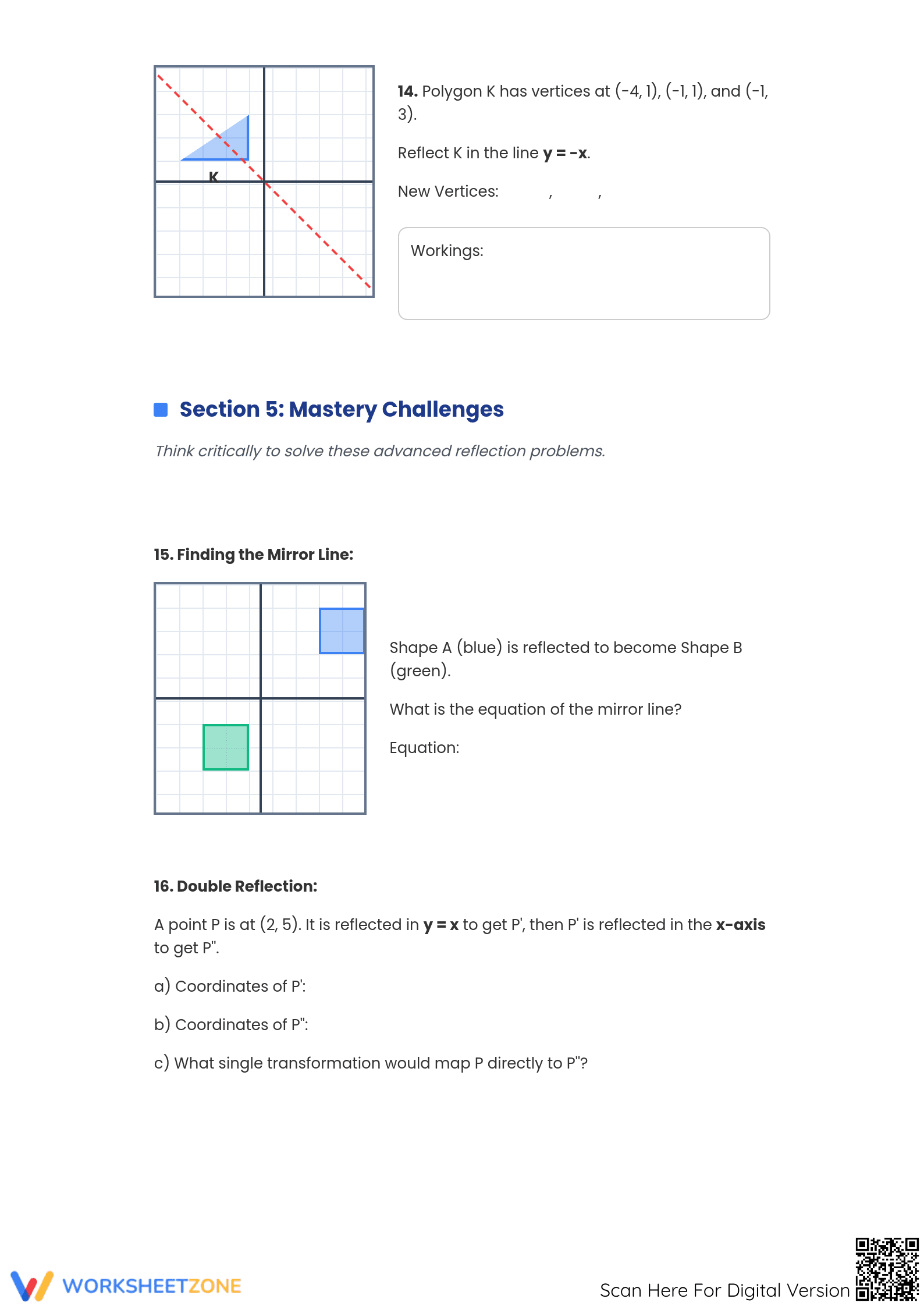
This 5-page PDF contains 18 diverse tasks, including coordinate-plane reflections across y=x and y=-x, reflections across shifted diagonal lines, vertex coordinate identification, and advanced mastery challenges. A complete answer key is provided to facilitate rapid grading or student self-check during independent practice sessions.
- Guided Practice: 8 initial problems introduce reflections across the origin-based diagonal lines (y=x and y=-x), providing vertex mapping tips to scaffold early success for every student.
- Supported Practice: 6 problems challenge students to reflect shapes across shifted lines such as y=x+2 and identify new vertex coordinates without immediate visual prompts or tip boxes.
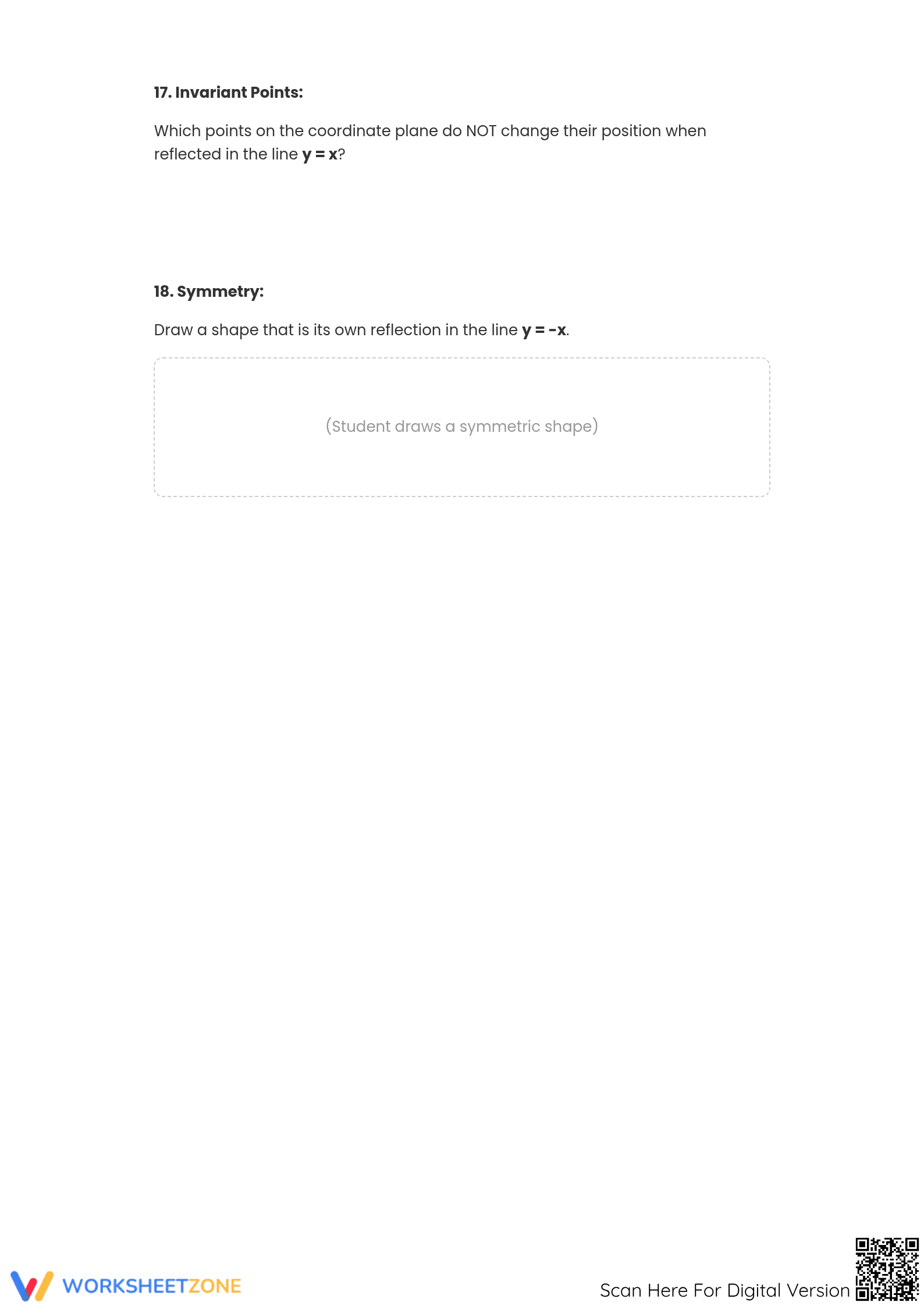
- Independent Practice: 4 mastery challenges require higher-order thinking, including finding mirror equations, performing double reflections, and identifying invariant points on the coordinate plane.
The packet follows a rigorous gradual-release model, moving from visual mapping on a grid to abstract coordinate manipulation required for high school geometry readiness.
This resource is strictly aligned to 8.G.A.3, which requires students to describe the effect of reflections on 2D figures using coordinates. By focusing on diagonal lines, it extends standard axial reflection skills to meet rigorous benchmarks for geometric transformations. This standard code can be copied directly into lesson plans, IEP goals, or district curriculum mapping tools.
Assign this packet as a core practice activity during your transformations unit after students have mastered reflections across the x and y axes. Use the "Mastery Challenges" on the final pages as a formative assessment to identify students ready for advanced geometric concepts. Expect completion within a 45-60 minute instructional block.
Designed for Grade 8 geometry students and high schoolers reviewing coordinate geometry basics. It is ideal for general education classrooms, small group intervention, or as a robust resource for students needing targeted practice with non-axial transformations. Pair this with a coordinate plane anchor chart to provide students with a natural pairing resource during the initial guided practice phase.
According to the RAND AIRS 2024 report on mathematical competency, student success in high-school algebra is strongly correlated with early mastery of coordinate plane transformations and linear relationships. This worksheet addresses the specific skill of diagonal reflection, which requires students to simultaneously manipulate both x and y coordinates according to linear rules. By moving from visual grids to abstract coordinate identification, the resource supports the development of spatial reasoning and mathematical fluency. Research by Fisher & Frey (2014) emphasizes that the gradual release of responsibility—moving from guided tips to independent mastery challenges—is essential for internalizing complex geometric properties. This standards-aligned resource provides the structured repetition and conceptual depth needed for students to confidently describe the effects of reflections as outlined in standard 8.G.A.3, ensuring they are prepared for higher-level spatial analysis in subsequent math courses.


