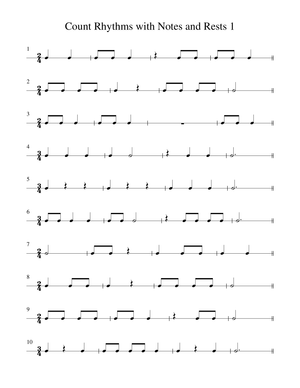
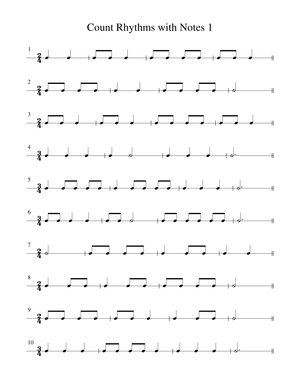
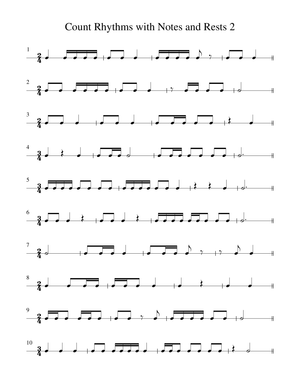
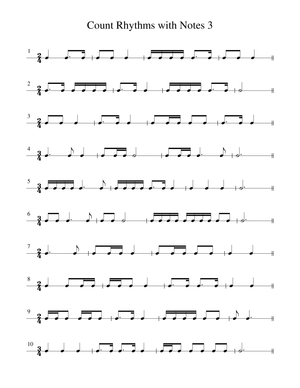
7th Grade Rhythm worksheets for Classroom Practice
These 7th grade rhythm worksheets resources give music teachers a printable set that moves well past note-name identification and into the counting problems that actually reveal whether students understand meter. Each worksheet targets a defined skill — time signature reading, dotted-note value calculation, syncopation, rest placement, or error correction — rather than mixing every element together on one undifferentiated worksheet.
The Specific Skills Targeted
Seventh graders arrive with uneven backgrounds. Some can clap a steady quarter-note pulse but stall completely on a dotted quarter followed by an eighth. Others know the symbol names cold and still miscount in 6/8. The set addresses that range directly. Across the worksheets, students:
- identify and write note and rest values inside complete measures, not as isolated symbols
- sort rhythms by meter, count beats per measure, and correct measures with too many or too few beats
- calculate the total value of dotted figures and distinguish ties from slurs in written examples
- count off-beat syncopated entrances and annotate where the accent falls against the steady pulse
- locate notation errors in a written measure, recount, and rewrite the corrected version
- write a short rhythm satisfying a given meter, beat count, or stylistic constraint
That last task — the short composition — separates this kind of practice from rote identification. A student who can produce a four-beat syncopated figure in 4/4 and explain why it holds together has internalized the relationship between pulse and duration in a way that circling correct answers never quite reveals.
Mistakes Students Make That These Worksheets Help You Catch
The most persistent error in seventh grade rhythm work is not misidentifying note values — students can usually name them. The trouble surfaces when they have to combine values inside a measure. A student who knows that a dotted quarter lasts one and a half beats will still write a dotted quarter plus a quarter in 3/4 and not notice the measure is overfull. They count the dotted quarter as one beat — treating it as a regular quarter with a cosmetic dot — then add the quarter as one more, arrive at two, and feel certain they are correct.
Tied notes produce a separate stumbling point. Many students understand that a tie connects two noteheads of the same pitch, but they subtract duration instead of adding it. They see a half note tied to a quarter and write the value as one beat rather than three. This error appears repeatedly in the error-analysis tasks, and it is most visible there because students must recount in writing and show each step — the skipped reasoning becomes impossible to hide.
Syncopation creates a third category. Students who can clap a steady pulse often lose it entirely when an off-beat accent pushes against the beat, either flattening the syncopation into even quarter notes or inserting rests where none belong. Having students mark subdivision numbers directly on the worksheet before they attempt to clap the pattern reduces this significantly. The visual anchor slows the impulsive guess.
Fitting These Worksheets Into Your Weekly Routine
The most effective use is short and repeated, not long and occasional. A single rhythm worksheet used for ten minutes as a Monday warm-up — projected, worked through together, marked directly on the worksheet, then collected — gives teachers cleaner information than a thirty-minute packet assigned on Friday. The physical worksheet matters here: students can draw beat lines between notes, box tied figures, and circle the syncopated entrance, producing written evidence of their thinking rather than just a circled final answer. That evidence is what makes the format useful for formative purposes.
Station work is another strong fit. One group claps through the patterns on a worksheet while another completes the written version independently and a third peer-checks answers from a previously completed worksheet. That rotation keeps the room active while giving one group the quiet focus the written format supports. Study.com notes that rhythm instruction produces stronger retention when students combine written tasks with active performance — the station structure builds both into the same class period without requiring extra planning. Used consistently across warm-ups and quick check-ins, a 7th grade rhythm worksheets set produces the kind of visible student thinking that helps teachers decide what to revisit before the next rehearsal.
For substitute days, each worksheet holds up without live modeling. The directions carry enough context that a non-music sub can distribute, monitor, and collect without needing to demonstrate anything. That is a practical value worth naming because seventh-grade music sub plans rarely go smoothly otherwise.
Standard Alignment
These worksheets align with MU:Pr4.2.8, the middle school standard asking students to analyze and interpret structure and rhythmic context in varied musical works in preparation for performance. They also connect to MU:Re7.1, which asks students to select and describe music using accurate musical language, including rhythmic terminology. In classroom terms, both standards frame rhythm reading as something in service of performance and musical analysis rather than notation as an end in itself. The error-analysis and short composition tasks address both simultaneously: students must identify what they observe, explain whether the notation is correct and why, and produce their own rhythm that reflects that reasoning.
Adjusting the Set for Mixed-Readiness Seventh Graders
Grade 7 music classes frequently include students across a wide span — some with four years of instrumental lessons who find basic beat-counting insulting, and others encountering rhythmic notation formally for the first time. The worksheets support both without requiring separate preparation for each group.
For students who need more structure, the adjustments are quick and practical. Pre-mark beat numbers beneath the first measure as a model. Limit how many items they attempt in one sitting so the goal stays accuracy rather than coverage. Have them count aloud with the group before independent practice begins. These additions keep the same skill objective in place without reducing the thinking the task requires.
For students ready to move further, the extension involves a different kind of thinking rather than more of the same problems. Ask them to write two measures with identical total beat counts but contrasting note combinations. Ask them to locate a syncopated figure in a recording, notate it, and compare it in writing to the worksheet example. The 7th grade rhythm worksheets format makes this manageable in a mixed classroom because extension students are still working on the same worksheet as their peers — the teacher adds a verbal or written prompt rather than distributing a separate resource entirely.
Frequently Asked Questions
What rhythm concepts does this set cover?
Note values, rests, time signatures, meter, dotted rhythms, ties, syncopation, error analysis, and short composition. Each worksheet focuses on one primary skill rather than combining all elements, which lets teachers match the resource to whatever concept they are currently addressing in class.
Do these work for students who do not play instruments?
Yes. The tasks involve reading, counting, writing, and annotating — not reading notation for a specific instrument. A student in a general music class and a student in band can work through the same worksheet. The error-analysis tasks are especially useful in general music settings where sustained performance practice is limited.
How long does each worksheet take to complete?
Most students finish in ten to fifteen minutes, which keeps each worksheet practical for warm-ups, station rotations, and exit tickets without cutting into rehearsal time. Students who finish early can tackle extension prompts; students who need more time can work through fewer items at full accuracy rather than rushing.
Can these be used for formative assessment?
The error-analysis and composition worksheets function well as formative assessment because students must show their counting reasoning in writing rather than selecting a multiple-choice answer. A 7th grade rhythm worksheets set used consistently across warm-ups and quick checks builds a running record of individual student understanding, which makes instructional decisions — and eventual summative assessments — easier to justify.
Clear All