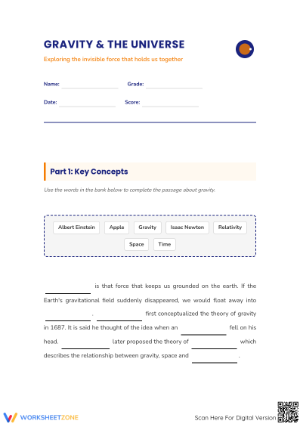
These 7th grade energy sound and light worksheets resources give middle school science teachers focused, printable practice on wave behavior — the kind that moves past recall and into applied explanation. The set targets sound energy, light energy, and the properties that govern how each interacts with matter, in a format ready for direct instruction support, station rotations, homework, and unit review.
What's Inside the Set
Each worksheet in a strong 7th grade energy sound and light worksheets set stays close to the concepts that return again and again in 7th grade physical science. The topics are specific enough to be useful and wide enough to carry a full unit:
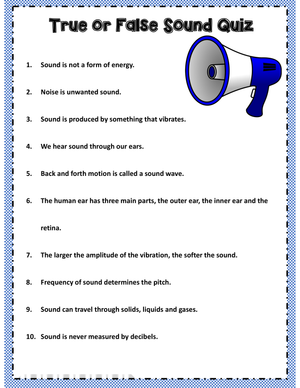
- Vibrations and sound production: students identify that sound begins with a vibrating object and moves as a mechanical wave through a medium.
- Sound through different media: each worksheet in this group asks students to compare how effectively sound travels through solids, liquids, and gases — a distinction teachers return to when explaining why sound cannot travel through a vacuum.
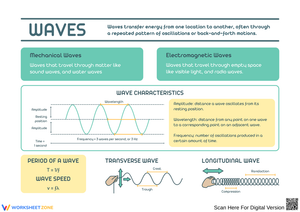
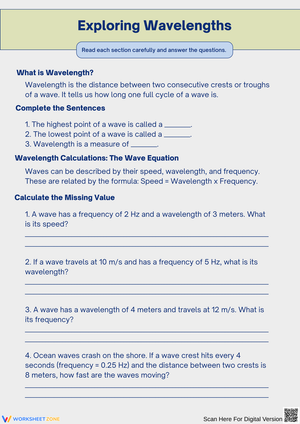
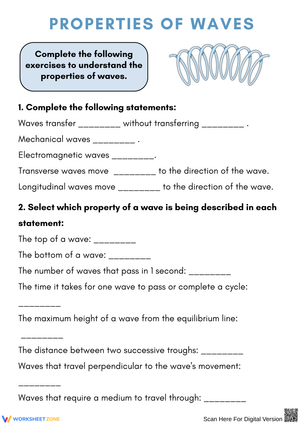
- Wave properties: amplitude, wavelength, and frequency with direct connections to pitch and volume, not just abstract definitions.
- Light behavior: students classify real-world examples as reflection, refraction, absorption, or transmission, then explain the distinction in writing.
- Material classification: sorting tasks for transparent, translucent, and opaque materials, including examples students encounter in lab settings.
- Constructed responses: prompts that ask students to compare both forms of energy and describe what happens when a wave property changes.
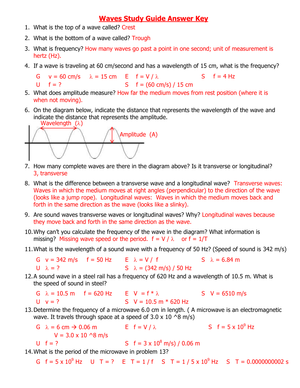
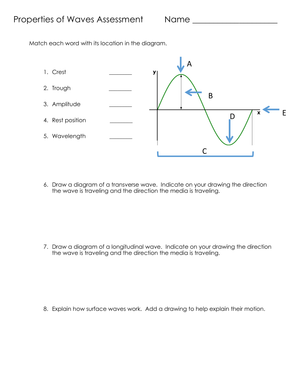
Diagram work appears throughout — labeled wave diagrams for amplitude and wavelength, ray diagrams for light behavior. These earn their place because abstract concepts like refraction become easier to discuss once students have a visual they can annotate and refer back to during writing tasks.
Errors Students Make That These Worksheets Help You Catch
Two errors show up persistently in 7th grade wave units, and both are worth teaching around rather than waiting for the assessment to reveal them.
The first is amplitude-frequency confusion. Students often read a wave diagram and describe a taller wave as having a higher frequency. They are reading visual density rather than counting cycles per unit length. A worksheet that asks students to mark specific wavelengths on two separate diagrams — rather than label features on one — forces them to slow down and apply the definition precisely instead of guessing from the image.
The second is treating reflection and refraction as near-synonyms. Students know both words involve light and a surface, so they use them interchangeably until the distinction is made concrete. Worksheets that pair a scenario ("a straw appears bent in a glass of water") with three answer choices and then ask students to explain in writing why the other two are wrong surface this confusion more reliably than matching tasks alone.
A smaller but consistent error: students write that light is "blocked" by opaque materials rather than absorbed. The phrasing matters. "Blocked" implies the light hits a barrier and stops, while "absorbed" places the event correctly within an energy-transfer frame. Short-answer prompts that require students to use the word absorbed in their response catch this before the misconception solidifies.
Smart Ways to Work These Worksheets Into Your Week
The most effective pattern is spreading individual worksheets across the unit rather than clustering them at the end. A vocabulary worksheet at the start of a sound lesson — completed during the first eight minutes while you take attendance — gives students a low-stakes preview of the terms they will encounter. A diagram worksheet mid-lesson, completed together before students try it independently, keeps the gradual release structure in place without needing a separate graphic organizer.
Station days work especially well with this set. One table handles a sound waves diagram worksheet while another group works through a light behavior sorting task. Because each worksheet is self-contained, the groups do not have to be at the same point in the unit — you assign based on what each group has already been taught, not on where the packet left off.
Sub-plan days are where printable resources prove their value most clearly. A reading comprehension worksheet on how sound travels through different media, paired with four text-dependent questions, runs itself. The 7th grade energy sound and light worksheets format holds diagrams and response spaces intact in a printed copy, which matters when a substitute is managing the room without access to the class presentation.
Standard Alignment
These worksheets connect directly to NGSS MS-PS4-1, which asks students to use mathematical representations to describe a simple model for waves, including how amplitude relates to the energy in a wave. MS-PS4-2 is equally relevant: students develop and use a model to describe how waves are reflected, absorbed, or transmitted through various materials — exactly the terrain the light behavior worksheets cover.
In most 7th grade pacing guides, this unit lands in the second semester after students have worked through matter and energy concepts. That placement matters because students arrive knowing that energy can be transferred but haven't yet formalized the idea that waves are one mechanism for that transfer. These worksheets treat wave vocabulary as a tool for explaining energy behavior rather than an endpoint in itself, which keeps instruction aligned with the spirit of both standards.
Adjusting the Set for Different Student Readiness Levels
For students who need more support, the diagram and labeling worksheets provide the most traction. When a student has a visual reference — a drawn wave with arrows pointing to specific features — they can use the image to self-check their vocabulary application. Pairing those students with one completed example at the top of the worksheet reduces the stall that happens when they do not know how to begin.
For students who move through the standard content quickly, the short-answer and constructed-response worksheets offer real challenge. A prompt like "explain why a higher-amplitude sound wave carries more energy than a lower-amplitude one traveling at the same frequency" requires connecting wave properties to energy transfer — a step beyond what most 7th graders are asked to make explicit. Those students can also write their own scenario question using two vocabulary terms correctly, then trade with a partner to answer.
One honest tradeoff: the diagram worksheets can frustrate students who struggle with spatial reasoning even when they understand the concept verbally. For those students, asking them to describe what they see in writing first — before filling in the diagram labels — often produces better evidence of what they actually know.
Frequently Asked Questions
Do these worksheets work as standalone resources, or do they need to be paired with direct instruction?
Both uses are possible, but the constructed-response and comparison worksheets work better after at least a brief lesson on the relevant concept. The vocabulary and diagram worksheets are accessible enough to serve as previews before instruction, which gives teachers useful formative information about what students already know coming in.
What file format are the resources available in, and can teachers print individual worksheets?
The 7th grade energy sound and light worksheets files are available as individual downloads, so teachers can print a single worksheet for a warm-up or pull the full set for a multi-day review block. PDF format keeps diagrams and response spaces intact regardless of which device or printer is used.
Are answer keys included?
Answer keys are included for vocabulary, matching, and diagram worksheets. For constructed-response items, a sample response with scoring guidance is provided rather than a single correct answer, since explanation quality varies and teachers need to calibrate expectations to their students' writing level.
How long does each worksheet take to complete?
Most worksheets run ten to fifteen minutes for independent completion. The reading comprehension worksheets with four or more questions can extend to twenty minutes. That range fits the most common use cases — bell work, guided practice, and homework — without requiring teachers to cut other parts of the lesson.












 Interactive Worksheet Maker
 Quiz Maker
 Word Search Maker
 Crossword Puzzle Maker
 Word Scramble Generator
 Sentence Scramble Generator
 Handwriting Worksheet Generator
 Name Tracing Generator
 Fill In The Blank Generator