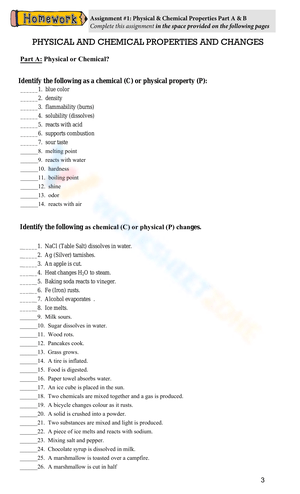
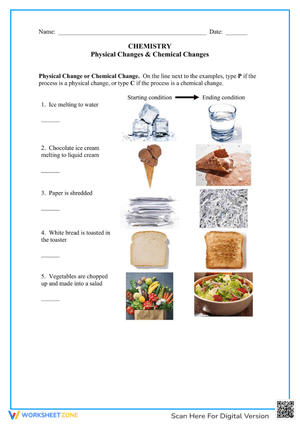
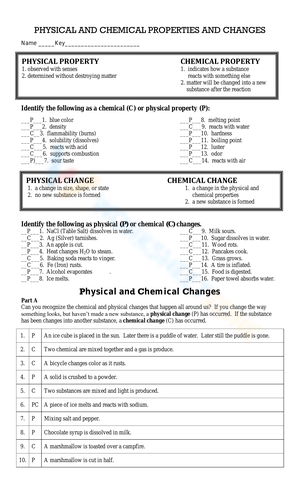
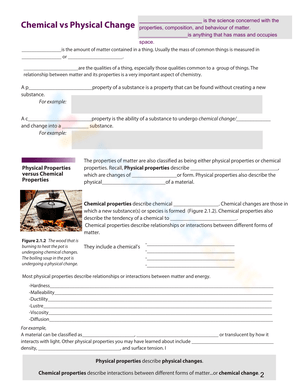
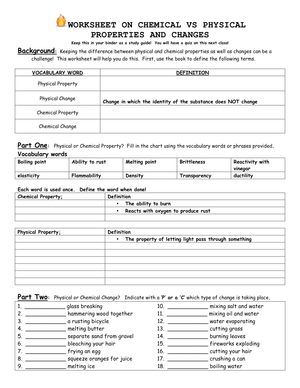
7th Grade Physical and Chemical Changes printable worksheets
These 7th grade physical and chemical changes printable worksheets give teachers ready-to-use practice on one of the trickiest conceptual boundaries in middle school science: the line between a change in form and the creation of an entirely new substance. Each worksheet asks students to identify the type of change, name the evidence that supports their classification, and write a brief justification — rather than guess from appearance. Answer keys include short reasoning notes, not just labels, which keeps grading consistent across multiple class periods.
What the Set Asks Students to Do
The worksheets move students through a deliberate sequence: first classify, then explain. That order matters because recognition does not transfer well on its own. A student who can circle "chemical change" on a multiple-choice item may still write that boiling water creates a new substance on the unit test, because the explanation step was never practiced — the step that requires stating what happened and whether a new substance formed.
Skills covered across the set include:
- Sorting tasks: Students classify examples as physical or chemical changes and record the specific evidence behind each choice.
- Multiple-choice items: Quick recognition checks that also prepare students for the question formats they will see on unit tests.
- Short written explanations: Students name what changed, state whether a new substance formed, and connect the example to the definition in their own words.
- Observation tables: A scenario describes a process — dissolving salt, burning magnesium ribbon, bending copper wire — and students record visible evidence before making their classification.
- Claim-evidence prompts: Students write a claim, cite at least one observation from the scenario, and draw a conclusion about whether a chemical reaction occurred.
Errors Students Make That These Worksheets Help Catch
The most persistent mistake in this unit is treating any dramatic visual change as evidence of a chemical change. Melting ice, boiling water, and dissolving sugar all produce striking changes in appearance, but no new substance forms. Students who are not pushed to ask "what evidence shows a new substance?" keep classifying state changes as reactions. The most reliable fix is repeated exposure to comparison items — one worksheet places a burning candle next to a melting candle and asks students to explain why one is classified differently from the other.
Dissolving trips students up particularly often. Because the solute seems to disappear, many students assume the substance was destroyed, which they read as evidence of a chemical change. A well-built worksheet slows that reasoning down by asking: can you get the original substance back? What do you observe in the liquid? If students can articulate that the salt is still salt — just dispersed — the misconception weakens.
Rusting and cooking are the flip side. Students sometimes resist calling these chemical changes because the transformations happen slowly or look like ordinary wear. The evidence checklist on each worksheet — color change, odor change, gas production, temperature change, formation of a precipitate — gives students something concrete to apply instead of relying on intuition about which changes "look important enough."
Building These Worksheets Into Your Lesson Planning
The sorting worksheets work well as a lesson opener. Ten examples, independent classification, then a partner comparison where pairs explain one disagreement aloud — that sequence takes about twelve minutes and surfaces the misconceptions worth addressing before direct instruction. Follow it with teaching, then return to a second worksheet that adds the explanation column. Students who just classified something and then heard the correct reasoning are much more likely to write a useful explanation than students who encounter the two tasks days apart.
For the 7th grade physical and chemical changes printable worksheets that include observation tables, a natural placement is immediately after a demonstration or lab. Students have just watched a reaction or process; the worksheet gives them structured language to record what they observed and tie it to the concept. Without that step, lab observations tend to stay as general impressions rather than evidence students can put into words.
Exit tickets are easy to pull from this set. Trim an observation table down to three or four scenarios and one explanation prompt — those few items give clear data on who still confuses state changes with reactions and who is ready to move on. The sorting and multiple-choice worksheets also hold up as sub plans, since the directions are self-contained and students do not need lab materials to complete them.
Standard Alignment
These worksheets align with NGSS MS-PS1-2, which asks students to analyze and interpret data on the properties of substances before and after interactions to determine whether a chemical reaction has occurred. In classroom terms, that standard means labeling alone is not enough — students need to use observable evidence to support a claim. The observation tables and claim-evidence prompts address exactly that demand. The sorting tasks and short-answer items build the vocabulary students need before they can fully meet the standard's expectation around analyzing and interpreting data, so the set works across multiple instructional moments rather than only at the end of the unit.
Tailoring the Set for Students at Different Points in Their Understanding
Students who are still building their vocabulary need the evidence list visible while they work. Adding a reference box to the worksheet — with terms like new substance, state change, gas production, precipitate, and temperature change — keeps the focus on reasoning rather than word retrieval. For students who freeze on open-ended prompts, a sentence starter ("This is a chemical change because I observed ___") removes the writing barrier without reducing the science thinking required.
Students who move through classification quickly benefit from the claim-evidence prompts, especially items built around genuinely tricky cases: dissolving, melting metals at high temperatures, or mixing substances without any visible reaction. These students can also be asked to write a counter-explanation — to argue why someone who chose the wrong category might have made that error. That task demands a deeper understanding than just arriving at the right answer. For the 7th grade physical and chemical changes printable worksheets that include observation tables with open rows, advanced students can add their own evidence without being confined to a fixed list.
Frequently Asked Questions
Can these worksheets replace a lab, or do they work alongside one?
They work alongside lab work, not instead of it. A lab shows students what a reaction looks like; the worksheet gives them language to explain what they saw and connect it to the broader concept. Teachers who use the observation tables immediately after a demonstration consistently get more precise student language during the follow-up discussion than teachers who rely on student memory alone.
How do I address the dissolving misconception if students have already written it wrong on an earlier assignment?
Use a worksheet that pairs dissolving with an actual chemical change — vinegar and baking soda works well — and ask students to compare the evidence side by side. The contrast is more effective than re-explaining dissolving in isolation. Once students see that the fizzing produces a gas and that baking soda cannot be recovered by evaporation alone, the distinction becomes concrete rather than just definitional.
Are these worksheets workable for students reading below grade level?
The sorting tasks and observation tables rely more on recognizing scenarios than on reading dense text, which makes them accessible to struggling readers. The short-answer prompts are more linguistically demanding. Teachers can pair those worksheets with a brief whole-class discussion first, or allow students to respond in bullet points rather than full sentences, without changing what the science task actually requires.
Where in a unit do these fit best?
The 7th grade physical and chemical changes printable worksheets in this set work at multiple points across a unit. Use sorting tasks at the start to surface prior knowledge and misconceptions. Use observation tables mid-unit after a demonstration or lab. Use claim-evidence prompts as a formative check before the assessment. The multiple-choice worksheets serve as practice for the test format itself and work equally well during a review block the day before the exam.
Clear All