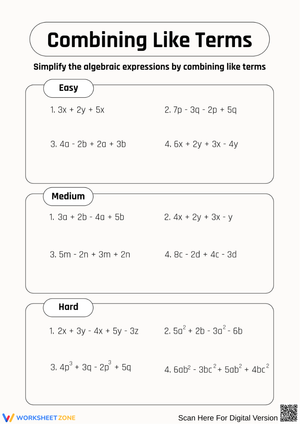
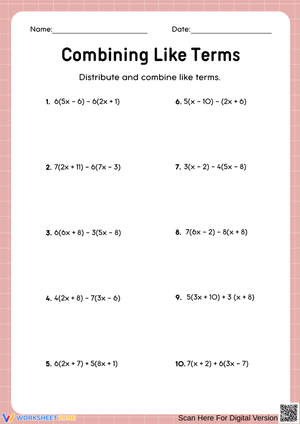
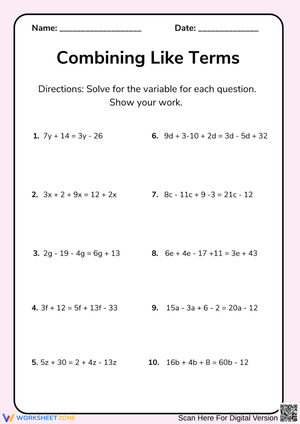
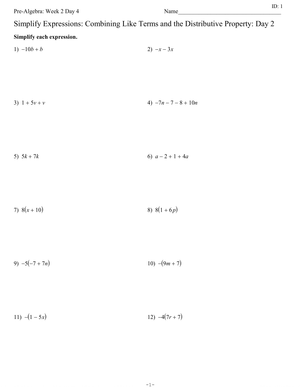
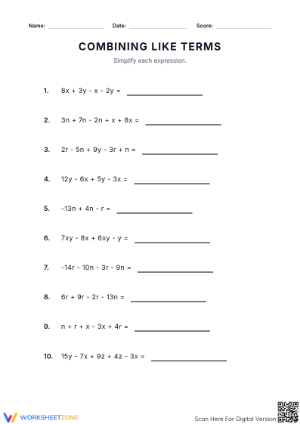
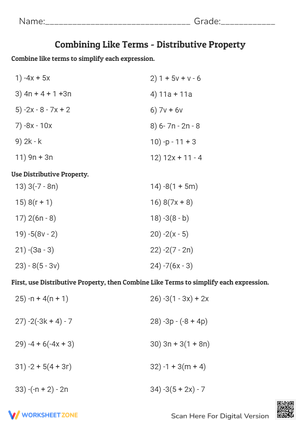
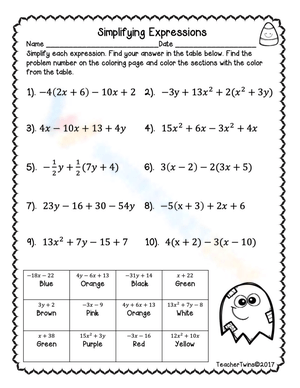
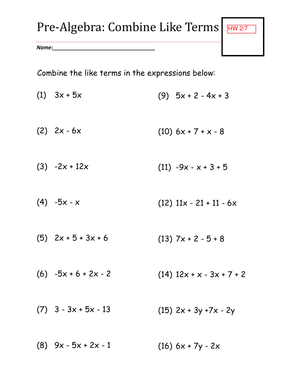
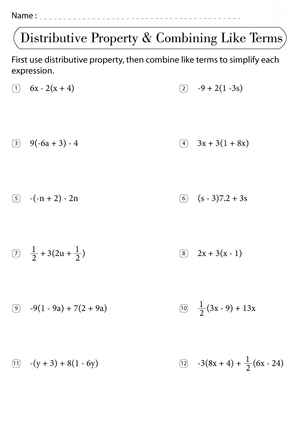
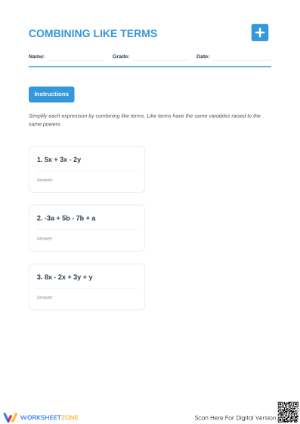
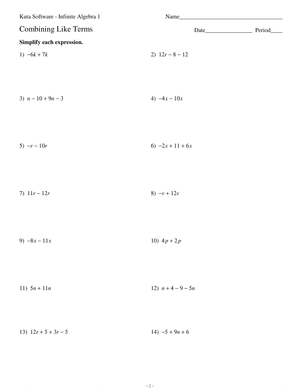
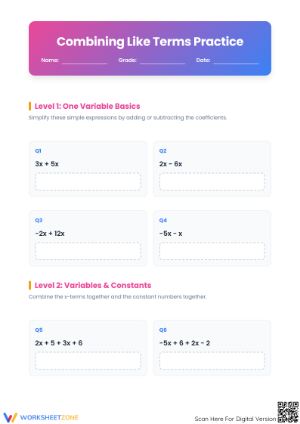
These 7th grade combining like terms worksheets resources give teachers a sequenced set of algebra practice that moves from identifying like terms with integer coefficients to simplifying multi-step expressions involving negatives, multiple variables, and the distributive property. Seventh grade is when students first have to track variable structure, sign management, and expression length all at once — a genuine cognitive step up from the arithmetic work of fifth and sixth grade. Each worksheet stands alone, so teachers can slot any of them into warm-ups, independent work blocks, small-group reteaching, or end-of-unit review without needing to follow a fixed sequence.
The Specific Skills Targeted in Each Worksheet
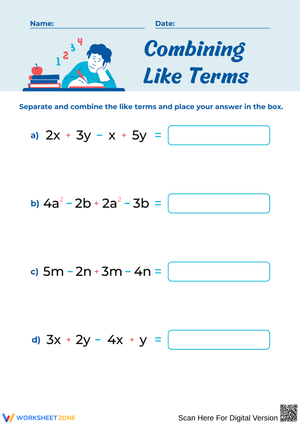
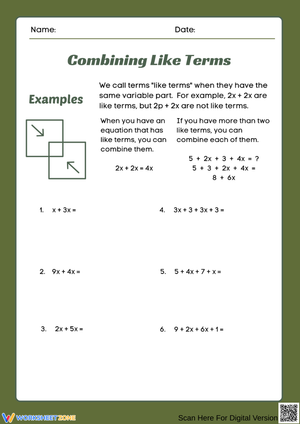
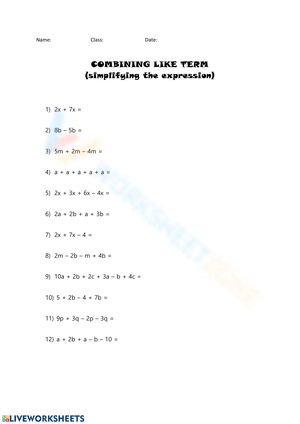
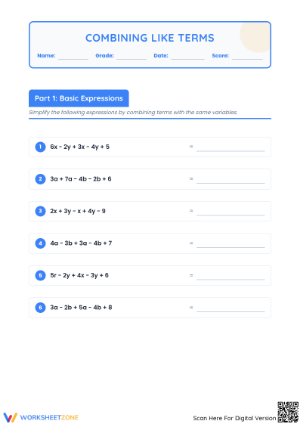
The set spans the full range of what Grade 7 algebra standards require before students move into equation solving. Early worksheets focus on the clearest cases: expressions like 4x + 9x or 6a - 2a, where the variable part is obvious and coefficients are small whole numbers. That entry point matters. Students who struggle later with sign errors often have a gap in how they first learned to read a term — coefficient, variable, exponent — as a unified unit rather than three separate pieces of information.
- Like-term identification: students mark or circle which terms can be combined before touching any arithmetic
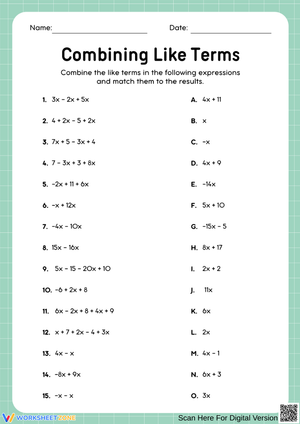
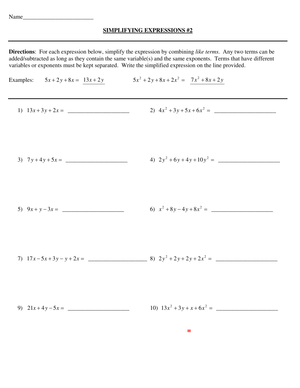
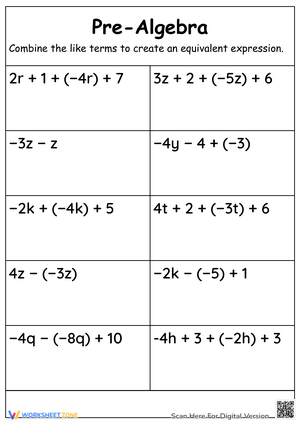
- Integer coefficients: expressions with negative coefficients, such as -3m + 7m - m, where sign tracking is the primary challenge
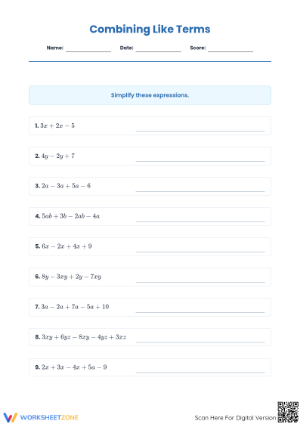
- Multi-variable sorting: expressions that require separating x-terms from y-terms and from standalone constant terms
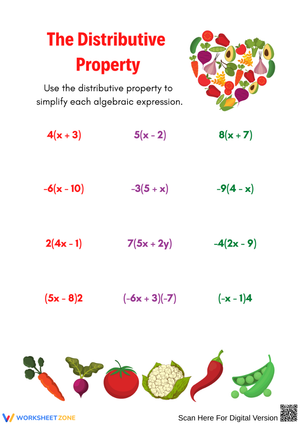
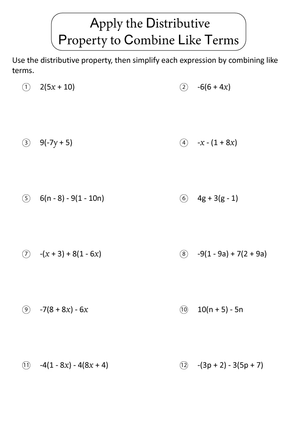
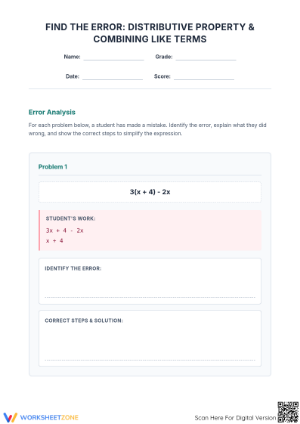
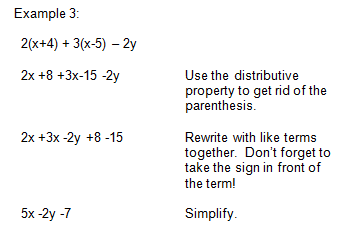
- Parentheses and distribution: problems where students must distribute a factor across a sum before combining
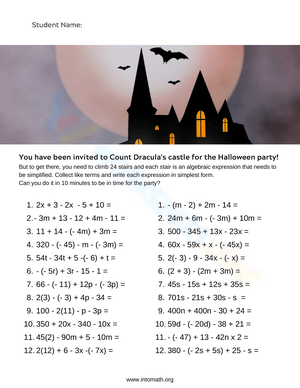
- Mixed review: longer expressions that blend all of the above, with no cue about which operation comes first
The identification tasks are worth assigning before the simplification worksheets, not alongside them. Students who mark like terms before writing any simplified form make noticeably fewer arithmetic errors when they move to the calculation step.
Frequent Errors Worth Catching Early
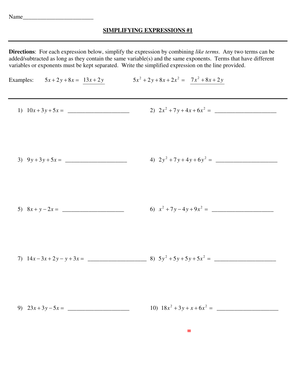
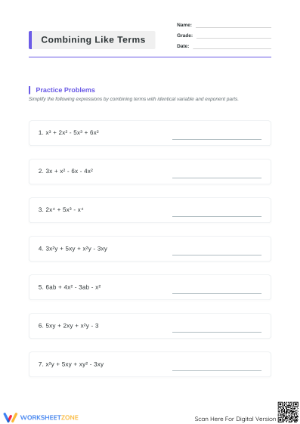
The mistake that derails the most 7th graders is not the one teachers usually anticipate. Sign errors are common, but the more persistent problem is students treating terms with mismatched exponents as like terms. A student who correctly writes 4x + 3x = 7x will sometimes also write 4x + 3x² = 7x without hesitating — dropping the exponent entirely because the variable letter is what anchors their recognition of "like," not the full term. Each worksheet in the set includes mixed-exponent expressions specifically to surface that pattern before it becomes a reflex.
Other errors that appear consistently when students practice this skill:
- Cross-variable combining: students add 5x and 5y because the matching coefficient makes the terms feel equivalent
- Dropped negatives during rewriting: when students copy an expression before simplifying, they frequently lose the negative sign on the second or third term
- Ignored constants: in an expression like 3x + 7 - x + 2, many students correctly arrive at 2x and stop, leaving the 7 and 2 uncombined
- Premature combining: when parentheses appear, some students combine visible like terms before distributing, arriving at a wrong answer that looks organized
A teacher circulating during independent work will spot most of these patterns in the first three minutes of student writing. That immediate diagnostic information is more instructionally useful than a quiz result that confirms something went wrong without identifying what.
How to Build These Worksheets Into Your Lesson Plans
These worksheets fit into daily class time in several ways, none of which require a dedicated full period. The most effective entry point is the five minutes immediately after initial modeling — when students have watched worked examples on the board and need to try the skill before the teacher circulates. Assigning a like-term identification worksheet at that moment, before students jump to simplifying full expressions, reduces the sign errors that appear when students move too quickly from watching to calculating on their own.
For workshop or station-rotation settings, one worksheet works well as a pair-verification task where partners check each step rather than just the final answer. That structure slows down students who rush — typically the same students who drop negative signs — without adding teacher overhead. For reteaching, the integer-coefficient worksheets are strong enough to anchor a small-group session three or four days after initial instruction, which is where spaced return to this skill has the most impact on retention. These 7th grade combining like terms worksheets resources make that spaced return logistically simple because each worksheet is self-contained and requires no setup or prior session to use.
Standard Alignment
These worksheets address CCSS 7.EE.A.1, which requires students to apply properties of operations to add, subtract, factor, and expand linear expressions with rational coefficients. In classroom terms, that standard sits between 6th grade work with numerical expressions and the equation-solving demands of 7.EE.B.4, where students simplify multi-step expressions inside the process of solving real-world problems. Teachers who use a well-sequenced 7th grade combining like terms worksheets set early in the expressions unit are building the procedural fluency those downstream standards depend on — students who are still uncertain about sign handling when combining terms will stall at equation solving because the like-term step becomes an embedded sub-skill rather than the main event.
Adjusting the Set for a Range of Learners
For students who need more support, the most effective adjustment is setting aside the multi-variable and parentheses worksheets until they show accuracy on single-variable integer expressions. The identification worksheets — where students mark like terms without writing a simplified answer — serve as a low-stakes entry point for students who freeze when asked to produce a result. Starting there, then moving to simplification on a second pass through the same expressions, builds procedural confidence without reducing the rigor of the skill.
Students who move quickly through basic expressions benefit most from the mixed-review and distributive property worksheets, where the challenge is deciding what to do first rather than executing a known procedure. A further extension is removing the worked example at the top of a worksheet and asking those students to verify their simplified answer by substituting a number for the variable and confirming both forms are equal. That substitution check requires genuine algebraic reasoning, not just arithmetic speed. These 7th grade combining like terms worksheets resources are flexible enough to serve both ends of that range without requiring separate sourcing for every instructional level in the room.
Frequently Asked Questions
What makes two terms "like" in a 7th grade expression?
Like terms share the same variable raised to the same exponent. The coefficients can be any integers — 7x and -3x are like terms — but the variable part must match exactly. That means 4x and 4x² are unlike terms even though they share the same base variable, a distinction students at this level consistently underestimate until they encounter it explicitly in practice.
How do students correctly handle negative coefficients when combining?
They combine only the coefficients, keeping the variable part unchanged. The practical difficulty is rewriting: when students copy a multi-term expression before simplifying, they often transcribe a negative sign as a subtraction operation between two positive numbers, which is equivalent but introduces ambiguity in longer expressions. Asking students to write each term with its sign explicitly attached — -5x rather than "subtract 5x" — reduces that error on worksheets with three or more terms.
Can these worksheets function as formative assessment?
Yes. Because each worksheet targets a specific layer of the skill — identification only, integer simplification, multi-variable sorting, or distribution — a teacher can assign a short set at the close of a lesson block and read student work to locate exactly where errors are occurring. That's more actionable than a full-class quiz, which confirms that students are wrong without telling you whether the error is a sign issue, an exponent issue, or a sequencing issue.
When in the unit should the parentheses worksheets be introduced?
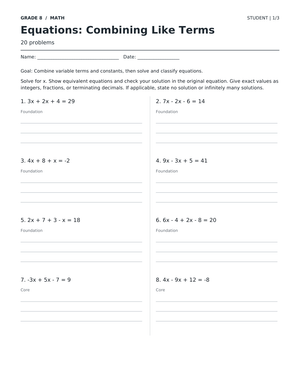
After students show solid accuracy on expressions without grouping symbols — typically three to five class sessions into the unit, depending on pacing. Students introduced to parentheses too early tend to combine what they see before distributing. The distribution worksheets work best as a bridge once simplification with integer coefficients is largely automatic, because at that point the cognitive load of the distribution step doesn't crowd out the like-term work that follows it.













 Interactive Worksheet Maker
 Quiz Maker
 Word Search Maker
 Crossword Puzzle Maker
 Word Scramble Generator
 Sentence Scramble Generator
 Handwriting Worksheet Generator
 Name Tracing Generator
 Fill In The Blank Generator