


























Views
Downloads


Combining Like Terms Worksheet | Grade 7 Printable
Paste this activity's link or code into your existing LMS (Google Classroom, Canvas, Teams, Schoology, Moodle, etc.).
Students can open and work on the activity right away, with no student login required.
You'll still be able to track student progress and results from your teacher account.
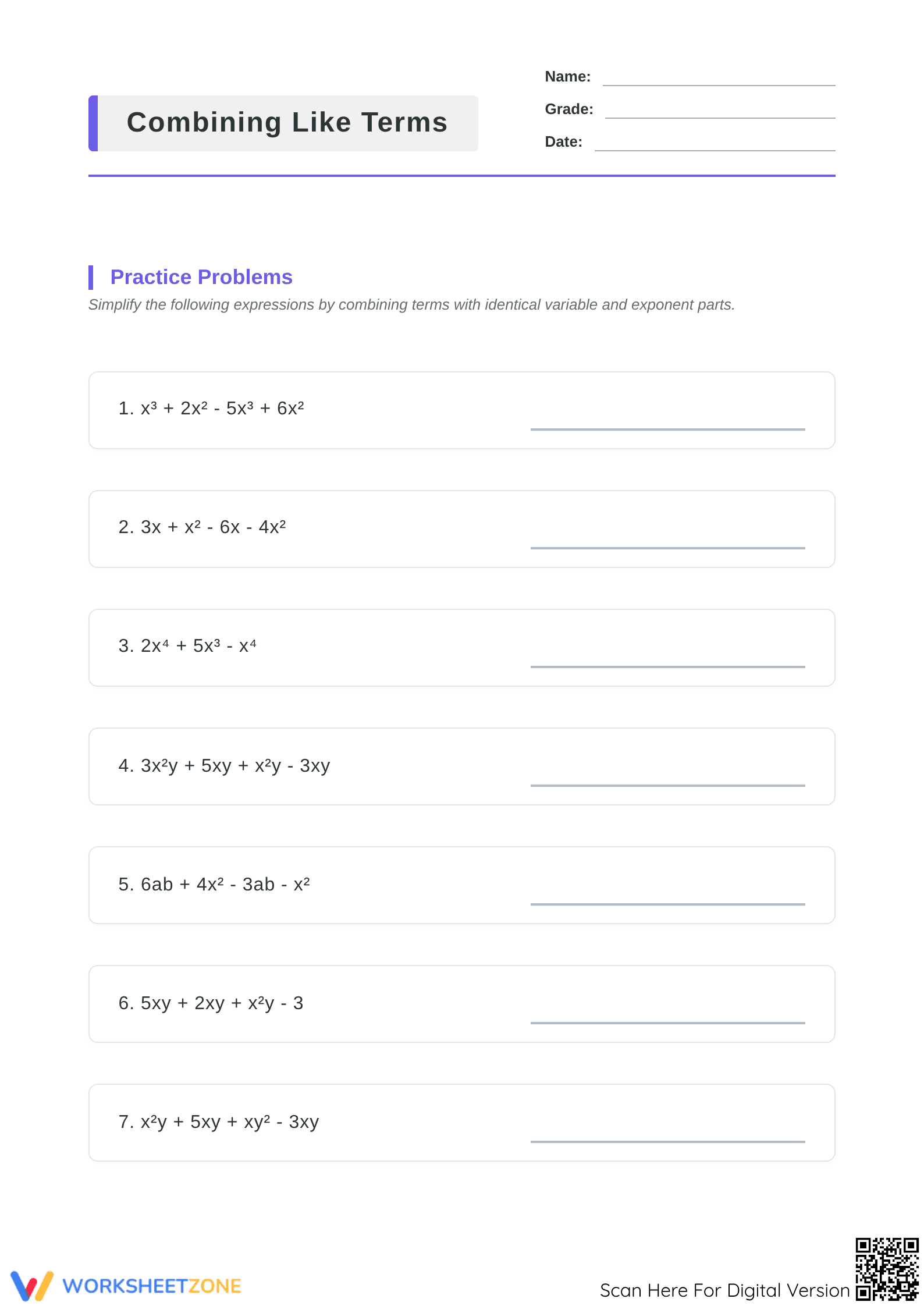
This focused math worksheet helps students master simplifying algebraic expressions by combining like terms. By working through these carefully structured problems, seventh and eighth graders will build the foundational algebra skills necessary for solving complex equations and understanding mathematical properties.
At a Glance
- Grade: 7 · Subject: Math
- Standard:
CCSS.MATH.CONTENT.7.EE.A.1— Apply properties of operations to simplify linear expressions- Skill Focus: Combining Like Terms
- Format: 2 pages · 10 problems · Answer key included · PDF
- Best For: Independent practice
- Time: 15–20 minutes
This two-page resource features a clean, straightforward layout designed to minimize cognitive overload. It includes eight standard practice problems where students must identify and combine terms with identical variables and exponents. Following the main practice section, two bonus challenge problems introduce multiple variables and descending powers to stretch student thinking. A complete answer key is provided for quick grading.
- Guided practice: The first few problems feature simpler expressions with single variables and basic exponents, allowing students to build confidence.
- Supported practice: Middle problems introduce mixed variables and require careful attention to positive and negative signs.
- Independent practice: The final bonus challenges demand higher-order thinking, asking students to handle multiple variables and descending powers carefully.
This gradual-release approach ensures students internalize the rules of algebra before tackling more advanced equations.
This worksheet is directly aligned to CCSS.MATH.CONTENT.7.EE.A.1, requiring students to apply properties of operations as strategies to add, subtract, factor, and expand linear expressions. It also supports eighth-grade review for foundational algebra concepts. Both standard codes can be copied directly into lesson plans, IEP goals, or district curriculum mapping tools.
Deploy this worksheet during the independent practice phase of direct instruction, immediately after modeling how to identify matching variables and exponents. It also serves as an excellent warm-up activity for eighth graders reviewing core concepts before starting linear equations. As a formative assessment tip, watch to see if students remember to include the negative sign when combining subtracted terms, as this is a common point of friction. Expected completion time is 15 to 20 minutes.
This resource is ideal for seventh-grade math students learning introductory algebra, as well as eighth graders needing targeted remediation. For students requiring accommodations, teachers can highlight like terms in different colors before distributing the assignment. Pair this worksheet with a visual anchor chart demonstrating the difference between coefficients and exponents to maximize student success.
Mastering the ability to simplify expressions is a critical stepping stone for all subsequent algebra coursework. According to EdReports 2024, instructional materials that provide focused, distraction-free practice on specific algebraic rules significantly improve long-term retention of mathematical procedures. This resource targets CCSS.MATH.CONTENT.7.EE.A.1, ensuring students can apply properties of operations to simplify linear expressions accurately. By isolating the specific skill of combining like terms, educators can easily identify misconceptions regarding negative signs or exponent rules before moving on to multi-step equations. Structured practice formats like this one reduce cognitive load, allowing learners to concentrate entirely on the mathematical relationships at hand. This targeted approach builds the automaticity required for higher-level mathematics, ensuring students are fully prepared for the rigorous demands of high school algebra and beyond.


