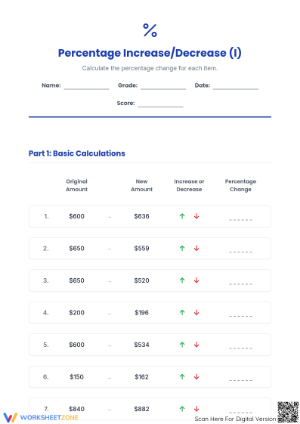
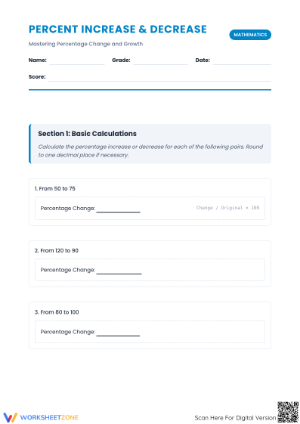
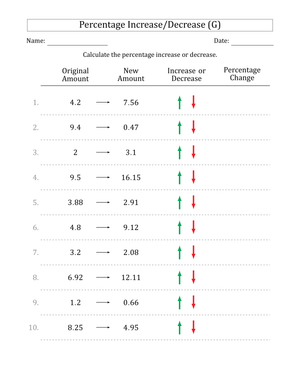
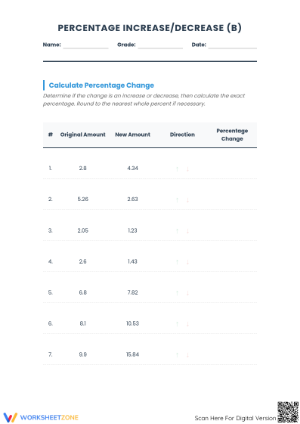
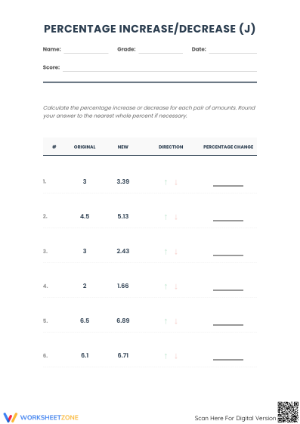
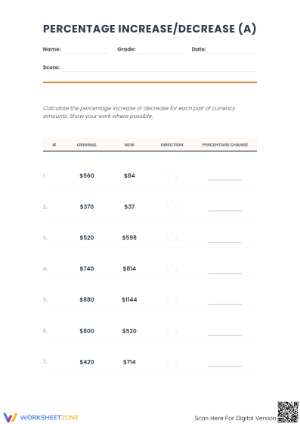
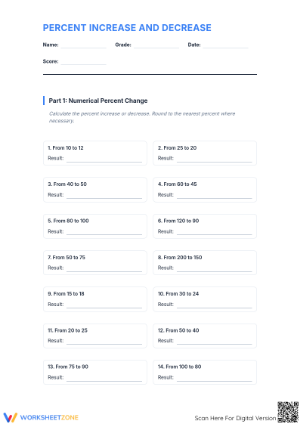
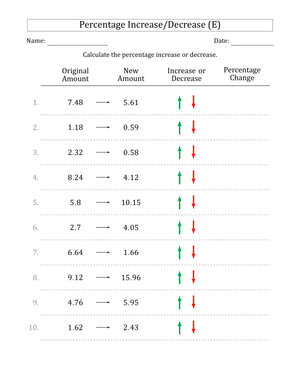
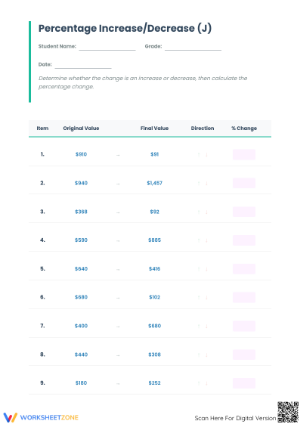
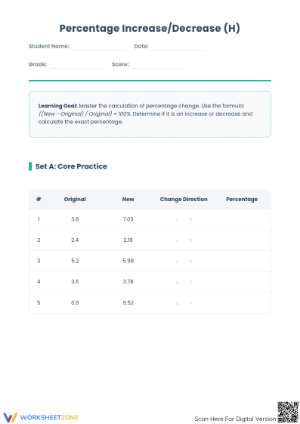
These increasing and decreasing percentages worksheets for 7th grade put three connected demands on students at once: deciding whether a quantity went up or down, calculating the amount of change, and expressing that change as a percent of the original value rather than the result. Teachers who have run this unit know the third step is where errors cluster. The set targets that specific failure point directly, with enough varied problem types to make anchoring every calculation to the original value habitual rather than effortful.
What Students Work Through in Each Worksheet
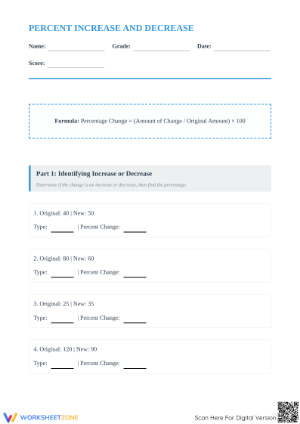
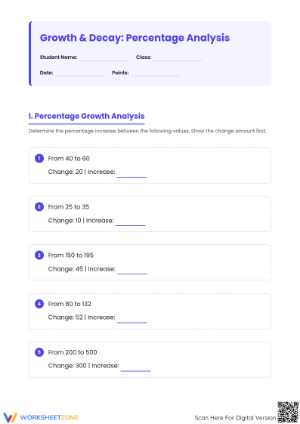
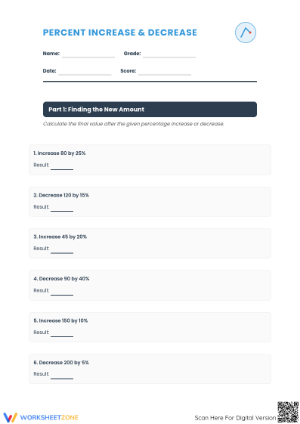
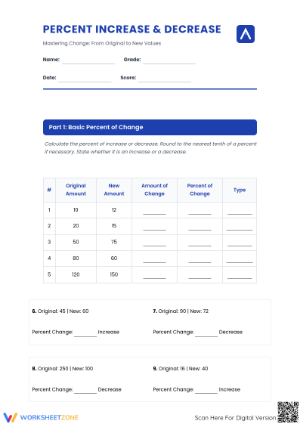
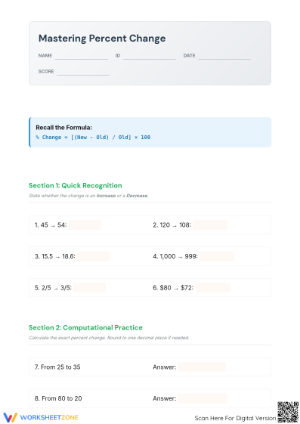
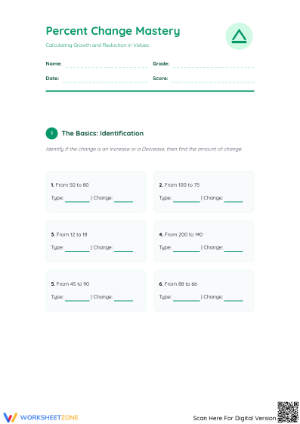
The sequence moves from recognition to calculation to application. Early worksheets ask students to examine two values and determine whether the situation describes an increase or a decrease — a step many 7th graders rush past, causing compounding errors later. From there, students calculate the amount of change, divide by the original value, and convert the result to a percent. Later worksheets introduce the multiplier approach: original times (1 + rate) for an increase, original times (1 minus rate) for a decrease. Requiring students to work both methods on the same problem type and confirm that the answers agree is a small but instructionally valuable exercise in mathematical coherence.
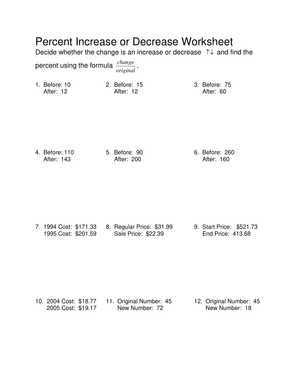
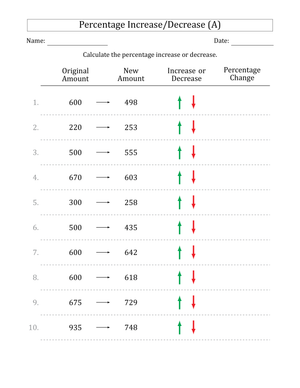
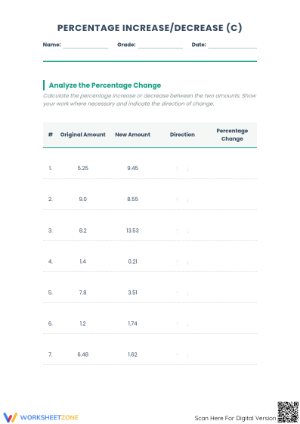
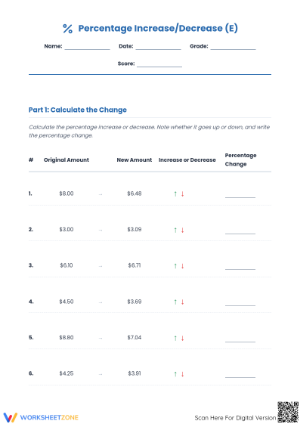
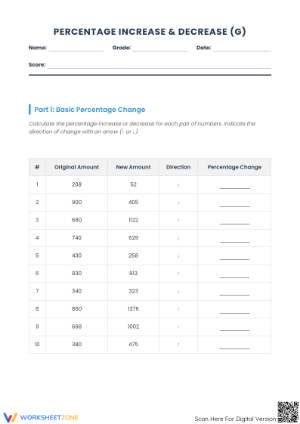
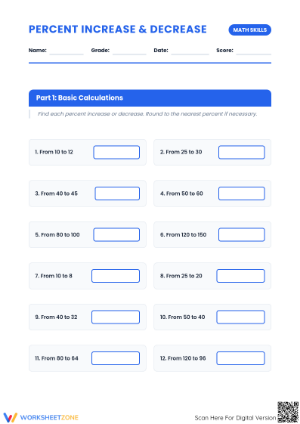
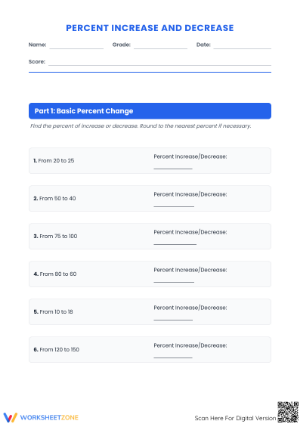
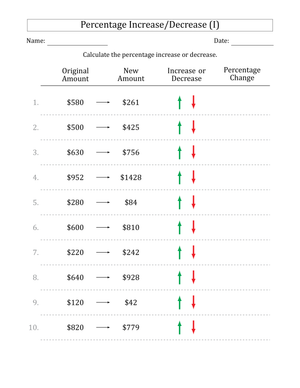
- Finding percent change given an original and a new value
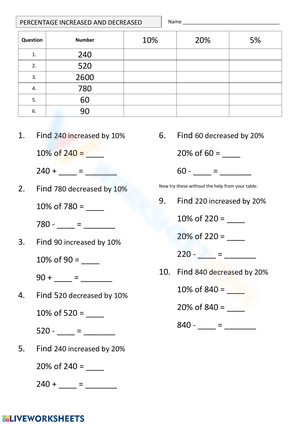
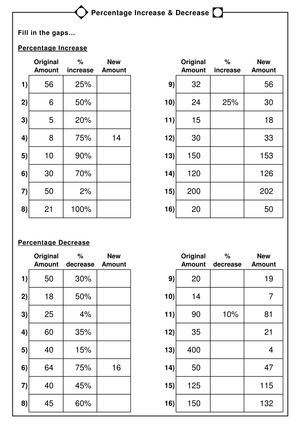
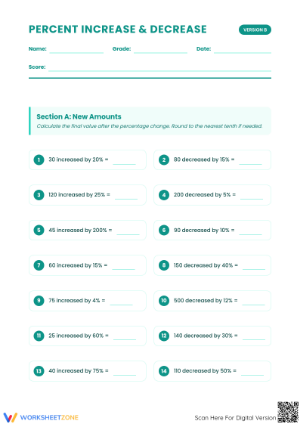
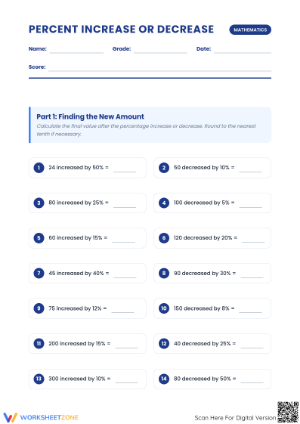
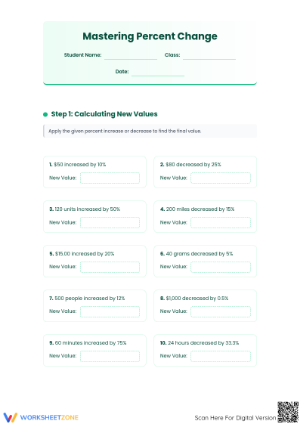
- Finding the new value given an original amount and a percent rate
- Real-world word problems: store discounts, restaurant tips, wage increases, population data, sports statistics
- Error-analysis items where students locate and correct a flawed solution
Where Percent Change Calculations Break Down
The most persistent error is dividing the change by the new amount instead of the original. If a shirt drops from $60 to $45, the change is $15. Students who write 15 divided by 45 instead of 15 divided by 60 arrive at roughly 33% rather than 25% — and the result looks plausible enough that nothing in the arithmetic signals a problem. The most effective correction is a classroom routine: require students to circle the original value on each problem before writing any numbers. That annotation habit, done consistently across a few sessions, eliminates this error for most students more reliably than extra computation practice does.
A second pattern appears at the final step. Students correctly find that 20% of $80 is $16, then list $16 as the final answer rather than applying the addition or subtraction that produces the actual new price. This is a question-reading error more than a math error, and it responds better to varied question phrasing than to more drill. Worksheets that alternate between "find the percent of change" and "find the new amount after the change" force students to read each item before reaching for a procedure. A related vocabulary trap: students who see "30% off" sometimes interpret it as "you pay 30%" rather than "you pay 70%." A few problems that ask for both the discount amount and the sale price cleanly separate those two ideas.
Standard Alignment
The increasing and decreasing percentages worksheets for 7th grade in this set address CCSS 7.RP.A.3 — using proportional relationships to solve multi-step percent problems including tax, tips, markups, markdowns, commissions, and percent increase and decrease. In most unit sequences, 7.RP.A.3 follows 7.RP.A.1 and 7.RP.A.2, which means students already have experience with unit rates and proportional relationships. That foundation matters here because understanding why percent change compares the difference to the original rather than the new value is a proportional reasoning question, not a procedural one. The problem types in this set reflect how 7.RP.A.3 appears on state assessments: context-embedded, multi-step, and requiring students to identify the original quantity before computing.
Fitting These Worksheets Into Your Week
Teachers who have used increasing and decreasing percentages worksheets for 7th grade as bell ringers get the best results when they select two or three items that mix an increase and a decrease rather than running the same type back to back. That small choice forces students to read each problem before applying a method — exactly the reading habit percent change questions require. Running a three-item warm-up three times across a week also produces stronger retention than one longer assignment, because the spacing requires students to retrieve the process rather than carry it forward from the last item.
For whole-class guided practice, working through the first two or three items from a worksheet publicly before releasing students to finish independently is a reliable structure. For intervention groups, the same worksheet works when the teacher reads each word problem aloud and pauses after each sentence to ask students to name the original amount. That adjustment removes reading load without changing the mathematics.
Supporting Students at Different Starting Points
Students who are still inconsistent with percent-to-decimal conversion need a simpler entry point before tackling percent change. Start them with items where the rate and original value are both given and the only task is finding the change amount — one multiplication, nothing more. Once that step is automatic, introduce the division step, then build toward the full two-step process. A reference card showing the formula and a worked example gives those students a concrete support without removing the mathematical thinking.
For students working above grade level, the most productive extension is working backwards: given the new amount and the rate of change, find the original value. This reversal appears on both 7th and 8th grade assessments and has a natural real-world framing — "a coat now costs $68 after a 15% discount; what was the original price?" — that makes the extension feel purposeful rather than like additional busy work.
Frequently Asked Questions
What is the difference between percent increase and percent decrease?
Both use the same core calculation — amount of change divided by the original value — but differ in direction and in whether the student adds or subtracts the change from the original. The formula is identical in both cases. What trips up 7th graders is deciding which situation they are in before they calculate, which is why labeling each problem as increase or decrease before writing any numbers is a useful classroom routine.
Can students use either the step-by-step method or the multiplier method?
Yes, and requiring students to try both at some point in the unit strengthens conceptual understanding. The step-by-step method — find the change, divide by the original, convert to percent — makes the reasoning visible. The multiplier method is faster and mirrors how this calculation appears in high school algebra and real financial contexts. Comparing both approaches on the same problem type helps students see that different correct methods produce the same result, which is a meaningful mathematical observation at this level.
Where in a Grade 7 unit do these worksheets fit best?
After students demonstrate fluency with basic percent operations — converting percents to decimals, finding a percent of a number — but before multi-step assessment preparation. Introducing percent change before students can reliably convert a percent to a decimal adds unnecessary cognitive load and causes errors that look like misunderstanding but are actually gaps in a prerequisite skill. The increasing and decreasing percentages worksheets for 7th grade in this set work best once the conceptual introduction is complete and students need volume and variety to solidify the skill.
Are these worksheets useful for test preparation?
Yes. 7.RP.A.3 appears consistently on state assessments, and multi-step percent problems — where students must apply a markup and then a discount, or find a tip and add it to a bill — are common formats. Teachers doing dedicated test prep can pair the word problem sections from these worksheets with released assessment items to give students exposure to both the format practiced in class and the presentation style they will encounter on a test.













 Interactive Worksheet Maker
 Quiz Maker
 Word Search Maker
 Crossword Puzzle Maker
 Word Scramble Generator
 Sentence Scramble Generator
 Handwriting Worksheet Generator
 Name Tracing Generator
 Fill In The Blank Generator