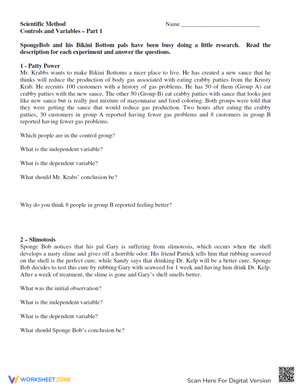
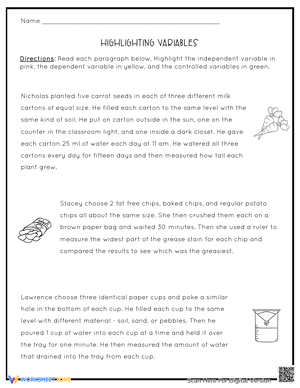
These 7th grade independent and dependent variables worksheets give teachers a ready-to-print set that moves students from basic identification toward genuine algebraic reasoning — working across tables, graphs, equations, and real-world scenarios rather than staying fixed in one format. Each worksheet keeps the same core question in front of students: which quantity is being controlled, which responds, and why one value depends on the other. The resources are built for the point in 7th grade where students need more than a vocabulary definition — they need repeated contact with the relationship in formats they'll see on assessments and carry forward into function work.
What Each Worksheet Targets
The skills across the set build outward from identification toward comparison, representation matching, and written explanation. No single format dominates, which is how teachers catch whether understanding is genuine or just memorized.
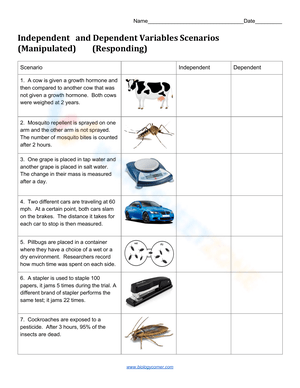
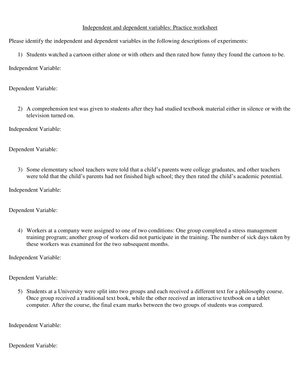
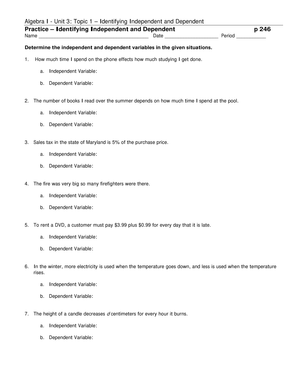
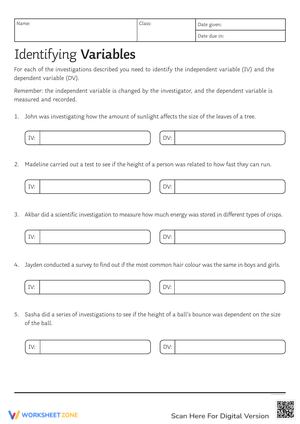
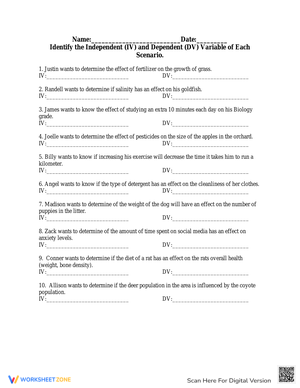
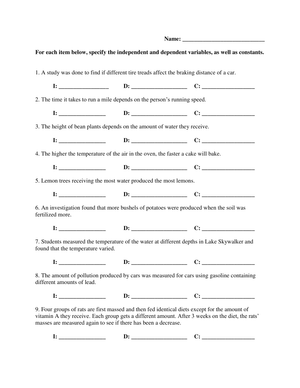
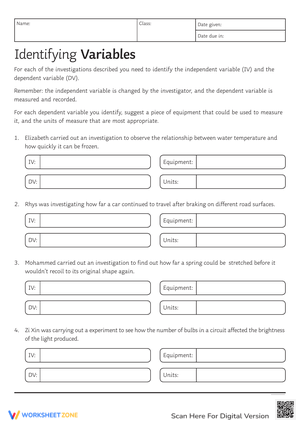
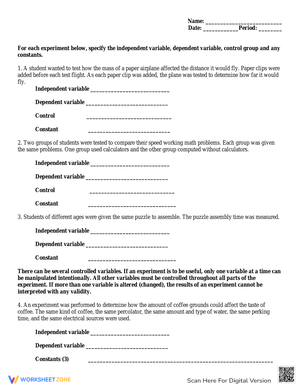
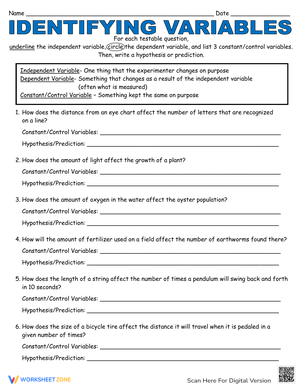
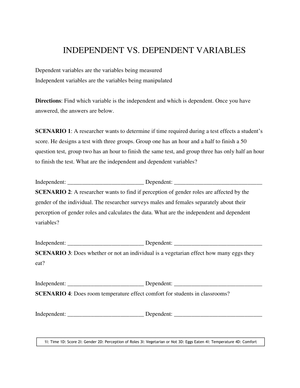
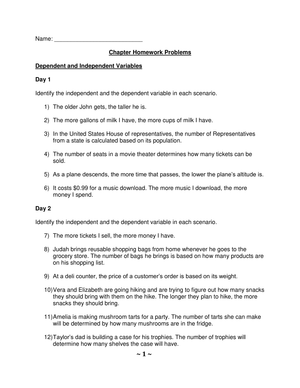
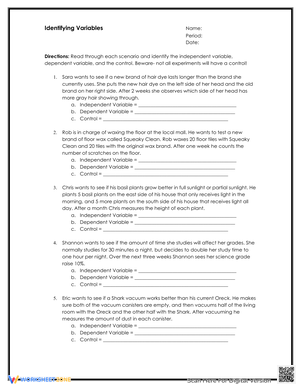
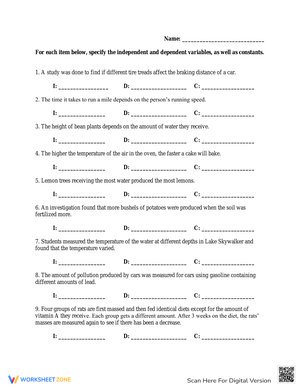
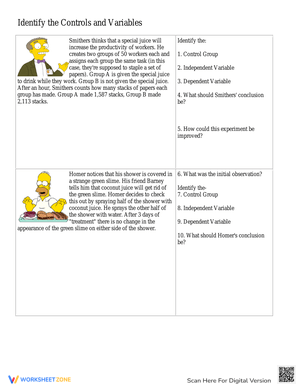
- Variable identification from word problems: Students read a short scenario — hours of sunlight and plant height, minutes on a treadmill and calories burned — and name the independent and dependent variable with a written justification.
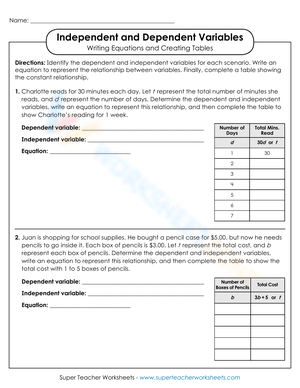
- Table interpretation: Students examine input-output pairs and label which column contains the independent variable and which reflects the dependent one.
- Graph axis analysis: Students connect horizontal and vertical axes to the variable relationship and explain the choice in a sentence.
- Equation-to-context matching: Students link a written rule to a real-life situation and identify which quantity each variable represents.
- Error analysis: Students review a sample answer where the variables are mislabeled and write a correction with reasoning.
That last format tends to be the most revealing in classroom use. A student who correctly identifies variables in a table may still accept a mislabeled graph without noticing the error, and those two results together tell a teacher more than either one alone. A set of 7th grade independent and dependent variables worksheets that includes error analysis alongside routine identification gives teachers a clearer picture of where the concept is stable and where it remains fragile.
Student Errors Worth Anticipating Before You Teach This
The most persistent mistake is positional: students treat whichever quantity appears first in a sentence as the independent variable. If a word problem reads "the total cost rises as more notebooks are purchased," students who haven't internalized the "depends on" relationship will mark total cost as independent because it's named first. The logic of the scenario — purchased quantity drives cost, not the reverse — doesn't override the left-to-right reading habit. This error is common enough that it's worth naming explicitly before students touch any worksheet.
A second pattern shows up with graphs. Many 7th graders carry an informal rule from earlier grades: x is always the input, y is always the output. That assumption collapses the moment a graph labels its axes with context nouns — "Days" and "Plant Height (cm)" — rather than x and y. Students freeze or guess because they were relying on axis position rather than on understanding which quantity causes the change. The worksheets in this set use contextually labeled axes for that reason: to surface the gap before it becomes a problem on an assessment.
A third error belongs to students who handle tables correctly but fall apart on written scenarios. They understand the relationship in numeric form — input column, output column — but haven't connected that structure to language. Giving students the sentence frame "The value of ___ depends on ___" before they begin a worksheet section reduces this gap. It forces them to articulate the relationship before they mark any labels, which turns out to be better error prevention than any amount of re-explanation after the fact.
Fitting These Worksheets Into Your Weekly Lesson Block
The most efficient use of the set runs across three or four sessions. Open with a mini-lesson using one or two familiar contexts — ticket prices, plant growth — then assign a worksheet covering tables and axis labeling as partner practice. Follow up the next day with word problems that require written justification, and close the sequence with an error analysis worksheet as a formative check before any quiz. That arc gives students enough contact with the concept to internalize it across formats without burning through the entire set in one sitting.
Individual worksheets also work well as Monday warm-ups. A two-column table or a mislabeled graph takes about six minutes at the start of a period and consistently reveals who needs a brief pull-aside before the day's lesson moves forward. The same worksheet revisited as a Friday exit ticket shows both student and teacher how much ground was covered in the week. Teachers who use 7th grade independent and dependent variables worksheets for spiral review find that rotating one or two items into the warm-up block every few weeks keeps the concept from disappearing between units.
Standard Alignment
This set addresses CCSS 6.EE.C.9, which calls for students to use variables to represent two quantities that change in relationship to one another and to write an equation expressing one quantity in terms of the other. Many 7th grade teachers revisit this standard early in the year because it anchors the reasoning students need for proportional relationships under 7.RP and for functions in 8th grade under 8.F.A.1. In practical terms, 6.EE.C.9 is the bridge standard: it formalizes the informal understanding of "this affects that" into the variable notation and directional reasoning that algebra requires.
Adjusting the Set for a Range of Learners
For students still building confidence with variable language, begin with sorting tasks: present a list of real-world pairs and ask students to sort each pair into "independent" and "dependent" columns before writing any explanation. That low-stakes categorization step often builds enough traction to carry students into full identification work on the next worksheet. Highlighting key phrases in the directions — depends on, caused by, for every — gives these students language anchors without reducing what's being asked of them cognitively.
Students who move through identification quickly need tasks where the relationship is less obvious. Each worksheet in the set that carries an extension prompt asks students to generate their own real-world scenario, write the corresponding table, and explain which variable they chose as independent and why. A student who can construct a valid example and articulate the direction of dependence has internalized the concept — not just recognized it. This is the level of understanding these 7th grade independent and dependent variables worksheets extension tasks push toward, and it's a meaningful step beyond what identification-only formats reach.
Frequently Asked Questions
How do these worksheets differ from a vocabulary exercise on the same topic?
Vocabulary exercises ask students to define terms and match labeled examples. These worksheets ask students to identify variables, analyze errors, and explain their reasoning in context. What a teacher learns from the work is different: a correct vocabulary match tells you a student memorized a definition; a correct error analysis explanation with written reasoning tells you the student understands the direction of the relationship.
At what point in the year do most 7th grade teachers use this content?
Most teachers introduce or review this topic in the first few weeks of the school year. It appears formally under CCSS 6.EE.C.9, but many students arrive in 7th grade with only surface familiarity. Using these worksheets early establishes the variable reasoning students need before moving into proportional relationships and later into formal function notation.
Can students who struggle with reading-heavy math problems still access this content?
Yes. The set includes table-based and graph-based tasks that require minimal reading. Teachers can sequence those formats first, then introduce written scenarios once students have built enough confidence with the relationship in numeric and visual form. Color-coding also helps: students mark each independent variable in one color and each dependent variable in another across an entire worksheet, which reduces the chance of losing track mid-problem. This approach tends to be especially useful for multilingual learners and for students who rush through written directions.
Do the worksheets include answer keys?
Each worksheet in the set includes a corresponding answer key. For error analysis items, the key provides a sample explanation — not just the corrected label — so teachers have a reference point when reading student reasoning rather than checking a single circled answer. Teachers who assign these worksheets for homework report that having that fuller key cuts grading time without weakening the assignment.













 Interactive Worksheet Maker
 Quiz Maker
 Word Search Maker
 Crossword Puzzle Maker
 Word Scramble Generator
 Sentence Scramble Generator
 Handwriting Worksheet Generator
 Name Tracing Generator
 Fill In The Blank Generator