


























Views
Downloads
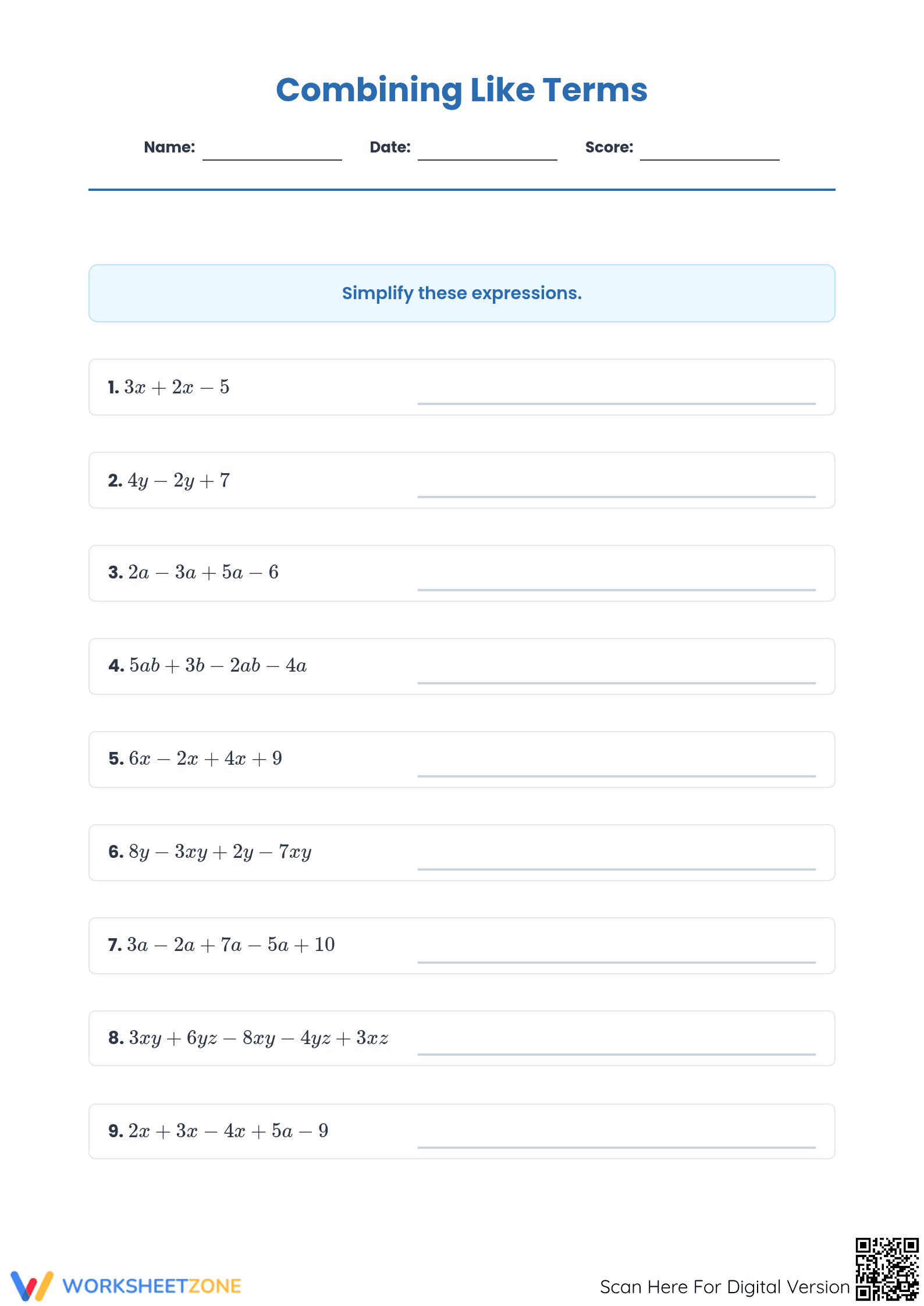


Combining Like Terms Worksheet | Essential Grade 6-7 Math
Paste this activity's link or code into your existing LMS (Google Classroom, Canvas, Teams, Schoology, Moodle, etc.).
Students can open and work on the activity right away, with no student login required.
You'll still be able to track student progress and results from your teacher account.
This Grade 6 and 7 math worksheet provides targeted practice for students learning to simplify algebraic expressions. By identifying and combining like terms, learners develop the foundational skills necessary for solving complex equations. This resource ensures students can confidently group variables and constants to create equivalent expressions in a clear, structured format.
At a Glance
- Grade: 6-7 · Subject: Math
- Standard:
CCSS.MATH.CONTENT.6.EE.A.3— Apply properties of operations to generate equivalent expressions by combining like terms- Skill Focus: Combining Like Terms
- Format: 2 pages · 20 problems · Answer key included · PDF
- Best For: Independent practice and skill reinforcement
- Time: 20–30 minutes
What's Inside
This comprehensive 2-page PDF features 20 unique algebraic expressions. The layout provides ample white space and clear horizontal lines for student calculations. It includes a variety of term types, including single variables, multiple variables, and constant terms. A full answer key is provided to facilitate quick grading or student self-correction, ensuring immediate feedback for learners.
Skill Progression
- Guided Practice: The first 5 problems focus on basic addition and subtraction of single-variable terms and constants to build initial confidence with low-complexity coefficients.
- Supported Practice: Problems 6-15 introduce multiple variables and longer strings of terms, requiring students to carefully track coefficients and variable pairings.
- Independent Practice: The final 5 problems challenge students with complex expressions involving three or more distinct term types and mixed operations.
This structure supports a gradual-release model, moving from simple grouping to multi-step simplification using the I Do, We Do, You Do approach.
Standards Alignment
The primary focus is `CCSS.MATH.CONTENT.6.EE.A.3`, which requires students to apply properties of operations to generate equivalent expressions. It also supports `CCSS.MATH.CONTENT.7.EE.A.1` by practicing the addition and subtraction of linear expressions. Both standard codes can be copied directly into lesson plans, IEP goals, or district curriculum mapping tools.
How to Use It
Assign this worksheet during the "You Do" phase of a lesson on algebraic properties. It serves as an excellent formative assessment tool; teachers should observe if students correctly handle negative signs when combining terms. Expect completion within 20 to 30 minutes depending on student fluency with integer operations.
Who It's For
This resource is designed for middle school students in general education or those requiring Tier 2 intervention in algebra. It pairs naturally with visual anchor charts that color-code like terms or direct instruction lessons on the distributive property and term identification.
Algebraic fluency is a critical predictor of success in higher-level mathematics. According to research from EdReports (2024), high-quality instructional materials must provide focused opportunities for students to manipulate expressions to build procedural skill and conceptual understanding. This worksheet addresses that need by isolating the skill of combining like terms, which is a prerequisite for solving multi-step equations. By engaging with 20 structured problems, students reinforce their ability to apply the commutative and associative properties of addition. The inclusion of an answer key supports immediate feedback, a practice highlighted by Fisher & Frey (2014) as essential for the gradual release of responsibility. This resource aligns with CCSS.MATH.CONTENT.6.EE.A.3, ensuring that Grade 6 and 7 learners meet rigorous national benchmarks for algebraic thinking. It provides the repetition necessary for mastery without overwhelming students with unnecessary complexity.


