


























Views
Downloads
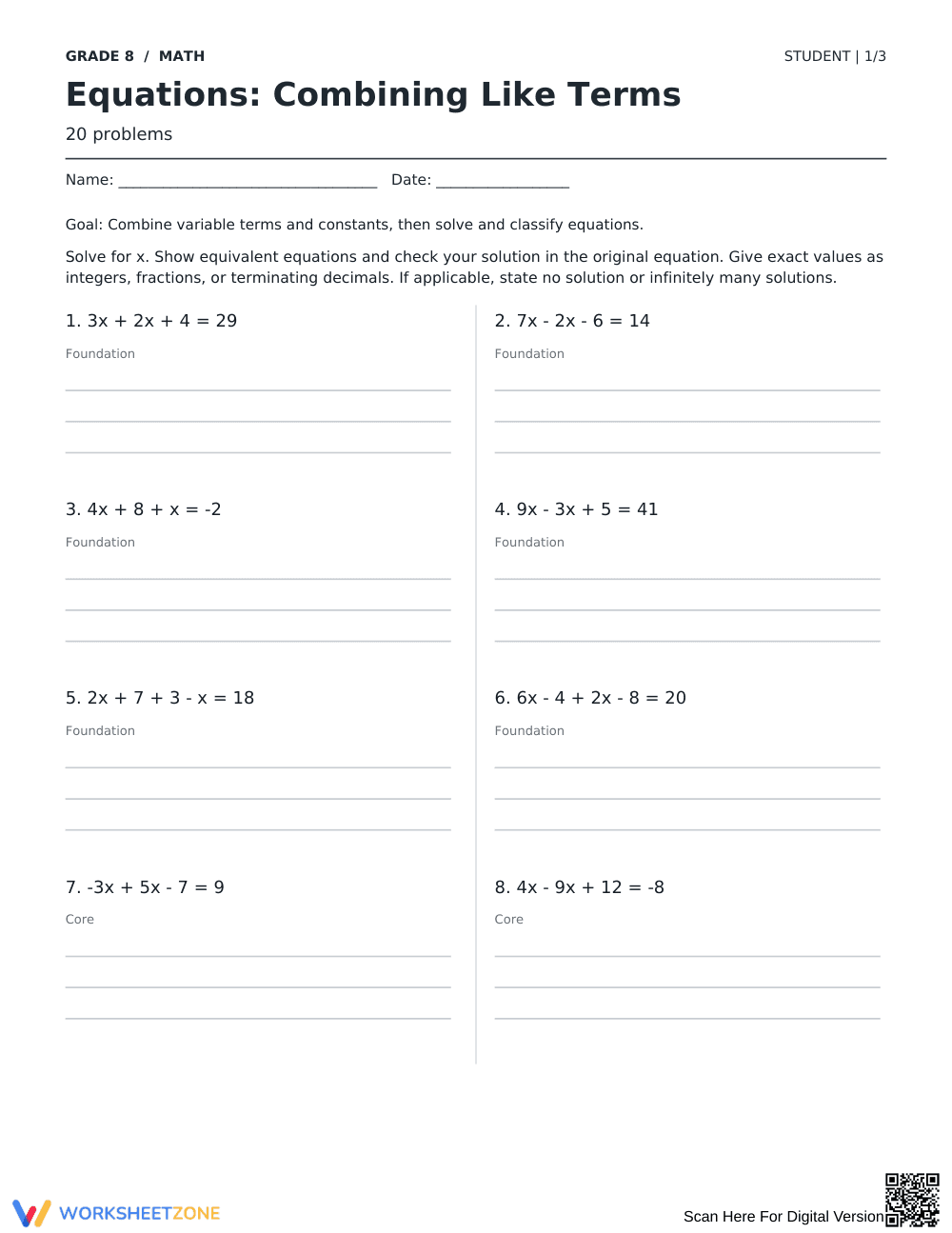
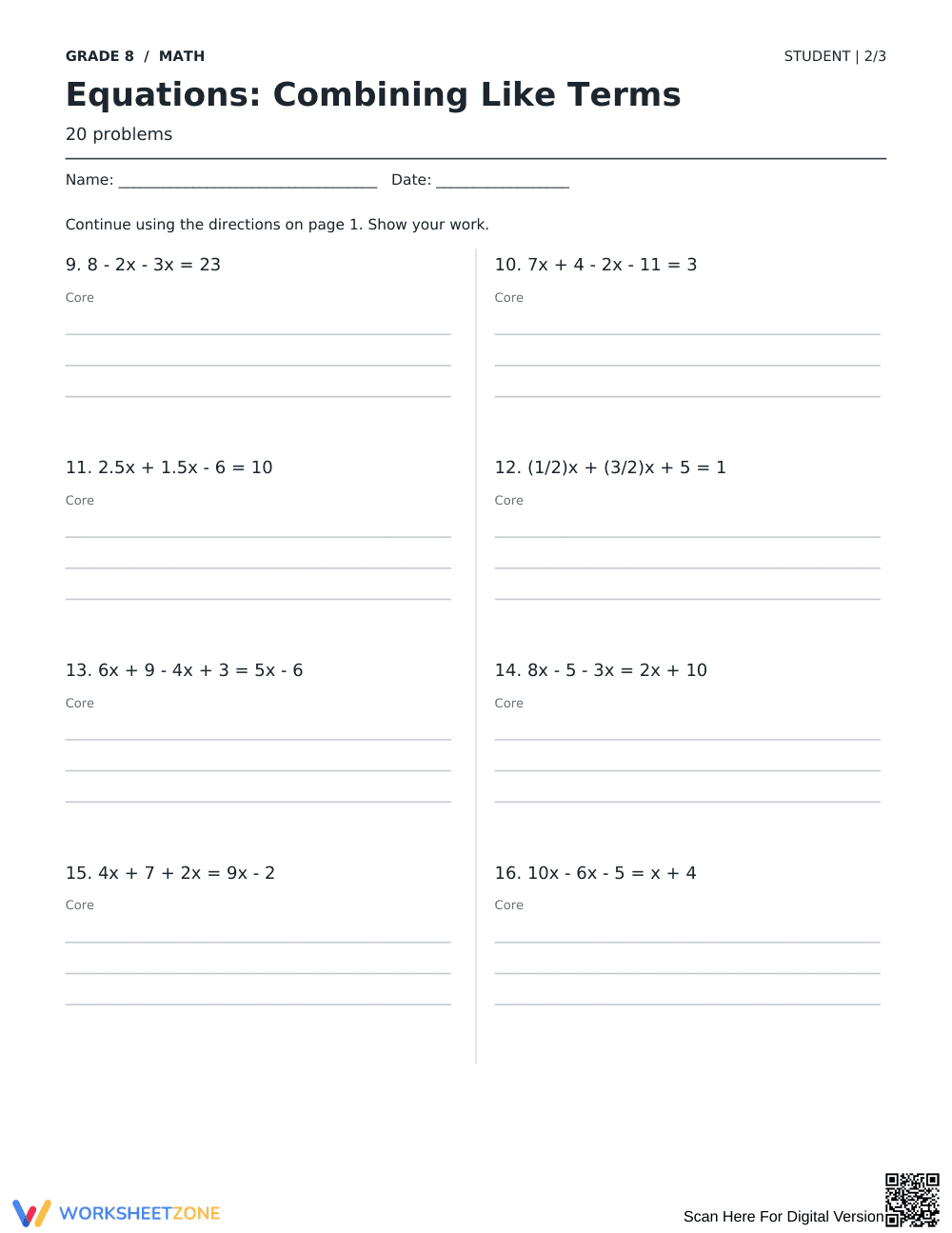
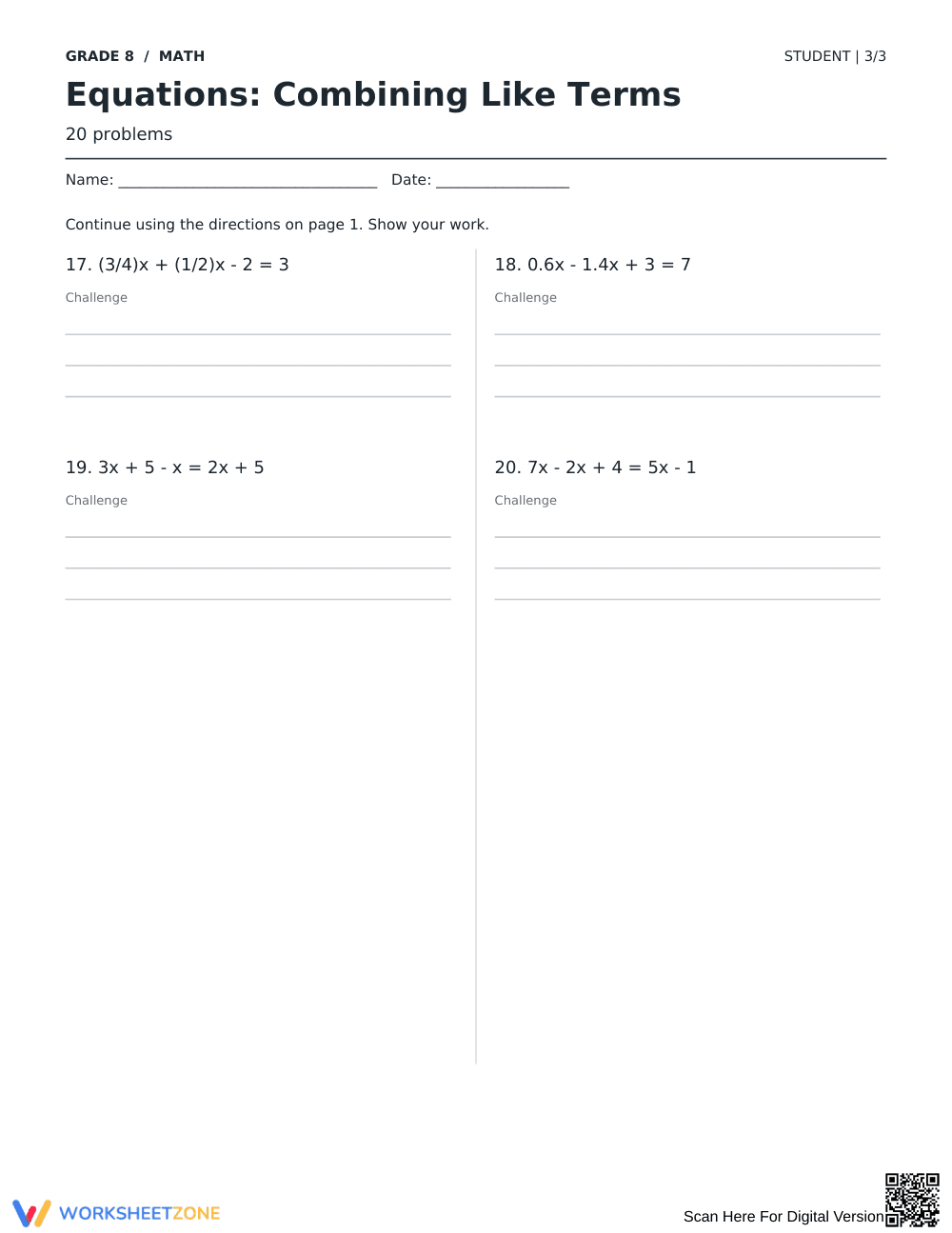

Combining Like Terms Equations Printable | Grade 8
Paste this activity's link or code into your existing LMS (Google Classroom, Canvas, Teams, Schoology, Moodle, etc.).
Students can open and work on the activity right away, with no student login required.
You'll still be able to track student progress and results from your teacher account.
This Grade 8 math worksheet builds fluency in solving linear equations by combining like terms across 24 structured problems. Students simplify both sides of each equation, isolate the variable, and record solutions — developing the procedural accuracy required for algebra readiness and standardized assessments.
At a Glance
- Grade: 8 · Subject: Math
- Standard:
CCSS.MATH.CONTENT.8.EE.C.7— Solve linear equations in one variable by combining like terms- Skill Focus: Combining like terms to solve one-variable linear equations
- Format: 2 pages · 24 problems · Answer key included · PDF
- Best For: Guided practice or independent skill reinforcement
- Time: 20–35 minutes
The worksheet spans 2 student pages and presents 24 equations requiring students to combine like terms on one or both sides before solving. Problems are arranged in a clean grid format with ample workspace for showing steps. The full answer key covers all 24 solutions and is included on separate pages for easy teacher use.
Skill Progression
- Guided practice (Problems 1–8): Equations with like terms on one side only; straightforward integer coefficients that build confidence with the combining step before isolating the variable.
- Supported practice (Problems 9–16): Like terms appear on both sides of the equation, requiring students to move terms across the equal sign — a key transition toward multi-step equation fluency.
- Independent practice (Problems 17–24): Mixed equation types with larger coefficients and negative values; students apply the full combining-and-solving process without scaffolding, mirroring test-level expectations.
This gradual-release structure mirrors the I Do, We Do, You Do model, allowing teachers to use the first set for whole-class modeling, the middle set for partner work, and the final set for individual assessment.
Standards Alignment
Primary standard: CCSS.MATH.CONTENT.8.EE.C.7 — Solve linear equations in one variable; give examples of linear equations in one variable with one solution, infinitely many solutions, or no solutions. Supporting standard CCSS.MATH.CONTENT.7.EE.B.4 is addressed implicitly as students apply prior knowledge of combining like terms from Grade 7 expressions work. Both standard codes can be copied directly into lesson plans, IEP goals, or district curriculum mapping tools.
How to Use It
Use Problems 1–8 during direct instruction as a whole-group practice set immediately after modeling the combining step on the board. Assign Problems 9–24 after instruction as independent practice or homework; target completion time is 20–35 minutes. As a formative-assessment tip, scan student work on Problems 17–20 specifically — errors here typically reveal whether students are combining terms correctly before dividing, pinpointing the exact misconception to address in the next lesson.
Who It's For
Designed for Grade 8 students working toward mastery of linear equations, this worksheet also supports Grade 7 advanced learners beginning equation work and Grade 9 students who need targeted remediation. Pair it with a combining-like-terms anchor chart or a brief direct-instruction lesson on the distributive property for maximum impact.
This worksheet targets CCSS.MATH.CONTENT.8.EE.C.7, requiring students to solve linear equations in one variable by first combining like terms. According to Fisher & Frey (2014), structured gradual-release practice — moving from teacher-led to independent work — significantly increases procedural fluency retention in middle-grade mathematics. The 24-problem sequence in this resource applies that principle directly: early problems isolate the combining step, mid-set problems introduce terms on both sides, and final problems demand full independent application. NAEP data consistently show that equation-solving with like terms is among the most frequently assessed Grade 8 algebra skills, making targeted practice essential for test readiness. Teachers can use student performance on the final eight problems as a quick formative checkpoint, with the included answer key enabling immediate scoring and feedback.


