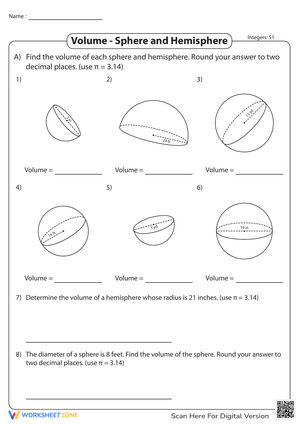
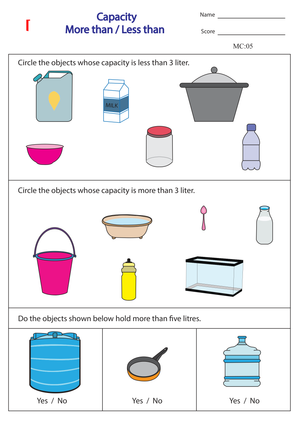
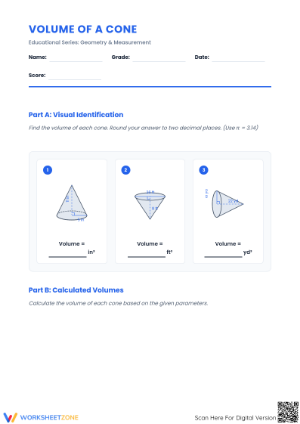
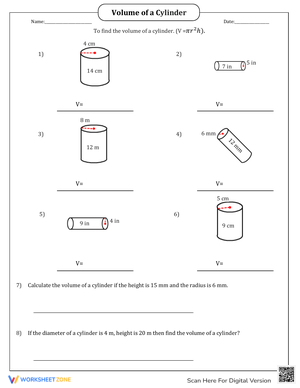
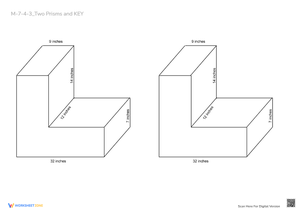
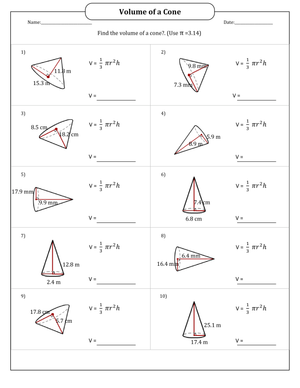
These volume printable worksheets for 7th grade give teachers a ready-to-print geometry practice set that spans the full range of Grade 7 volume skills — from calculating the volume of right rectangular prisms to decomposing composite figures into manageable parts before applying any formula. The worksheets pair direct computation with applied reasoning, so teachers can pull what fits the lesson without rebuilding practice materials by hand.
The Specific Skills Targeted
Each worksheet addresses one or more calculation and reasoning tasks from the standard Grade 7 volume progression:
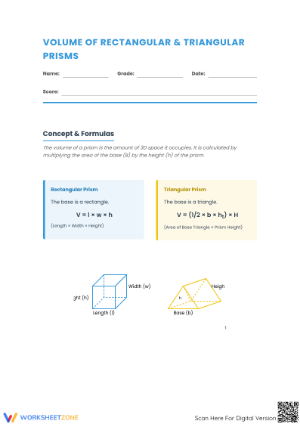
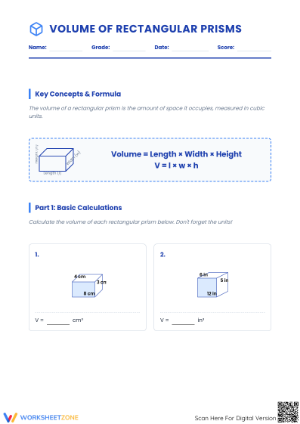
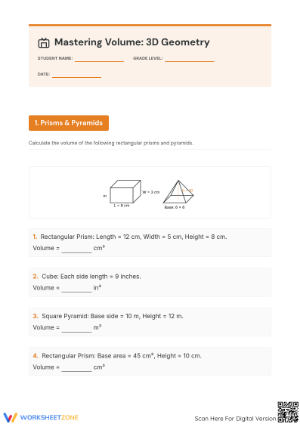
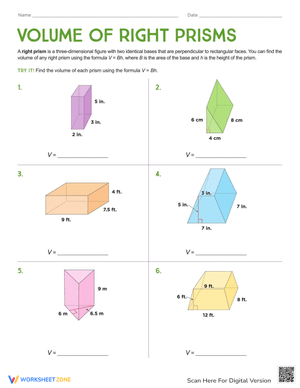
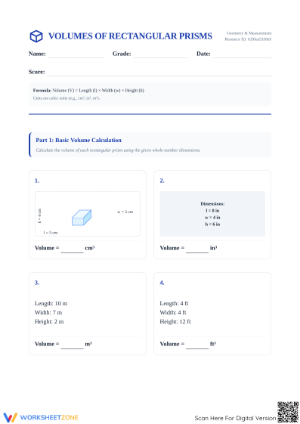
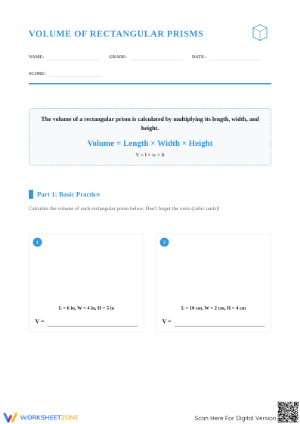
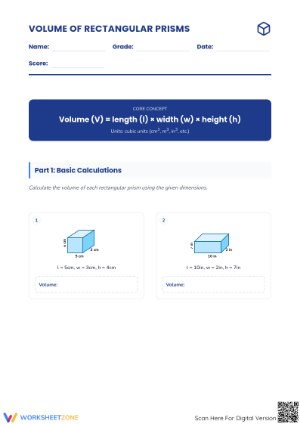
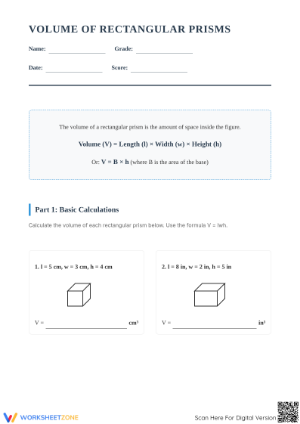
- Right rectangular prism volume: Students apply V = lwh with integer and decimal dimensions, including problems where one measurement is a fraction.
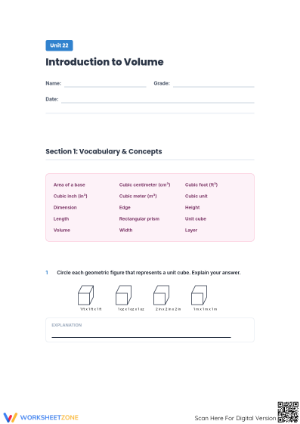
- Cube and unit cube models: Problems connect physical cube-counting to the algebraic formula, reinforcing why the formula works before students move to pure computation.
- Missing-dimension problems: Students work backward from a known volume to find an unknown side length — a task that requires rearranging the formula, not just substituting values.
- Real-world word problems: Contexts include aquariums, shipping containers, garden beds, and storage spaces. Students identify relevant dimensions, choose a strategy, and interpret the result in context.
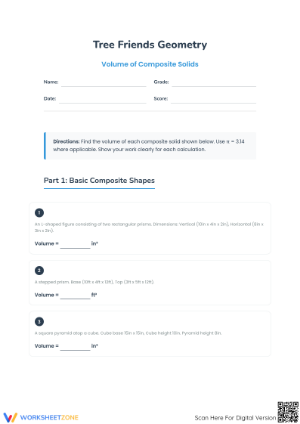
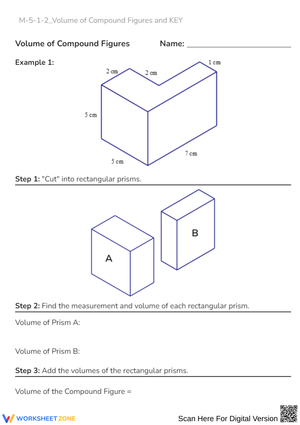
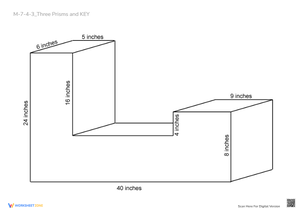
- Composite figures: Students identify how to partition an irregular solid into rectangular prisms, calculate partial volumes, and sum the results.
- Cubic unit labeling: Several problems ask students to label or correct answers, targeting the persistent habit of writing "cm" instead of "cm³."
The move from single-prism problems to composite figures reflects how volume reasoning actually develops at this grade. Students who execute V = lwh smoothly on a labeled diagram will still stall when a figure requires spatial decomposition first, because that step demands a different kind of thinking than direct calculation does.
Mistakes Students Make That These Worksheets Help You Catch
A few errors appear reliably in Grade 7 volume work, and the most useful practice materials bring those errors to the surface rather than paper over them with uniform problem formats.
The most common is stopping after two dimensions. A student who multiplies length times width and records an answer has found area, not volume — but if the number looks plausible and no one asks them to recheck their process, the error sits undetected. A problem with dimensions 4 cm × 6 cm × 3 cm will reveal in about ten seconds of work-scanning whether a student writes 72 cm³ or 24 cm². Worksheets that require students to show the intermediate multiplication step before writing the final answer make this error visible during the lesson, not after the quiz.
Missing or incorrect units are nearly as common. Students write "48 inches" when the answer is 48 cubic inches, and often the number itself looks correct enough that neither student nor teacher flags it. Worksheets that include a dedicated label line — separate from the numerical answer line — push students to think about the unit explicitly rather than appending it as an afterthought.
With composite figures, the predictable failure point is misidentifying the decomposition. Students add whole prism volumes without accounting for overlapping regions, or they assign the wrong dimension set to each sub-prism. Worksheets that present partially annotated diagrams — where students must draw and label the decomposition line themselves before calculating — expose this confusion during practice instead of at the end-of-unit assessment.
How to Work These Worksheets Into Your Weekly Lesson Plan
A focused, single-skill worksheet fits well as a warm-up the day after direct instruction — five to seven minutes at the start of class to check whether the previous lesson transferred before moving to new material. Mixed-problem worksheets anchor center rotations during small-group teaching, when the teacher is pulling a group and needs the rest of the class doing structured, independent practice without heavy management overhead.
Volume printable worksheets for 7th grade also serve intervention blocks efficiently. When exit ticket data shows that a subset of students is confusing area and volume, pulling a worksheet that isolates the three-dimension step — with a formula reference box and problems that deliberately mix two-dimensional and three-dimensional setups — is faster than rebuilding practice from scratch. The included answer key makes each worksheet workable as a self-check station or a leave-behind for a substitute who is not a math specialist.
One organizational move worth building into your unit: sort the worksheets by the decision type rather than by difficulty. Keep one group of worksheets for "find the volume," a second for "find the missing dimension," and a third for "decompose and calculate." That arrangement lets you match reteach material to exit ticket results in under two minutes — which matters when you have 48 hours between the lesson and the next small-group block and need to know exactly what to hand students when they sit down.
Standard Alignment
These worksheets align to CCSS 7.G.B.6, which asks students to solve real-world and mathematical problems involving area, volume, and surface area of two- and three-dimensional objects, including cubes and right prisms. In classroom terms, 7.G.B.6 shifts the expectation from procedural recall toward applied problem-solving — students are not simply asked to remember the formula but to use it in situations where dimensions are embedded in a description, a diagram, or a multi-step context. The right rectangular prism problems, composite figure tasks, and word problems in this set all target that application layer rather than formula recitation.
Adapting the Set for Mixed-Ability Classrooms
The worksheets support differentiation without requiring teachers to rewrite problems or build separate materials from scratch.
- Students who need more support: Begin with worksheets that show fully labeled diagrams, include a formula reference box, and use whole-number dimensions only. Having students annotate the diagram — circling each dimension before writing the formula — adds a step that slows impulsive calculation and reduces setup errors without changing the core task.
- On-level practice: Mixed worksheets with diagrams, word problems, and missing-dimension items give most students enough variety to surface gaps without the pacing feeling choppy.
- Extension: Composite figure worksheets and error-analysis prompts stretch students who have mastered single-prism calculation. Asking students to write their own word problem that requires composite figure reasoning reverses the usual direction and demands deeper understanding of the concept.
- Language support: Highlight the terms prism, dimensions, cubic units, and volume on any worksheet used with students building academic vocabulary. When the diagram and the written problem appear together rather than on opposite sides of the worksheet, students spend less cognitive effort toggling between representations.
Volume printable worksheets for 7th grade lend themselves to tiered assignment without signaling ability levels to students. Assigning every student the first six problems, then directing each student to a specific follow-up worksheet based on a mid-class check, keeps the whole class working on the same topic while targeting practice to where individual students actually are.
Frequently Asked Questions
What volume skills are covered across the worksheets?
The set addresses right rectangular prism volume, unit cube models, missing-dimension problems, real-world word problems, and composite figures. Each worksheet also targets cubic unit labeling, which often reveals whether students understand what volume measures or are simply executing a memorized procedure.
Do the worksheets come with answer keys?
Yes. Answer keys are included with each worksheet, which makes the set practical for self-check stations, quick grading during a planning period, and sub days. For volume specifically, answer keys are useful mid-class as well — teachers can scan for whether students are consistently getting the arithmetic right but writing the wrong unit, which points to a conceptual gap rather than a computation error.
How do I pick the right worksheet for reteach after a bad exit ticket?
Match the worksheet to the specific error pattern rather than the general topic. If students are omitting the third dimension, use a worksheet that requires students to identify and record all three measurements before solving. If the error is wrong or missing units, choose a worksheet with a dedicated label line. Volume printable worksheets for 7th grade are most useful when selected by skill gap, not just pulled in order from a packet.
Are composite figure worksheets appropriate for independent practice or homework?
Composite figure worksheets are better suited to class time than to homework. When a student misidentifies the decomposition at 9 p.m. with no feedback available, they often spend significant time reinforcing the wrong approach. Single-prism and word problem worksheets transfer well to homework once those formats have been introduced and practiced in class.













 Interactive Worksheet Maker
 Quiz Maker
 Word Search Maker
 Crossword Puzzle Maker
 Word Scramble Generator
 Sentence Scramble Generator
 Handwriting Worksheet Generator
 Name Tracing Generator
 Fill In The Blank Generator