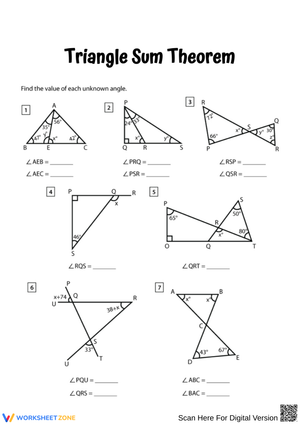
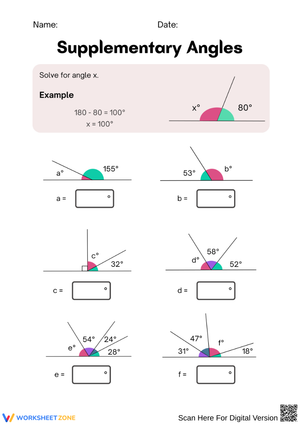
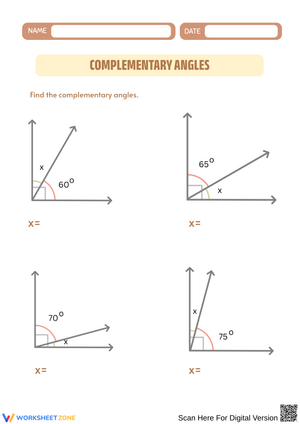
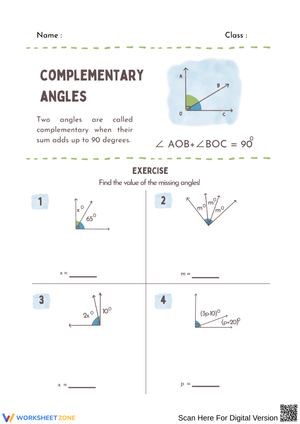
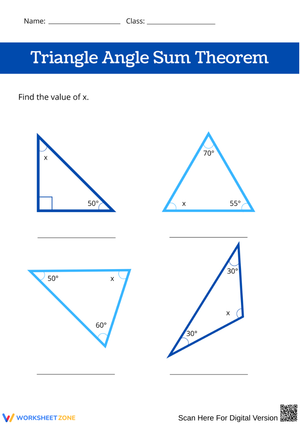
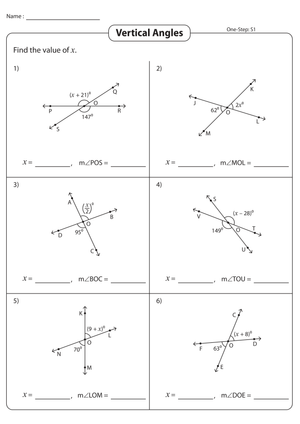
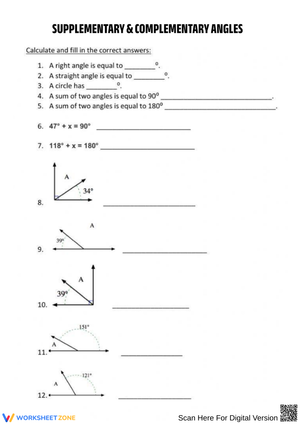
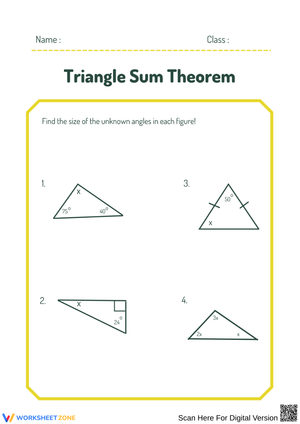
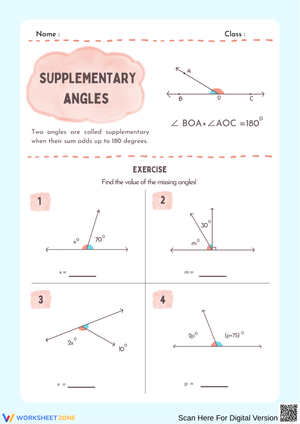
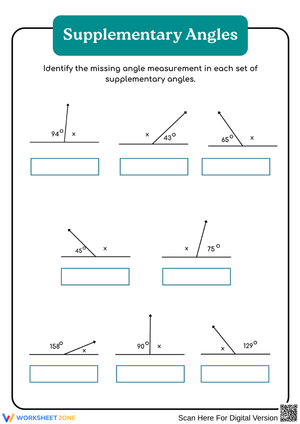
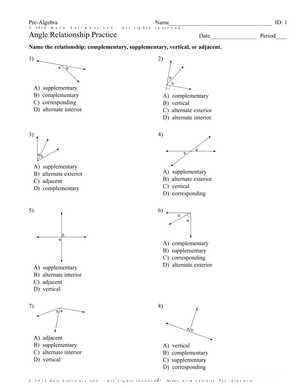
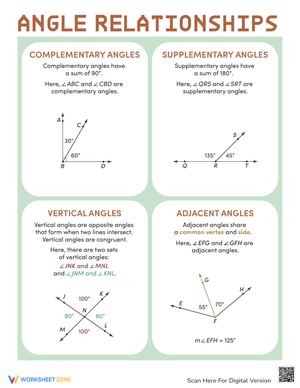
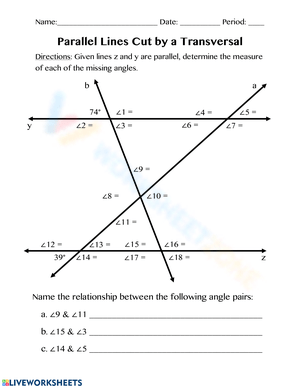
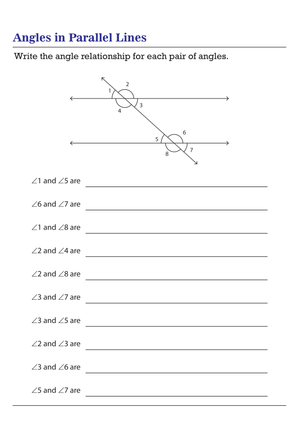
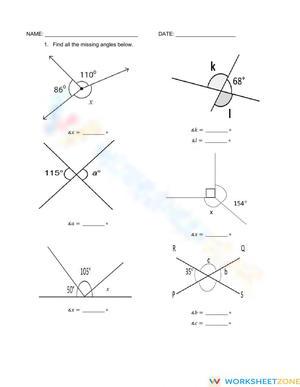
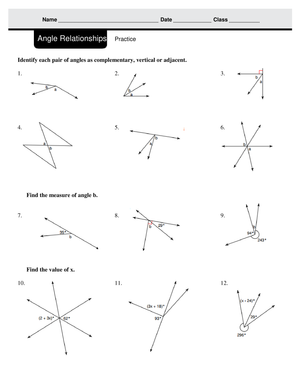
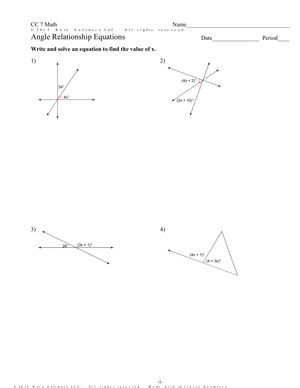
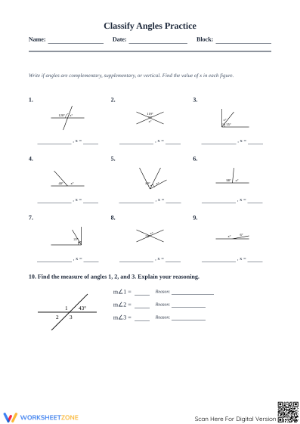
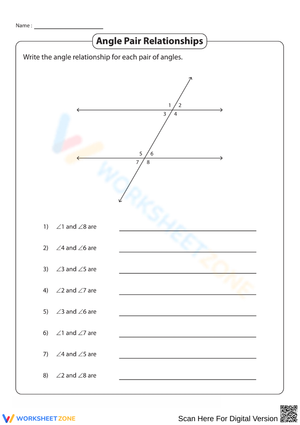
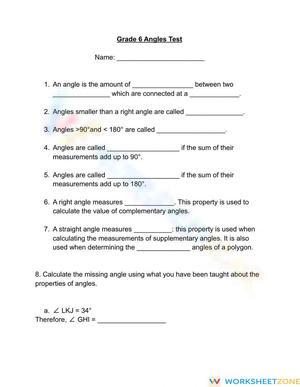
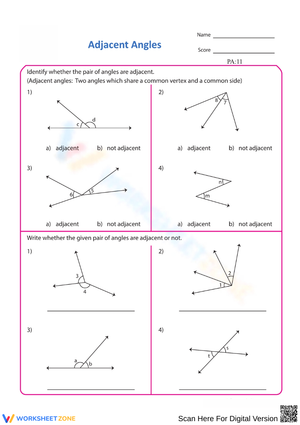
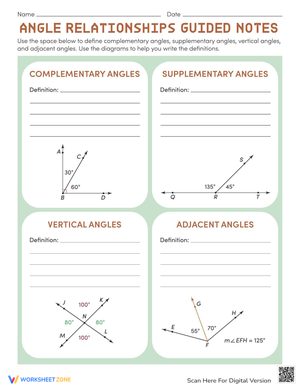
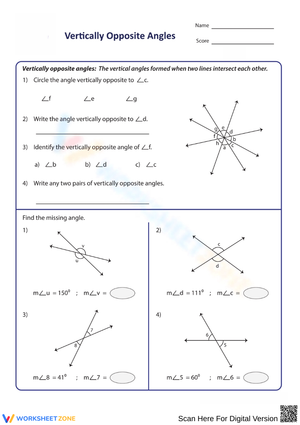
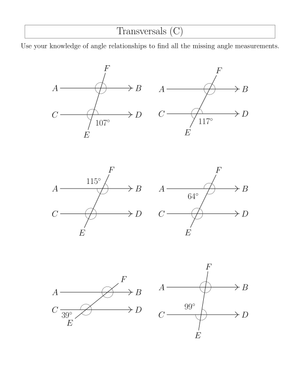
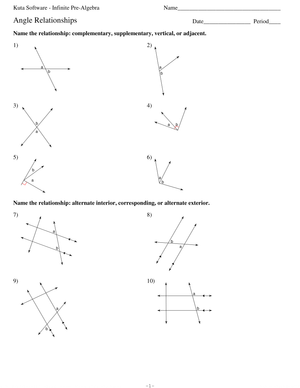
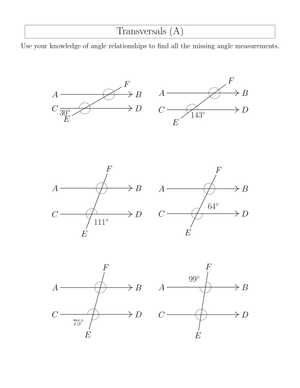
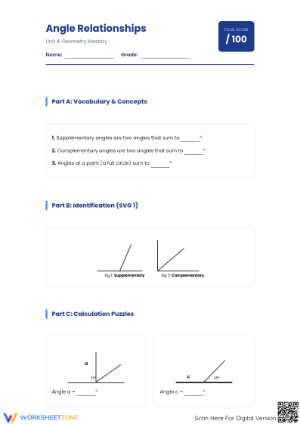
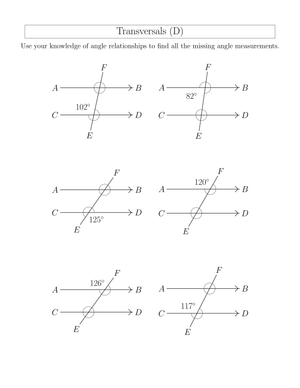
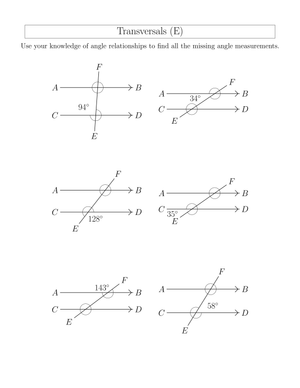
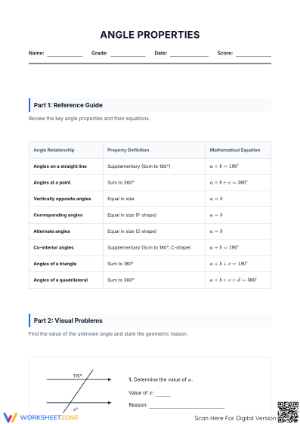
These angle relationships printable worksheets for 7th grade give students practice moving from diagram recognition to equation-based problem solving — the exact progression most 7th-grade geometry units require. The set covers complementary, supplementary, vertical, adjacent, and linear pair angles through varied task formats: identification exercises, diagram-to-vocabulary matching, and algebra problems where students write and solve equations from labeled figures. Answer keys include equation setups alongside final values, which matters when a student's arithmetic is correct but their reasoning started from the wrong relationship.
What the Set Covers and How It's Sequenced
Each worksheet targets a defined piece of the angle relationships unit rather than cycling through every concept in one sitting. Here is what the set builds across the sequence:
- Identifying angle pairs: Students mark complementary, supplementary, vertical, adjacent, and linear pair angles in labeled diagrams, including cases where two relationships look visually similar.
- Arithmetic angle problems: Given one angle measure, students find its complement, supplement, or the vertical angle opposite it — and write the relationship in words before calculating.
- Equation setup and solving: Diagrams with algebraic expressions, such as (2x + 14)° and (x + 38)° labeled as vertical angles, require students to write the equation, solve for x, and then find each angle's actual measure.
- Mixed-relationship figures: Later worksheets place multiple angle types in a single figure so students must decide which relationship applies before choosing a solution method.
- Justification prompts: Selected problems ask students to write one sentence explaining why two angles are related as they are — a format that surfaces vocabulary gaps calculation problems alone won't reveal.
That sequence — single relationship first, then mixed application — mirrors how most 7th-grade teachers introduce this unit and gives the worksheets a natural fit from day one through end-of-unit review.
Errors Students Make Before They Ever Write an Equation
The most persistent problem in this unit is diagram misreading, not arithmetic. Students frequently assume two angles are supplementary because they appear to share a line, without confirming they actually form a linear pair. A student who writes x + 53 = 180 when the two angles are complementary has made a relationship error — and a key that shows only the final answer won't reveal that. Teachers see the wrong number and assume a calculation mistake when the real problem happened one step earlier.
Vertical angle identification breaks down when intersection diagrams aren't drawn as a clean plus-sign shape. Students use "across from each other" as a rough visual cue rather than a geometric definition, so a slightly rotated or asymmetrical figure sends them to the wrong pair. The worksheets include diagrams that vary in orientation for exactly this reason — catching visual habit errors while the stakes are low.
The complementary-versus-supplementary confusion also persists longer than teachers expect. Students who correctly solved five supplementary problems will still write x + 27 = 90 for a supplementary pair on quiz day. The mix-up resurfaces under assessment pressure. Short identification tasks distributed across several worksheets — rather than one long review session — are what actually close that gap.
Building These Worksheets Into Your Geometry Unit Plan
The most effective approach is to separate identification worksheets from equation worksheets by at least a day or two. Running them together the same class period compresses a sequence that benefits from spacing. Students who can name an angle pair reliably on Monday are often ready to write 3x − 5 = 2x + 12 from a vertical-angle diagram by Thursday — but Tuesday is usually too soon.
Bell-ringer use fits this topic well. Three problems — one identification, one arithmetic solve, one equation setup — take about six minutes and activate the vocabulary students need before a full lesson. The included answer keys let teachers cold-call confidently during the debrief without losing time to uncertainty about correct values.
For homework, single-relationship worksheets (all vertical angles, or all linear pairs) give focused repetition without asking students to make strategy decisions independently at home. Save the mixed-figure worksheets for class, where the first two problems can be walked through together before students work on their own. That's where the interpretation step needs to be visible, not hidden inside someone's homework.
Standard Alignment
The angle relationships printable worksheets for 7th grade align to CCSS.MATH.CONTENT.7.G.B.5, which requires students to use facts about supplementary, complementary, vertical, and adjacent angles in multi-step problems to write and solve simple equations for unknown measures. In classroom terms, this standard lands near the start of the 7th-grade geometry unit and connects directly to what students have been doing in the expressions and equations domain. Students who have solved one-step and two-step equations bring that skill here — the geometry layer adds the step of identifying the correct relationship first, which is the instructional hinge the whole unit turns on.
Differentiating These Worksheets Across Ability Levels
For students still building vocabulary fluency, the identification-only worksheets give a lower-stakes entry point — name the relationship, no calculation required. Pairing those worksheets with a small reference card showing a labeled diagram of each angle type lets students look up what they need so language confusion doesn't block geometric reasoning.
On-level students work through the mixed-format worksheets: identify the relationship, write the equation, solve. This is the core task the standard targets. Used this way, these angle relationships printable worksheets for 7th grade serve a mixed-ability class without requiring entirely separate materials for each tier.
For students ready for more challenge, the multi-step worksheets require finding a first angle, using that value to establish a second relationship, and solving again. Some include a justification line. A useful extension question: ask those students to explain why a specific pair of angles cannot be complementary even if their measures happen to sum to 90° — that question separates students who understand the definition from those who have only memorized the sum.
Frequently Asked Questions
Do students need to know how to solve equations before using these worksheets?
Students need one-step equation fluency before the algebraic worksheets make sense. The identification and arithmetic-solve worksheets work without that background and are a practical starting point if the class hasn't finished the equations unit yet. Once students can isolate a variable reliably, the equation-setup worksheets connect that skill to a geometry context without introducing new procedural demands at the same time.
What order should these worksheets follow across a unit?
Start with worksheets that focus on a single relationship type — complementary and supplementary first, then vertical and adjacent — before moving to mixed-figure practice. Bring in the equation worksheets once students can identify the relationship from a diagram without prompting. Mixed-figure worksheets belong in the second half of the unit, after all five relationship types have been practiced in isolation.
Can these worksheets be used for test prep and review, not just initial instruction?
The angle relationships printable worksheets for 7th grade work well at the review stage, particularly the mixed-relationship and multi-step worksheets. Those require students to choose the right strategy rather than repeat a memorized procedure. Cutting a mixed worksheet into strips also gives a fast exit-ticket format — three or four problems that take under four minutes to complete and check.
How detailed are the answer keys for diagnosing student errors?
Each worksheet's answer key includes the equation setup alongside the final angle measure wherever a problem requires solving. That format tells teachers whether a student identified the relationship incorrectly, wrote the wrong equation, or made an arithmetic error on an otherwise sound approach — a distinction that matters when deciding what to reteach and to whom.













 Interactive Worksheet Maker
 Quiz Maker
 Word Search Maker
 Crossword Puzzle Maker
 Word Scramble Generator
 Sentence Scramble Generator
 Handwriting Worksheet Generator
 Name Tracing Generator
 Fill In The Blank Generator