


























Views
Downloads

Essential Angle Relationships Worksheet | Grades 7-8
Paste this activity's link or code into your existing LMS (Google Classroom, Canvas, Teams, Schoology, Moodle, etc.).
Students can open and work on the activity right away, with no student login required.
You'll still be able to track student progress and results from your teacher account.
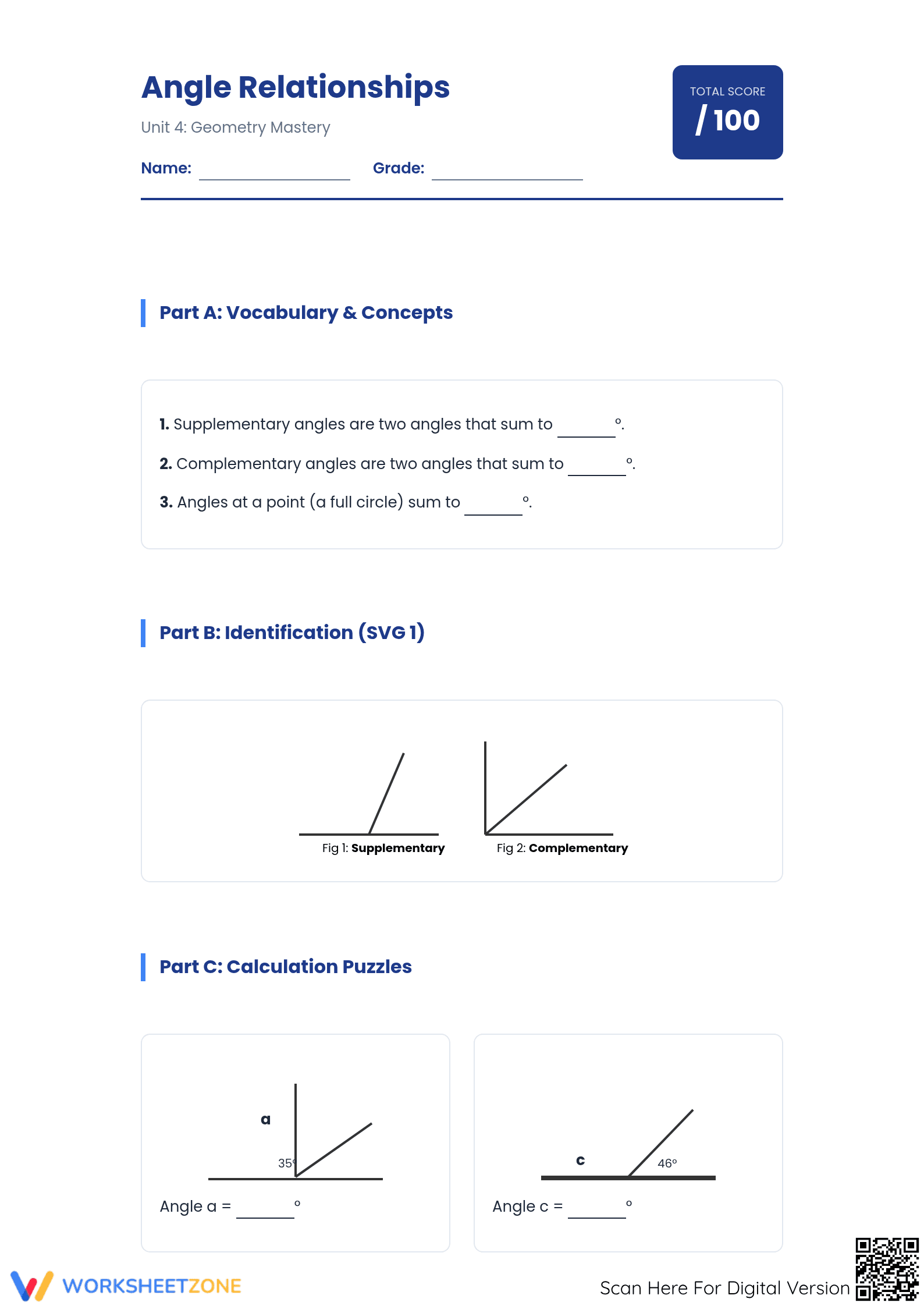
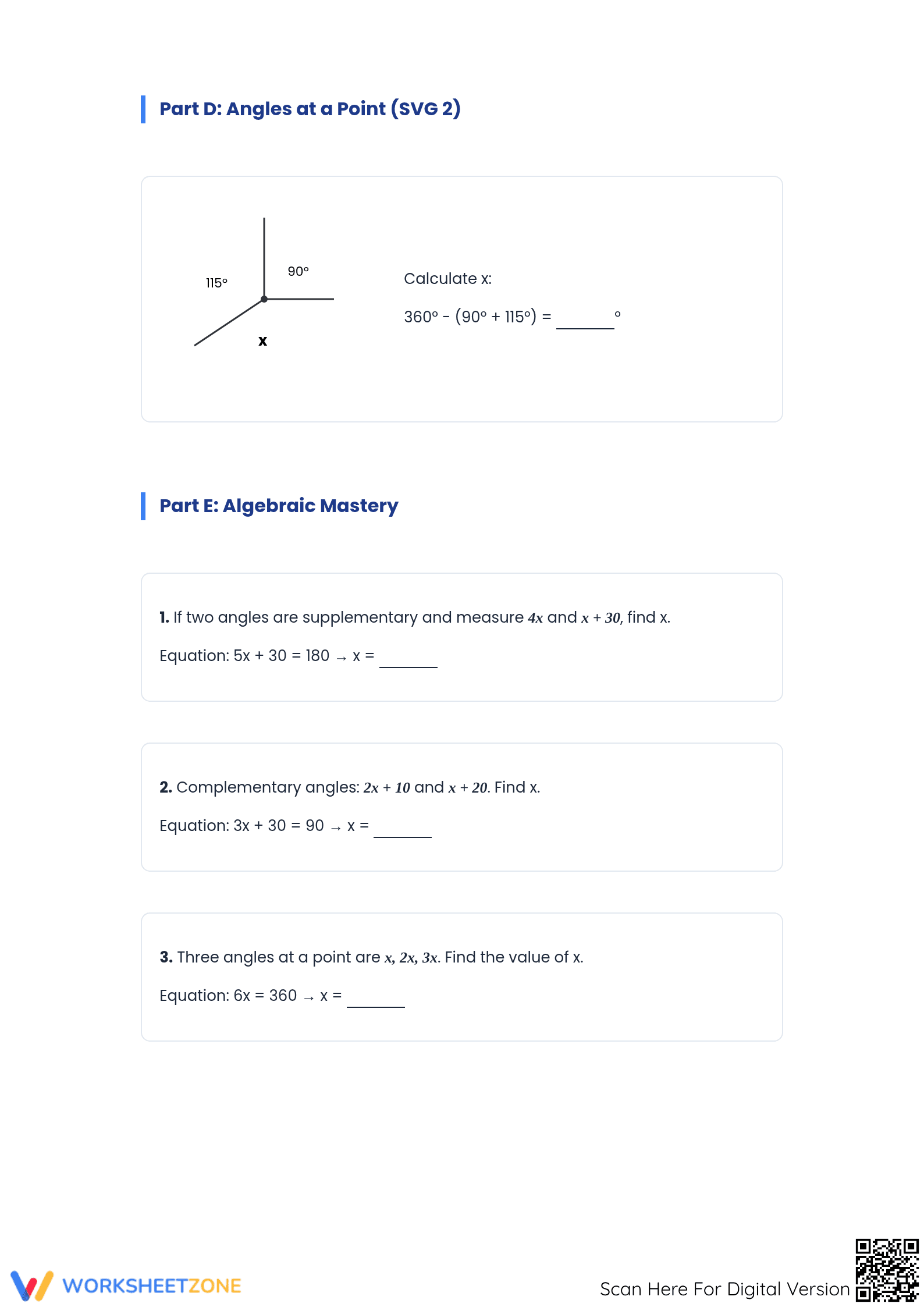
This essential Grade 7-8 geometry worksheet helps students master angle relationships through a structured progression of tasks. By identifying and calculating complementary, supplementary, and angles at a point, learners build a strong foundation for geometric reasoning. Students will solve multi-step algebraic equations, ensuring complete mastery of standard CCSS.MATH.CONTENT.7.G.B.5.
At a Glance
- Grade: 7-8 · Subject: Math
- Standard:
CCSS.MATH.CONTENT.7.G.B.5— Use angle facts to write and solve equations for unknown angles in figures- Skill Focus: Angle relationships and algebraic geometry
- Format: 2 pages · 11 problems · Answer key included · PDF
- Best For: Geometry mastery and algebraic application practice
- Time: 25–35 minutes
This comprehensive two-page PDF includes 11 targeted tasks designed to solidify geometric concepts. The worksheet features vocabulary definitions, visual identification, calculation puzzles, and algebraic mastery. It includes clear diagrams, worked-out equation templates to support learning, and a full answer key for rapid grading. This structure ensures students move from basic recognition to complex, equation-based problem solving.
Implementing this resource takes less than two minutes of preparation. First, print the two-page document (30 seconds). Next, distribute the sheets during independent practice or as a transition activity (1 minute). Finally, use the included answer key to review results or allow students to self-correct (30 seconds). This streamlined workflow makes it an ideal choice for substitute plans, homework assignments, or quick formative assessments without any teacher setup required.
Standards Alignment
This worksheet is aligned with `CCSS.MATH.CONTENT.7.G.B.5`, requiring students to use facts about supplementary, complementary, vertical, and adjacent angles to write and solve simple equations. By integrating variables into geometric figures, the resource also supports foundational algebraic skills. Both standard codes can be copied directly into lesson plans, IEP goals, or district curriculum mapping tools to ensure instructional compliance and accurate progress tracking.
How to Use It
Use this worksheet during the "You Do" phase of instruction to monitor student progress after introducing angle definitions. It serves as an excellent formative assessment tool; observe students in Part E to see if they can translate geometric relationships into algebraic equations. The expected completion time is 30 minutes, making it a perfect fit for a standard class period or homework.
Who It's For
This resource is designed for Grade 7 through Grade 10 students mastering middle school geometry or reviewing fundamentals. It provides scaffolding for learners who need visual cues and equation frames while offering rigorous algebraic challenges for advanced students. It pairs naturally with an introductory lesson on angle types or a geometry anchor chart for quick student reference.
According to the RAND AIRS 2024 report, providing students with structured practice that bridges the gap between geometric visualization and algebraic computation is critical for retention of spatial reasoning skills. This worksheet addresses that need by systematically guiding learners through the CCSS.MATH.CONTENT.7.G.B.5 standard. By starting with conceptual vocabulary and moving toward complex equation-based problem solving, the resource aligns with best practices for cognitive load management. Researchers emphasize that this type of scaffolded independent practice allows students to internalize geometric properties before applying them to abstract algebraic contexts. Using this printable ensures that learners receive 11 high-quality, standards-aligned tasks that support mastery of complementary, supplementary, and angles at a point while maintaining a zero-prep environment for busy educators, allowing for more focused direct instruction.


