


























Views
Downloads

Essential Angle Relationships Practice | Grade 7 Math
Paste this activity's link or code into your existing LMS (Google Classroom, Canvas, Teams, Schoology, Moodle, etc.).
Students can open and work on the activity right away, with no student login required.
You'll still be able to track student progress and results from your teacher account.
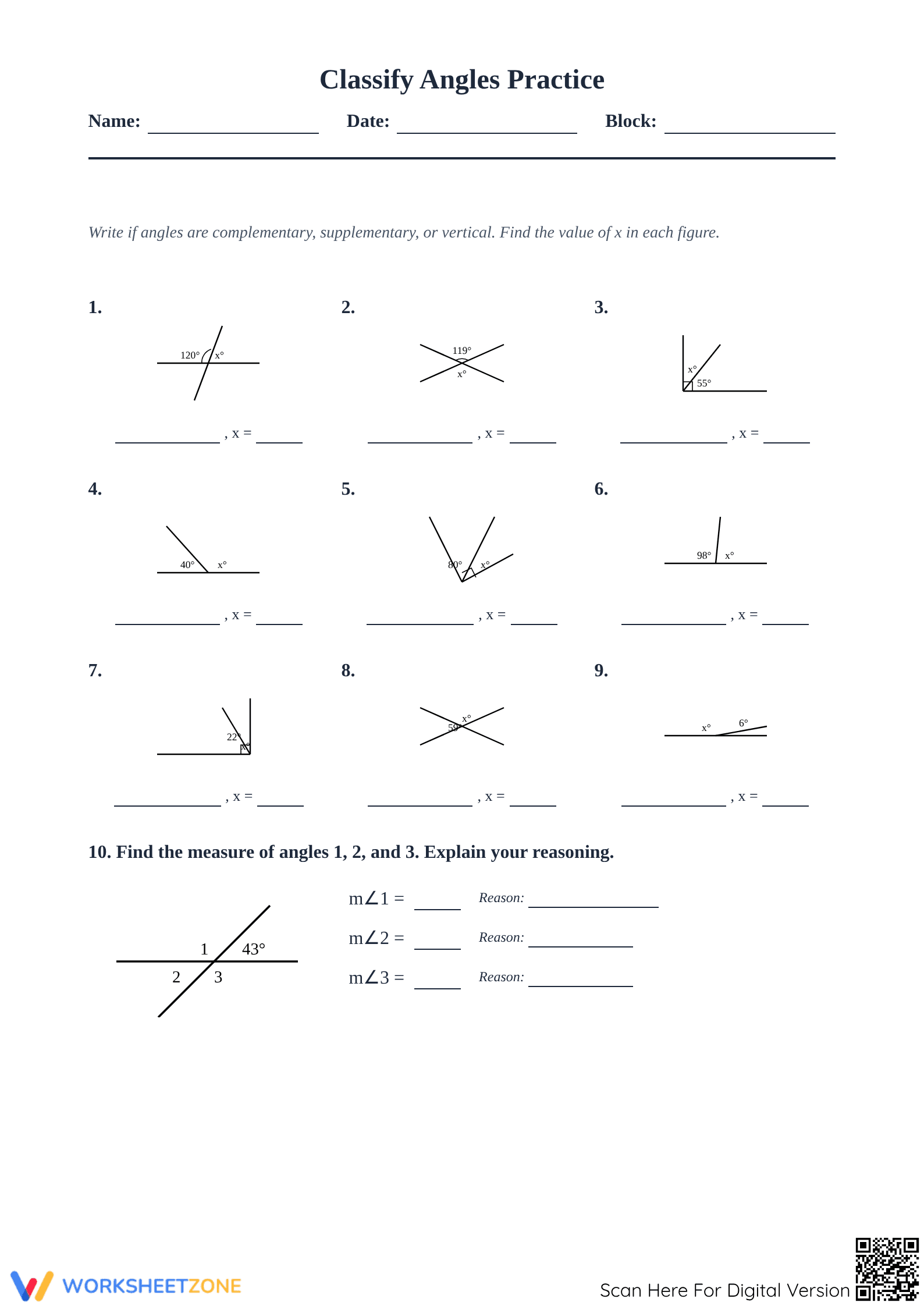
This Grade 7 math worksheet provides essential practice for identifying and calculating angle relationships. Students apply geometric properties to solve for unknown variables and justify their mathematical reasoning. By mastering these concepts, learners build the foundation for high school geometry and advanced spatial reasoning.
At a Glance
- Grade: 7 · Subject: Math
- Standard:
CCSS.MATH.CONTENT.7.G.B.5— Use angle facts to write and solve equations for unknown angles- Skill Focus: Complementary, Supplementary, and Vertical Angles
- Format: 2 pages · 11 problems · Answer key included · PDF
- Best For: Independent practice or formative assessment
- Time: 25–35 minutes
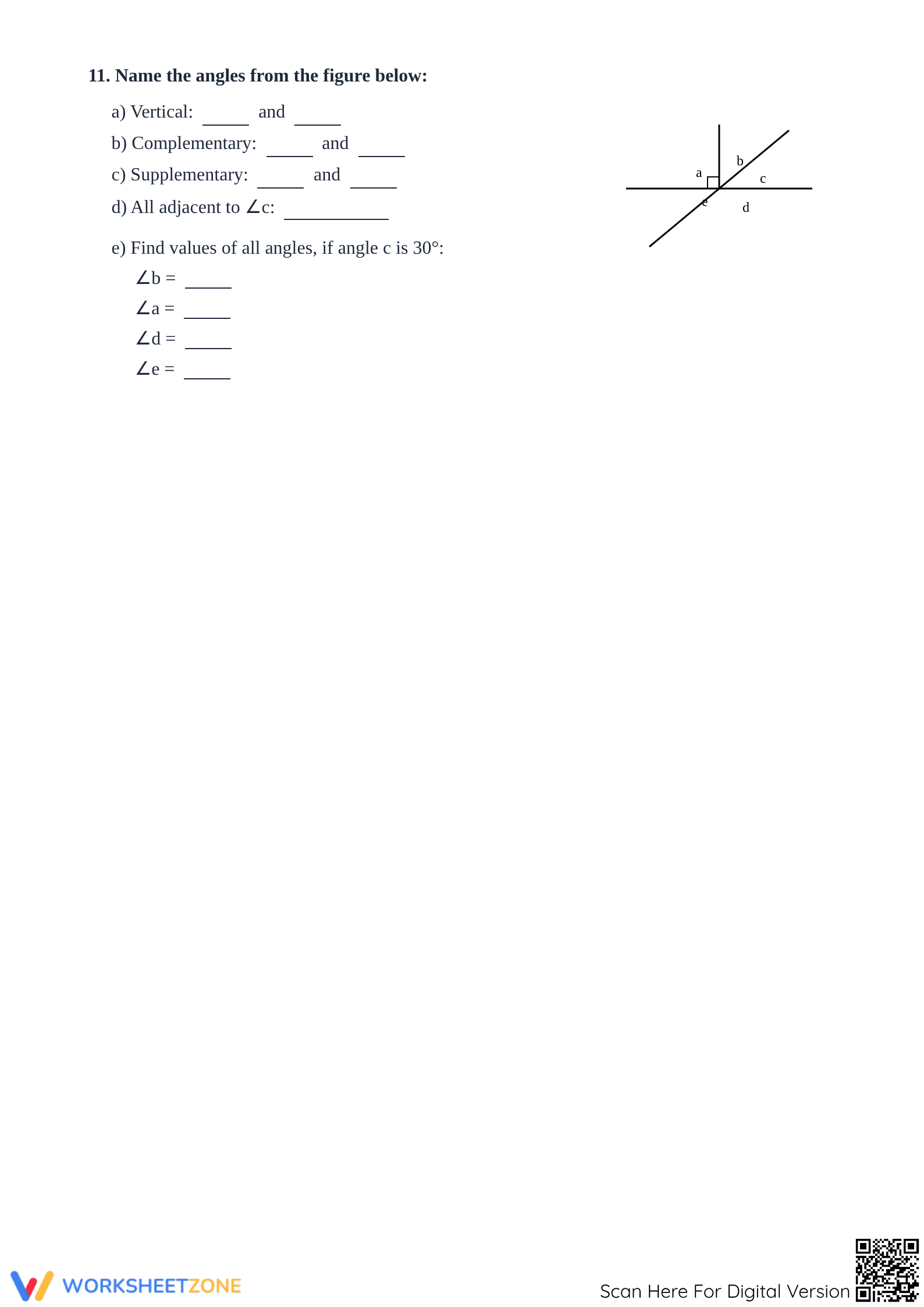
Inside are two pages of geometric exercises. Page one features nine visual problems where students classify relationships and solve for x. It concludes with a challenge requiring students to find three angle measures and provide written reasoning. Page two uses a complex figure for naming angle pairs and performing multi-step calculations based on a given value.
This resource supports a zero-prep workflow. 1. Print: Select the PDF and print for your roster (30 seconds). 2. Distribute: Hand out as a bell-ringer or independent session (1 minute). 3. Review: Use the included answer key for immediate feedback or peer-grading (5 minutes). Total prep time is under 2 minutes, perfect for substitute plans.
Aligned to CCSS.MATH.CONTENT.7.G.B.5, which requires students to use angle facts to solve simple equations for an unknown angle. The worksheet also supports foundational skills for Grade 8. Both standard codes can be copied directly into lesson plans, IEP goals, or district curriculum mapping tools.
Use this during the independent practice phase of a lesson. After demonstrating how to set up equations for 90 and 180-degree angles, assign this for seatwork. For formative assessment, check problem 10; if students struggle with the "Reason" column, they may need more vocabulary support for geometric proofs. Completion takes 25 to 35 minutes.
This set is tailored for 7th-grade students but serves as a review for 8th and 9th graders. It provides visual support for learners through clear diagrams. Pair this resource with an anchor chart displaying definitions of vertical and adjacent angles for maximum instructional impact in the classroom.
Effective geometry instruction requires students to move beyond rote memorization toward the application of properties. According to Fisher & Frey (2014), the gradual release of responsibility is most effective when students are provided with structured opportunities to justify their mathematical thinking. This worksheet facilitates that transition by requiring students to not only calculate the value of x but also to name the relationship and explain their reasoning in writing. By targeting CCSS.MATH.CONTENT.7.G.B.5, the resource ensures that students are practicing the specific multi-step equation solving required for middle school mastery. Research from EdReports (2024) emphasizes that high-quality math materials must balance procedural fluency with conceptual understanding. This 2-page PDF achieves that balance by combining simple identification tasks with complex figures that demand higher-order spatial analysis and logical deduction.


