


























Views
Downloads


Essential Angle Relationships Worksheet | Grade 7 Math
Paste this activity's link or code into your existing LMS (Google Classroom, Canvas, Teams, Schoology, Moodle, etc.).
Students can open and work on the activity right away, with no student login required.
You'll still be able to track student progress and results from your teacher account.
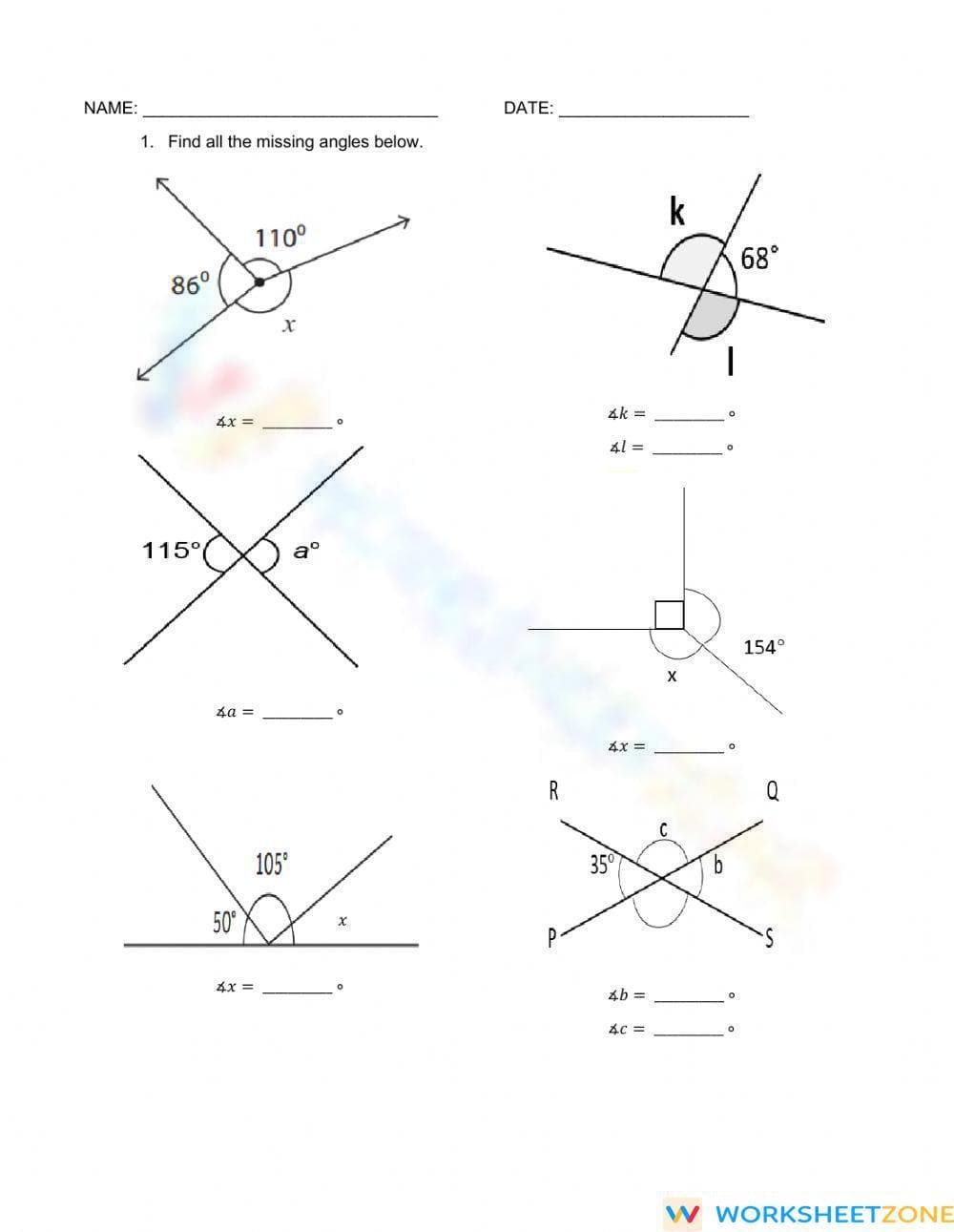
This geometry worksheet helps seventh-grade students master angle relationships by solving for unknown values. Students apply geometric rules to find missing measurements in intersecting lines, straight angles, and angles at a point. By calculating these values, learners build the foundational spatial reasoning required for high school geometry and advanced algebraic problem-solving.
At a Glance
- Grade: Grade 7 · Subject: Geometry
- Standard:
CCSS.MATH.CONTENT.7.G.B.5— Use angle facts to write and solve equations for unknown angles- Skill Focus: Supplementary, vertical, and adjacent angles
- Format: 2 pages · 8 problems · Answer key included · PDF
- Best For: Independent classroom practice, homework, and quick review
- Time: 20–30 minutes
What's Inside
This comprehensive two-page PDF contains eight multi-part geometry problems designed to test student understanding of angle properties. The worksheet features clear, high-resolution diagrams illustrating intersecting lines, perpendicular rays, and adjacent angles. Students will find a dedicated space to write their final numerical answers for each variable, including x, a, b, c, k, and l. A complete answer key is provided to facilitate rapid grading and self-assessment.
Skill Progression
- Guided Practice: The first three problems scaffold learning by presenting basic intersecting lines and straight angles with clear visual cues, requiring single-step subtraction.
- Supported Practice: Problems four through six introduce multi-step scenarios, including right angles and multiple unknown variables on intersecting lines, requiring students to combine angle rules.
- Independent Practice: The final two problems on page two challenge students with complex multi-line intersections and word-based geometric descriptions, requiring them to write equations to solve for the target angles.
This structured layout follows a gradual-release model, moving students from basic recognition to independent algebraic application.
Standards Alignment
This resource aligns directly with the Common Core State Standards for middle school mathematics. The primary focus is `CCSS.MATH.CONTENT.7.G.B.5`, which requires students to use facts about supplementary, complementary, vertical, and adjacent angles in a multi-step problem to write and solve simple equations for an unknown angle in a figure. Additionally, it supports foundational geometric concepts from Grade 6 regarding variable equations. Both standard codes can be copied directly into lesson plans, IEP goals, or district curriculum mapping tools.
How to Use It
Use this worksheet during the independent practice phase of your lesson on angle relationships, or as a formative assessment at the end of a geometry unit. Teachers can observe students during the transition from page one to page two to identify who struggles with multi-step equations. The worksheet typically takes 20 to 30 minutes to complete.
Who It's For
This resource is designed for seventh-grade math students, but it also serves as an excellent review for eighth graders or an extension activity for advanced sixth graders. Pair this worksheet with a direct instruction lesson on supplementary angles or a hands-on protractor activity to reinforce the visual concepts before students begin calculating.
This worksheet targets `CCSS.MATH.CONTENT.7.G.B.5` by requiring students to apply geometric theorems to solve for unknown angles. According to research by Fisher & Frey (2014) on the gradual release of responsibility, scaffolding geometry tasks from simple vertical angles to complex multi-line intersections helps students build spatial reasoning and algebraic fluency. By practicing these structured problems, students transition from concrete visual identification to abstract mathematical reasoning. This progression is critical for success in high school geometry, where students must write formal proofs based on these exact angle relationships. The inclusion of diverse problem types ensures that students develop a flexible understanding of how supplementary, complementary, and vertical angles interact in various geometric configurations, preparing them for standardized assessments and future STEM coursework.


