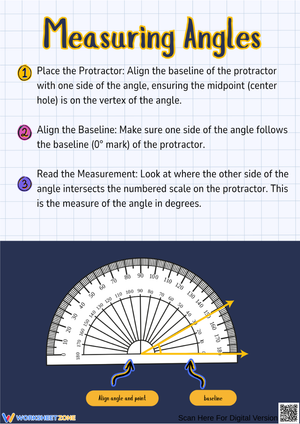
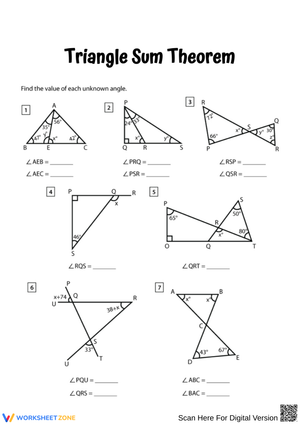
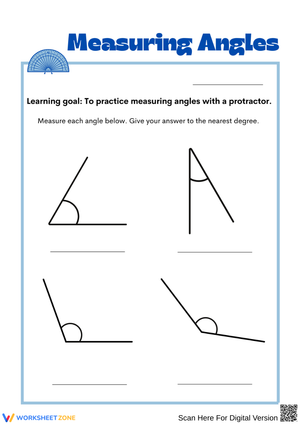
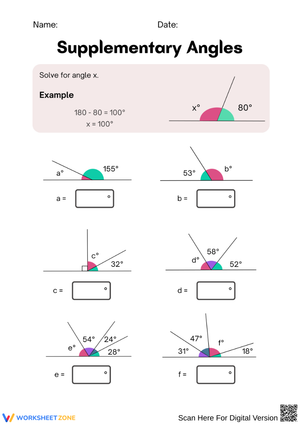
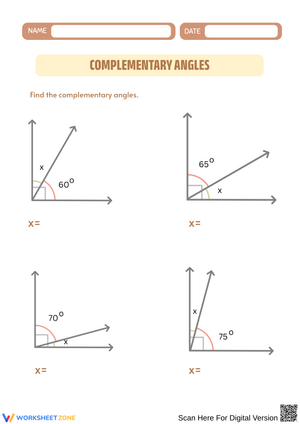
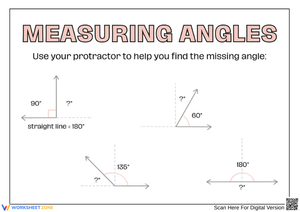
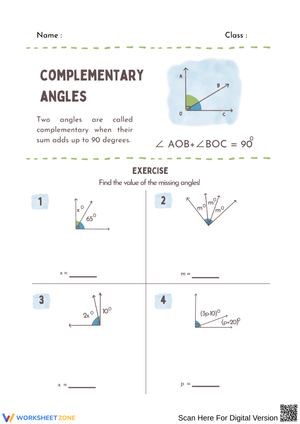
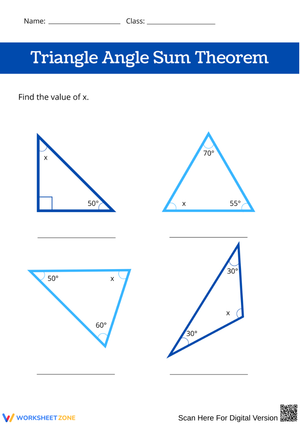
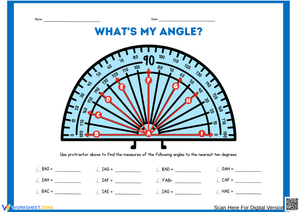
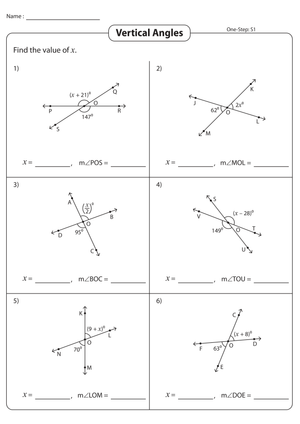
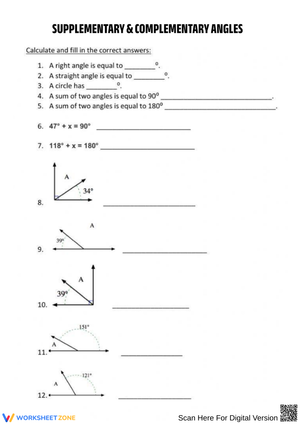
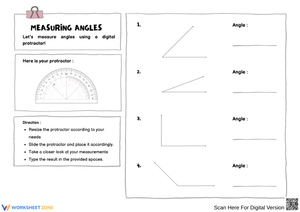
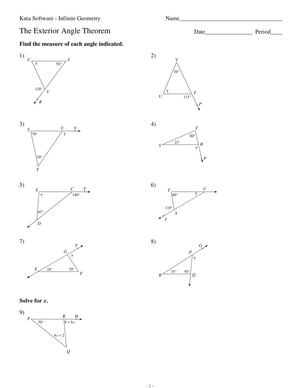
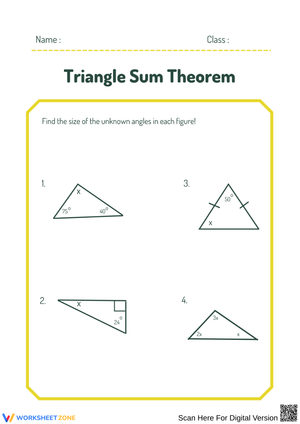
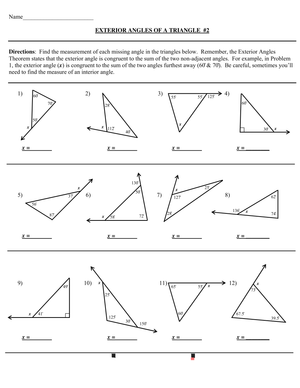
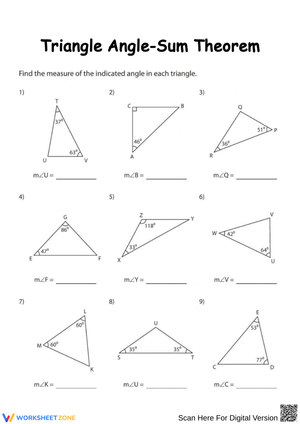
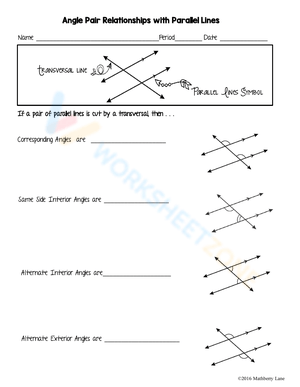
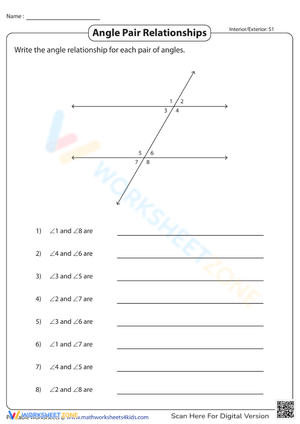
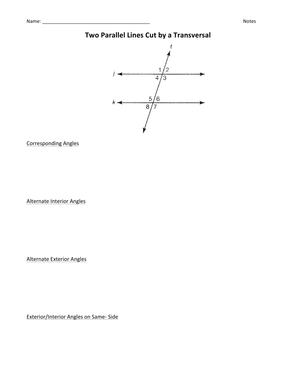
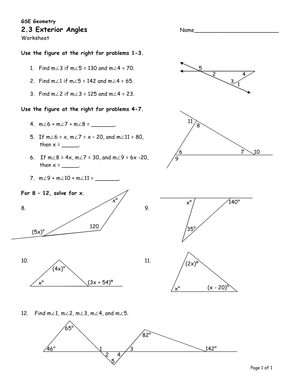
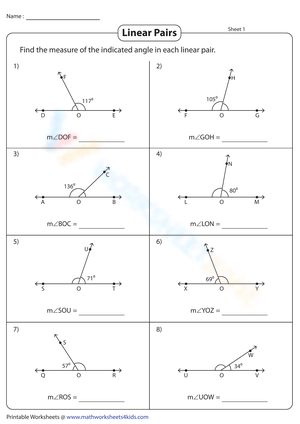
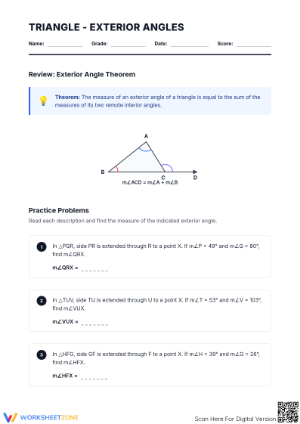
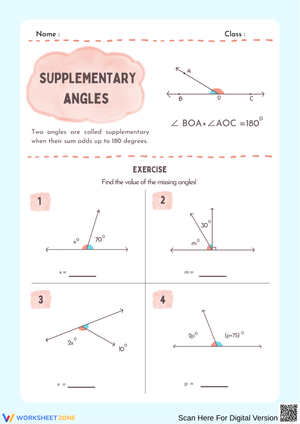
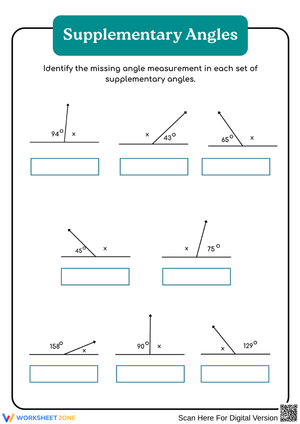
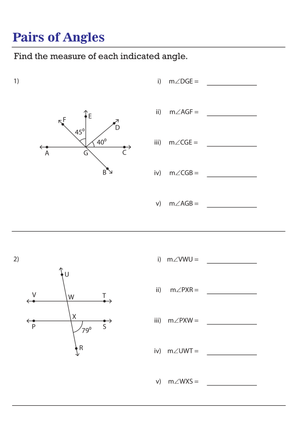
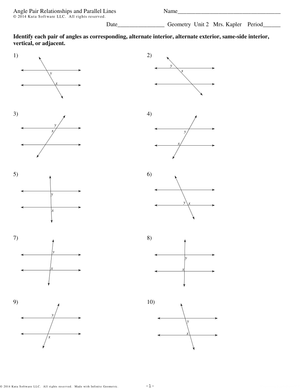
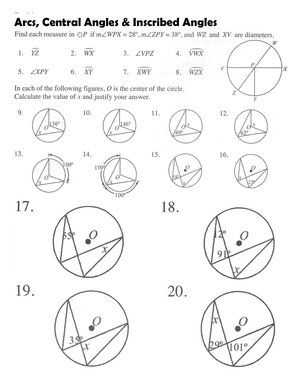
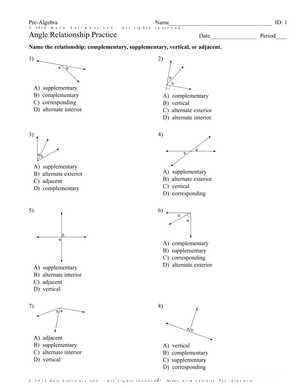
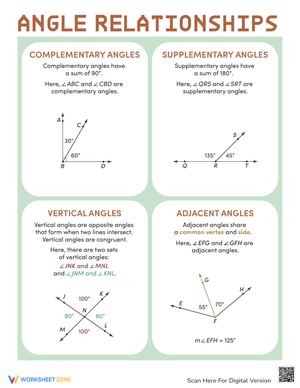
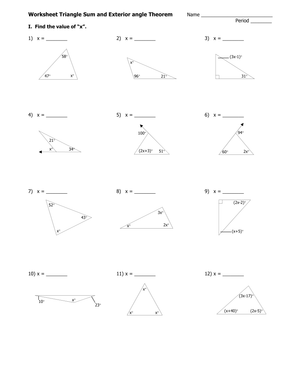
These 7th grade angles pdf worksheets target the four angle relationships at the center of grade 7 geometry—complementary, supplementary, vertical, and adjacent—and extend into algebraic reasoning, where students write equations to find unknown angle measures. The set moves from identification tasks with labeled diagrams into multi-step problem solving, asking students to connect what they observe in a figure to a mathematical rule before they calculate. Teachers who have run this unit recognize the pattern quickly: students can recite the definitions by day two but need repeated, deliberate practice before the equation-writing becomes reliable.
What Students Work Through Across the Set
A well-organized set of 7th grade angles pdf worksheets gives teachers the range to match the right resource to the right moment in a unit, and the worksheets here do that by targeting distinct layers of angle reasoning. The earliest tasks ask students to identify and name angle pairs in diagrams—no calculation required. That recognition work matters more than it seems. Students who cannot reliably distinguish a supplementary pair from an adjacent pair in a figure with multiple angles will choose the wrong equation every time, and the algebra gives them a confident-looking wrong answer.
Once identification is solid, the practice shifts to single-variable equation solving. A typical problem shows two complementary angles, one labeled with a number and one with an expression like 3x - 8. Students write the equation, solve, then confirm the result makes sense in the figure. Vertical angle problems introduce a different structure—both expressions get set equal to each other rather than summed to a constant—and that structural shift catches students who have been memorizing steps rather than reasoning from the relationship. The more advanced worksheets in the set place three or more labeled angles in one diagram, requiring students to solve sequentially: find one angle, then use that value to determine the next.
- Angle pair identification: Students mark, label, and name complementary, supplementary, vertical, and adjacent angles across diagrams that vary in complexity.
- Single-variable equation practice: Students translate a geometric relationship into an equation and solve it, with space provided to show each step.
- Multi-angle diagram work: Students work through figures where solving one unknown gives them what they need to find the next, building sequential reasoning rather than isolated calculation.
- Application problems: Short context-based prompts ask students to interpret an angle situation without a diagram, strengthening transfer beyond figure-only work.
- Error analysis: Selected worksheets show a worked solution with a deliberate mistake; students identify the error and correct the reasoning.
Student Mistakes to Anticipate Before You Assign These
The most persistent error across 7th grade angle work is the complementary-supplementary flip. A student who confidently states "complementary angles add to 90" will still write x + 42 = 180 when the diagram shows a clear right angle marker. The confusion compounds when both relationship types appear in the same worksheet, because students make a classification decision before they calculate—and a wrong classification produces an entirely confident-looking wrong answer. The tell in student work is a result that is numerically plausible but geometrically impossible once you check it against the diagram.
Vertical angles create a different problem. Many students expect vertical angles to look like a V with both rays pointing upward, so when the intersecting lines form a flatter X or the diagram is rotated, they misidentify which angles are vertical. Watching students annotate a diagram before they write an equation surfaces this error faster than reviewing final answers after the fact.
Adjacent angles cause systematic errors in diagrams with transversals. Because adjacent angles share a side, students assume they must also be supplementary—so they add the wrong pair, reach a believable total, and proceed confidently in the wrong direction. A brief sorting task at the start of a lesson, asking students simply to mark angle pairs as adjacent or supplementary, reduces this confusion before independent work begins.
Finally, when solving equations like 2x + 10 = 3x - 20, students frequently stop at x = 30 without substituting back to find the actual angle measure. That substitution step is where the algebra reconnects to the geometry, and skipping it means students never verify whether the answer is reasonable in context—a habit that costs them on unit assessments.
Building These Worksheets Into Your Lesson Plans
The most practical organizational move is to sort the set into three folders by function: identification, equation-solving, and mixed review. That simple system makes it possible to pull the right worksheet during a lesson without combing through a larger file. On a day when students need reteaching on naming relationships, grab from the identification folder. On a day when they are ready for more complex work, pull a multi-step diagram worksheet. For sub plans written the evening before, the folder labels tell a substitute exactly what to hand out without additional explanation.
Within a standard 45-minute block, a workable sequence is to open with two or three identification problems as a warm-up, model one equation-solving example with the class, then move students into independent work on the day's target worksheet. The last five to eight minutes—the stretch that is hard to fill with anything substantive before the bell—works well as a pair-check: students swap worksheets, compare their answers, and flag any disagreements for a brief whole-class exchange. That routine produces useful formative data without requiring a separate assessment tool.
Single-skill worksheets fit station rotations well, too. Placing an identification worksheet at one station and an equation-solving worksheet at another lets student groups rotate by readiness rather than by a fixed timer, so students who still need work on naming relationships stay with that task while others move into algebraic solving.
These 7th grade angles pdf worksheets also adapt well to homework. A short, single-skill worksheet sent home after direct instruction reinforces the exact content students practiced in class—not a mixed set that asks them to self-sort concepts they have not yet fully separated.
Standard Alignment
These worksheets align to CCSS 7.G.B.5: "Use facts about supplementary, complementary, vertical, and adjacent angles in a multi-step problem to write and solve simple equations for an unknown angle in a figure." In classroom terms, that standard marks the transition from naming angle relationships—something many students first encounter in 6th grade—to using those relationships as the foundation for algebraic equations. The identification worksheets in the set address the fact-recall component of 7.G.B.5. The equation-solving and multi-diagram worksheets address the multi-step problem-solving requirement directly. Teachers pacing a geometry unit can use identification tasks during the first few days of instruction and shift to equation-solving worksheets once students demonstrate reliable recognition.
Adjusting These Worksheets Across a Range of Learners
Students who are still building foundational understanding benefit most from worksheets with uncluttered diagrams, one variable per problem, and a consistent format throughout. When every problem follows the same structure—angle measure plus an expression, set equal to 90—students can focus on the algebra rather than re-reading the setup each time. Pairing that practice with a brief reference card listing the four relationships and their sums lets students confirm their classification before writing the equation, without converting the worksheet into a reference sheet that does the thinking for them.
On-level students handle mixed worksheets that require them to classify the relationship before solving. That decision step—"Is this supplementary or vertical?"—is what separates procedural recall from actual geometric reasoning, and the mid-difficulty worksheets in this set build in that decision consistently.
For students ready for more challenge, the multi-angle diagram worksheets and error analysis tasks serve that purpose well. Asking a student to write two sentences justifying why 3x + 15 = 165 applies to a given pair of angles is a different cognitive task than simply solving it, and it surfaces gaps that correct numerical answers would otherwise hide. Short explanation prompts can be added in the margins of any worksheet without altering the problems themselves.
Frequently Asked Questions
What angle concepts should students have down before moving into the equation-solving worksheets?
Students should be able to identify and name complementary, supplementary, vertical, and adjacent angles from diagrams before they move into equation-solving tasks. If students are still uncertain about which relationship sums to 90 and which sums to 180, the identification worksheets in the set address that gap directly. Pushing into algebraic solving before that recognition is solid produces the classification errors described above—students pick the wrong equation type and arrive at a wrong answer with full confidence.
Can these worksheets be used with 6th graders reviewing geometry or 8th graders filling in foundational gaps?
The core angle relationships—complementary, supplementary, vertical, adjacent—appear across grades 6 through 8 in most state curricula. The identification worksheets are accessible to 6th graders reviewing geometry, and the multi-step equation worksheets serve as a reasonable intervention resource for 8th graders with gaps from 7th grade. Teachers using the 7th grade angles pdf worksheets with off-grade students typically start with the identification tasks to locate the specific gap before assigning equation-solving work.
Are answer keys included, and how detailed are they?
Answer keys are included with the set. For equation-solving problems, each key shows the equation written from the angle relationship, the value of x, and the final angle measure—so teachers and students can identify exactly where an error occurred rather than just noting a wrong final answer. That level of detail matters most on the multi-step diagram worksheets, where a correct value of x can still lead to a wrong angle measure if students forget to substitute back into the expression.













 Interactive Worksheet Maker
 Quiz Maker
 Word Search Maker
 Crossword Puzzle Maker
 Word Scramble Generator
 Sentence Scramble Generator
 Handwriting Worksheet Generator
 Name Tracing Generator
 Fill In The Blank Generator