


























Views
Downloads

Angle Properties Worksheet | Grade 7-9 Essential Math
Paste this activity's link or code into your existing LMS (Google Classroom, Canvas, Teams, Schoology, Moodle, etc.).
Students can open and work on the activity right away, with no student login required.
You'll still be able to track student progress and results from your teacher account.
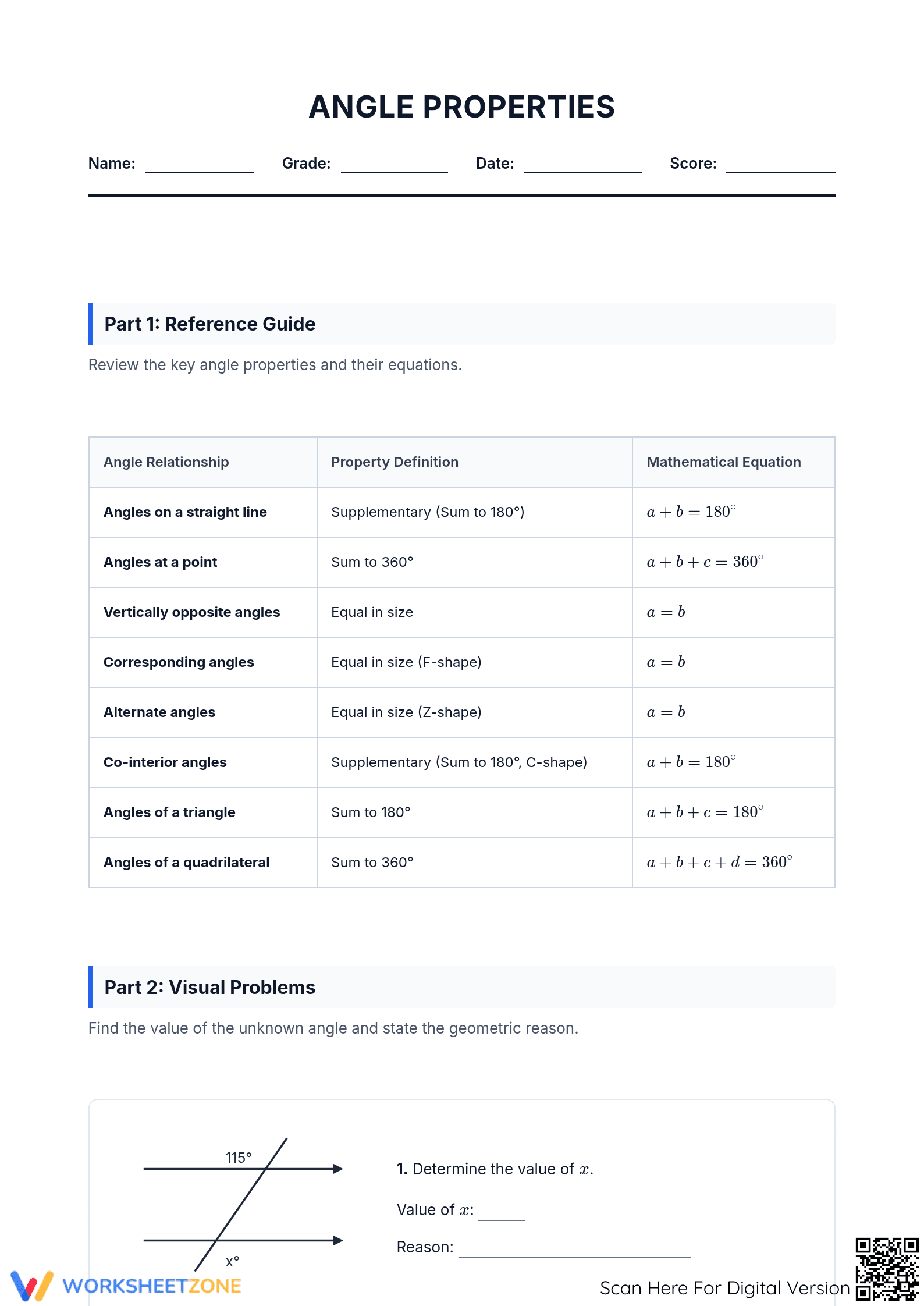
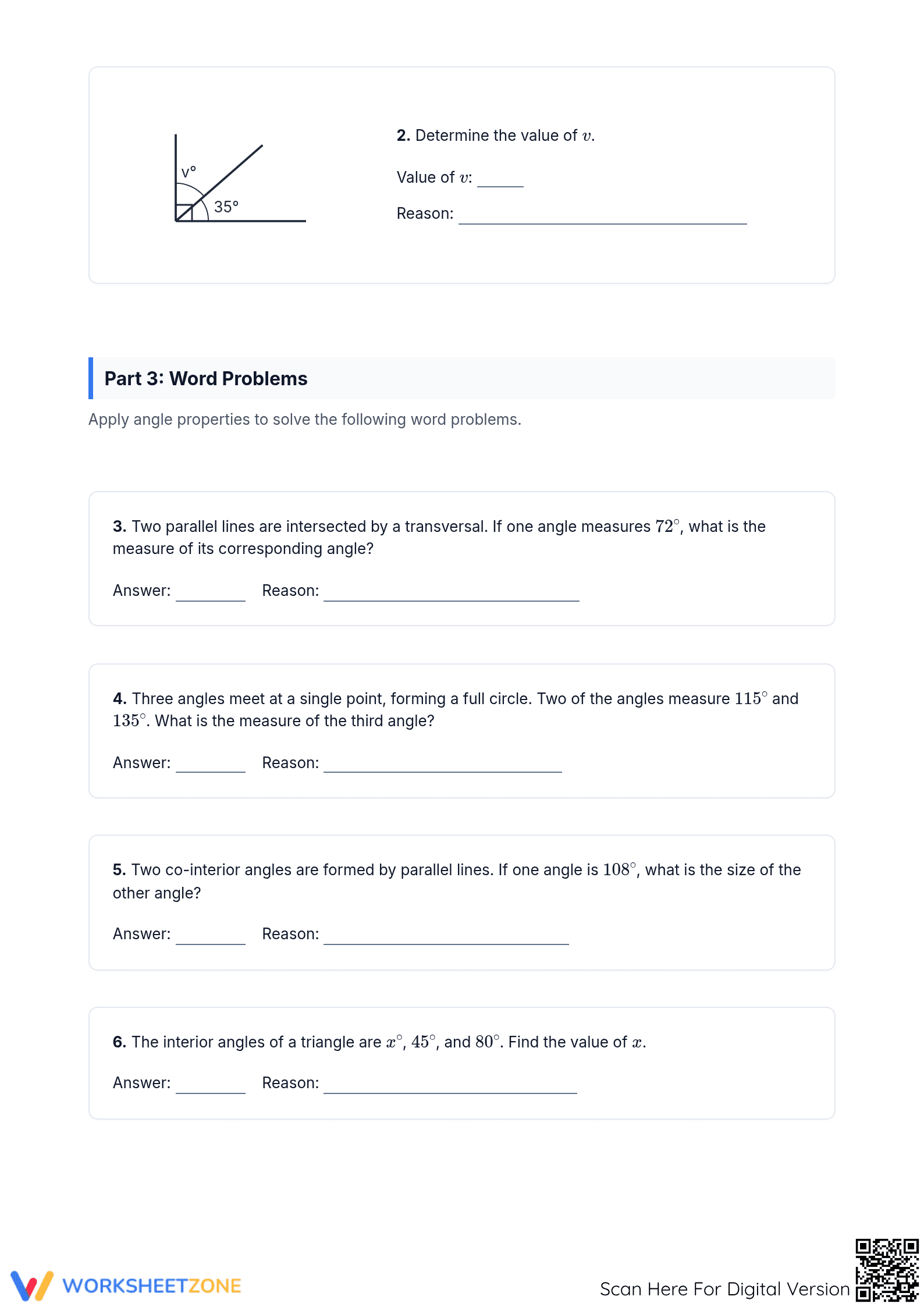
This Grade 7-9 math worksheet provides a comprehensive review of geometric angle properties, enabling students to calculate unknown values using logical reasoning. By combining a detailed reference guide with visual and word-based problems, learners develop the fluency needed to solve complex geometric equations. It ensures students can identify and apply specific theorems across various geometric configurations.
At a Glance
- Grade: 7-9 · Subject: Math
- Standard:
CCSS.MATH.CONTENT.7.G.B.5— Use angle facts to write and solve equations for unknown angles- Skill Focus: Geometric Angle Relationships
- Format: 2 pages · 6 problems · Answer key included · PDF
- Best For: Independent practice or sub plans
- Time: 20–30 minutes
The resource is structured into three distinct parts across two printable pages. Part 1 features a robust Reference Guide table that defines eight key angle relationships, including supplementary, vertically opposite, and co-interior angles, complete with mathematical equations. Part 2 presents visual problems requiring students to calculate variables from diagrams. Part 3 transitions to word problems, challenging students to visualize and solve without direct illustrations. A full answer key is provided for rapid grading.
Zero-Prep Workflow
- Print: Select the two-page PDF and print enough copies for your class (30 seconds).
- Distribute: Hand out the sheets; the built-in reference guide serves as a self-contained anchor chart, eliminating the need for a separate lecture (30 seconds).
- Review: Use the included answer key to review student work or facilitate peer-grading at the end of the period (1 minute).
Total teacher preparation time is under 2 minutes, making this an ideal solution for emergency sub plans or last-minute review sessions.
Standards Alignment
The primary focus is CCSS.MATH.CONTENT.7.G.B.5: "Use facts about supplementary, complementary, vertical, and adjacent angles in a multi-step problem to write and solve simple equations for an unknown angle in a figure." Additionally, it supports 8th-grade geometry standards regarding parallel lines cut by a transversal. Both standard codes can be copied directly into lesson plans, IEP goals, or district curriculum mapping tools.
How to Use It
Assign this worksheet during the "independent practice" phase of a geometry unit after students have been introduced to basic protractor use. It serves as an excellent formative assessment tool; observe whether students correctly identify the "Reason" for their calculation, as this reveals their conceptual understanding versus simple arithmetic. The expected completion time is 20 to 30 minutes depending on prior knowledge.
Who It's For
This material is tailored for middle school students in Grades 7 through 9, particularly those requiring a structured reminder of geometric rules. It is highly effective for students with IEPs who benefit from the scaffolded reference guide. Pair this worksheet with a digital geometry tool or a physical set of parallel line diagrams for a multi-modal learning experience.
According to the RAND AIRS 2024 report on mathematics instructional materials, the inclusion of explicit reference guides within practice tasks significantly reduces cognitive load for middle school learners. This worksheet aligns with those findings by providing a clear table of angle properties—such as alternate, corresponding, and co-interior angles—before requiring independent application. By requiring students to state the "Reason" for each answer, the resource promotes the mathematical practice of constructing viable arguments and critiquing the reasoning of others. Research from Fisher & Frey (2014) emphasizes that this gradual release of responsibility, moving from a guided reference to independent word problems, is essential for long-term retention of geometric concepts. The 6-task structure ensures that students achieve a high volume of successful repetitions without becoming overwhelmed by repetitive calculations. This evidence-based design makes the worksheet a reliable tool for achieving mastery in CCSS.MATH.CONTENT.7.G.B.5.


