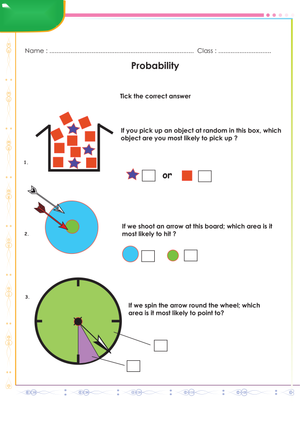
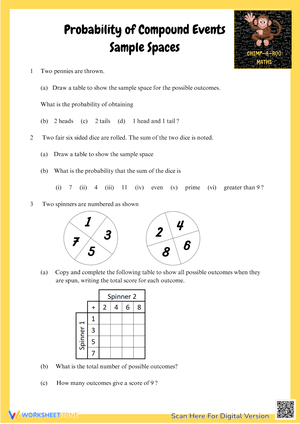
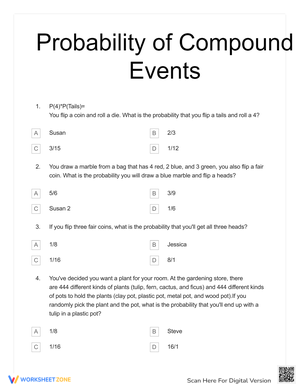
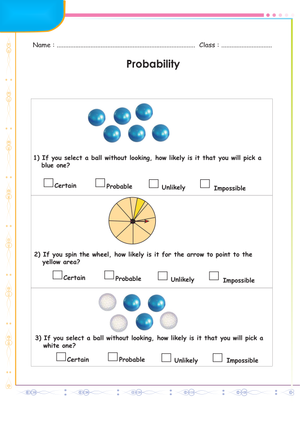
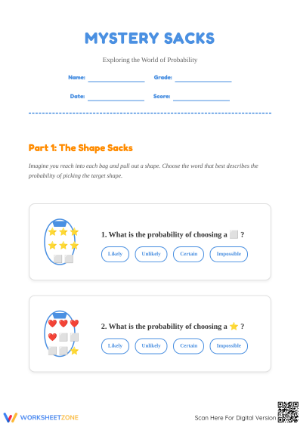
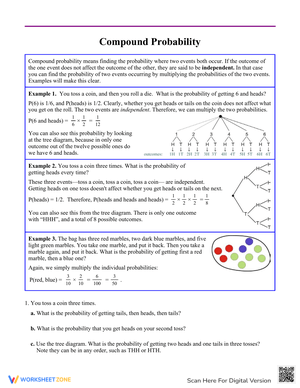
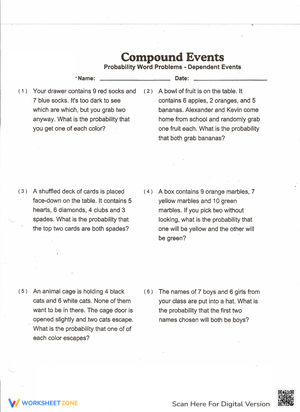
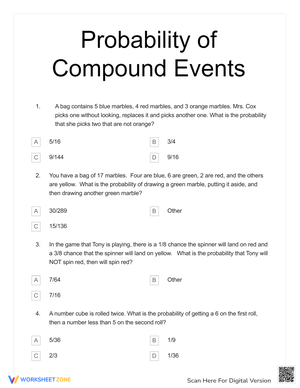
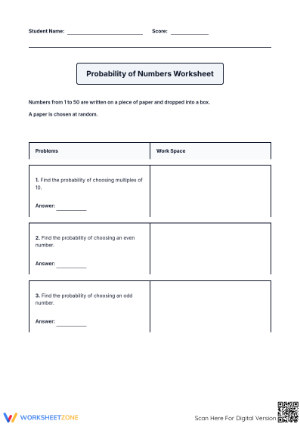
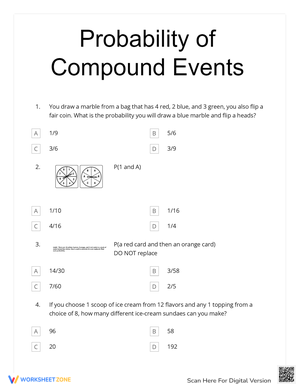
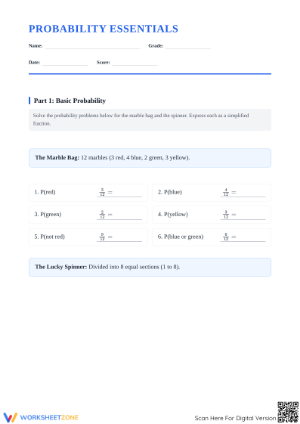
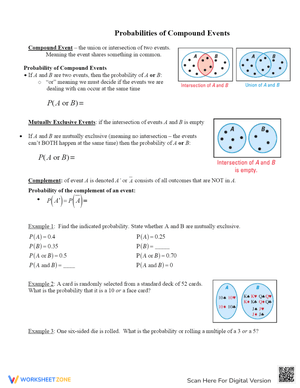
These 7th grade probability worksheets sets move students from informal probability language — likely, unlikely, impossible — into precise computation grounded in sample spaces, fractions, and numerical comparisons. Grade 7 is where probability stops being a vocabulary exercise and starts being a calculation skill, and students who leave the unit still expressing answers as vague comparisons rather than numerical values show up in 8th grade underprepared for data interpretation. Each worksheet in the set targets a specific skill so teachers can match the assignment to what the class actually needs on a given day.
The Specific Skills Each Worksheet Builds
Grade 7 probability clusters around four moves: enumerating sample spaces, computing theoretical probability, recording and interpreting experimental results, and converting among fractions, decimals, and percents. The worksheets address each one directly, in formats that progress from visual and concrete to numeric and applied.
- Simple events: finding probability from fair coins, six-sided dice, standard card draws, and labeled spinners
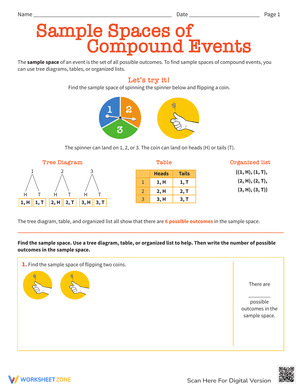
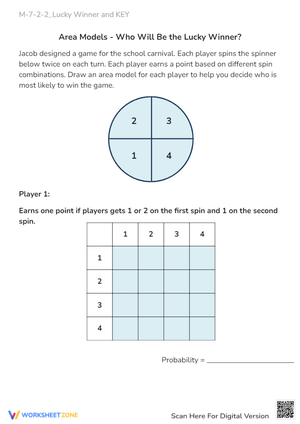
- Sample space construction: listing all outcomes systematically and using that list to justify a probability ratio
- Theoretical probability: calculating expected probability when outcomes are equally likely
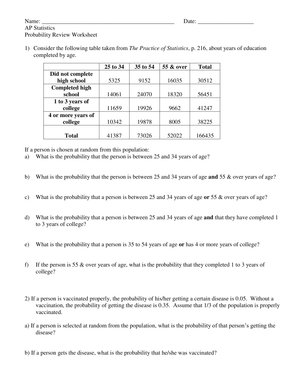
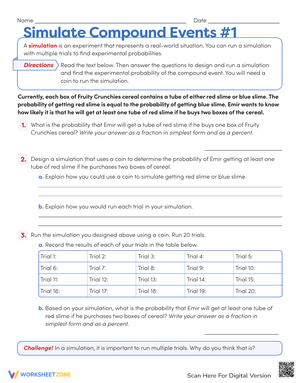
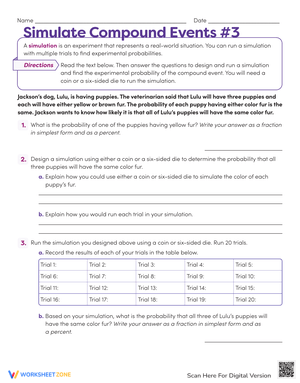
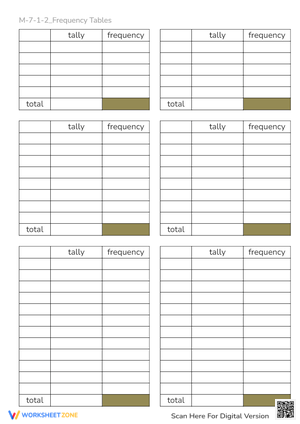
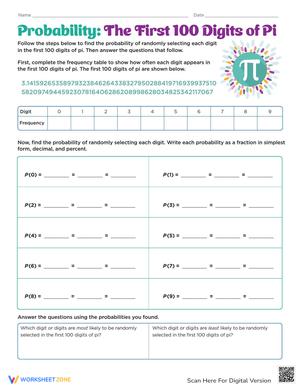
- Experimental probability: reading trial data in tables, computing frequency ratios, and comparing to theoretical predictions
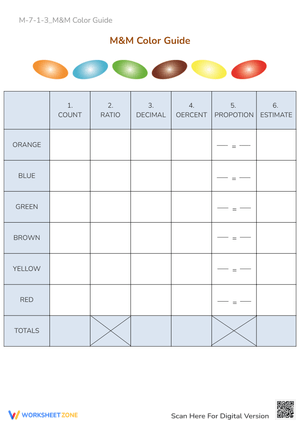
- Representation flexibility: writing the same probability as a fraction, a decimal, and a percent
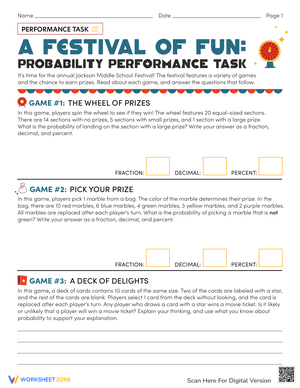
- Applied word problems: short scenarios set in familiar contexts that require students to identify the event, build the ratio, and interpret the result
The sequence matters more than the list suggests. Students who jump straight to word problems before owning sample space enumeration tend to guess at the denominator — and that guess runs in the same wrong direction almost every time. Starting with listing and labeling all outcomes builds the reasoning that makes the fraction setup feel derived rather than memorized.
Student Mistakes Worth Anticipating Before Independent Practice
The most persistent error in Grade 7 probability work is a denominator confusion that looks minor but runs deep. When asked for the probability of rolling a number greater than 4 on a standard die, a student will sometimes write 2/2 — using the count of favorable outcomes (5 and 6) as both numerator and denominator. The student knows there are two outcomes that work; the misunderstanding is that the denominator must represent all possible outcomes. Worksheets that require students to record the full sample space first, then circle favorable outcomes, then write the ratio — in that explicit sequence — disrupt this pattern more reliably than problems that jump straight to calculation.
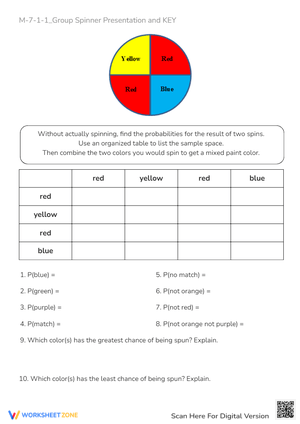
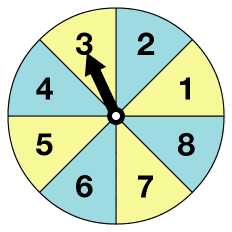
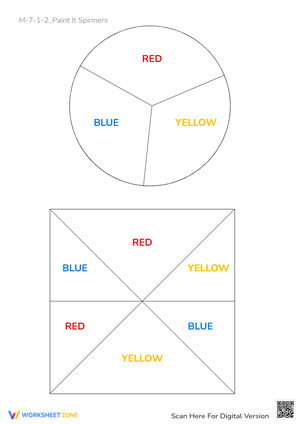
Spinners with unequal sections expose a separate misconception. Students who have internalized "probability equals 1 divided by the number of sections" will assign 1/4 to every region on a four-section spinner even when one section covers half the circle. Non-uniform spinners belong in every worksheet set because they reveal whether students understand what probability measures or are applying a memorized shortcut.
The decimal-to-percent conversion also trips students who are otherwise computing correctly. A probability of 3/8 equals 0.375 as a decimal, which students frequently report as 3.75% — moving the decimal point one place instead of two. That specific error is worth a direct whole-class example before independent practice, and it surfaces often enough on unit assessments that teachers should watch for it by name.
Working These Worksheets Into Your Unit Plan
For initial instruction, single-skill worksheets work best as immediate follow-up to direct teaching — five to eight focused problems while the lesson is still fresh. Bell work is another reliable use: three items covering the previous day's skill take about seven minutes and keep probability vocabulary active without requiring a new lesson launch. That low-stakes repetition matters in a unit where terms like sample space, theoretical, experimental, and favorable outcome need sustained exposure before students use them with any precision.
Center rotations fit this unit particularly well. One group runs a quick experiment — flipping a coin 20 times, spinning a paperclip spinner, rolling a die — while another completes an experimental-probability worksheet using trial data provided in a table. When those groups compare notes afterward, the conversation about why recorded results diverge from theoretical predictions is more durable than any explanation a lecture can produce. A well-designed 7th grade probability worksheets set provides the data tables and comparison prompts that structure that debrief without requiring teachers to build materials from scratch.
For quiz review, pull five or six items from across different worksheets — one sample space problem, one theoretical calculation, one experimental comparison, one conversion — and run them as a timed warm-up. That targeted pull gives teachers a quick formative read on where the class actually stands before assessment.
Standard Alignment
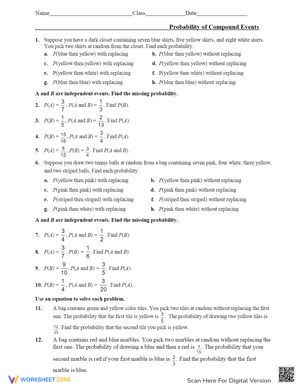
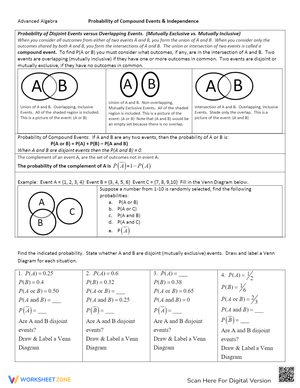
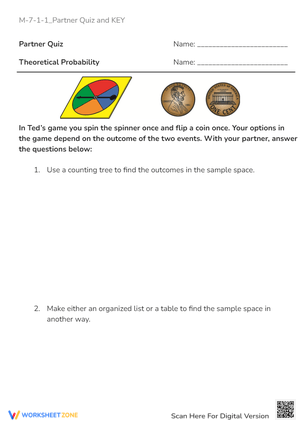
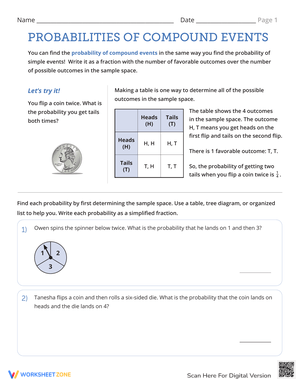
These worksheets address CCSS domain 7.SP (Statistics and Probability), specifically standards 7.SP.C.5 through 7.SP.C.8. Standard 7.SP.C.5 establishes that probability is a number between 0 and 1 — the foundational idea behind every fraction, decimal, and percent conversion task in the set. Standards 7.SP.C.6 and 7.SP.C.7 address experimental and theoretical probability as separate but related skill tracks, which is how most of the worksheets are organized. Standard 7.SP.C.8 moves into compound events and represents the upper end of the unit, appearing in worksheets that ask students to list outcomes for two-stage experiments using organized lists or tree diagrams.
Most Grade 7 teachers reach 7.SP in the third or fourth quarter, after rational number fluency is reasonably solid. Students who are still shaky on converting fractions to decimals will need extra attention specifically on the representation worksheets, because the computation there depends on clean fraction division. Knowing that before the unit begins makes grouping decisions much easier.
Adjusting the Set for Students at Different Entry Points
Probability is one of the more differentiation-friendly topics in the Grade 7 curriculum because the visual models carry genuine instructional weight at the concrete end, while conceptual explanation tasks create real challenge at the advanced end — without forcing teachers to depart from the standard entirely.
Students who need more support do best with worksheets built around coins, standard six-sided dice, or two-color counters — models they have likely encountered in earlier grades. Keep problems to single events, and let students label favorable outcomes in the sample space before they write any numbers. Skipping that labeling step to save time is the fastest route back to denominator errors.
On-level practice should mix models and short written scenarios. Students at this tier write probabilities in all three forms, place values on a 0-to-1 scale, and explain whether a result is reasonable. The interpretive piece matters — Grade 7 students need to do more than produce a correct fraction; they need to say what it means.
Students ready for greater challenge benefit from prompts that ask them to reconcile theoretical and experimental results in writing. A question like "Your 20 trials produced a probability of 7/20 for rolling an even number on a fair die. The theoretical probability is 1/2. Write two sentences explaining the difference and predict what would happen over 500 trials" raises the cognitive demand without abandoning the standard. A strong 7th grade probability worksheets set includes that kind of writing-integrated prompt alongside the computation practice, giving teachers a formative tool rather than just another exercise.
Frequently Asked Questions
What probability skills should 7th graders demonstrate by the end of the unit?
Students should be able to identify and list complete sample spaces, compute theoretical probability from equally likely outcomes, record and interpret experimental results, convert probabilities among fractions, decimals, and percents, and explain why theoretical and experimental values may differ. They should also locate any probability on a 0-to-1 scale and describe what that placement means in context — not just state the number.
How do these worksheets work when students still struggle with fraction operations?
Fraction difficulty is the most common obstacle in this unit, and it's worth planning for explicitly. Start those students on worksheets where total outcomes are small — six-sided dice, four-section spinners, two-color counters — so simplification stays minimal. Once they can set up the ratio correctly and convert to decimal form, increase the complexity. Avoid presenting fraction conversion and sample space reasoning as new challenges in the same problem; that combination overwhelms students who are still shaky on either one.
What is the difference between theoretical and experimental probability on these worksheets?
Theoretical probability is what the sample space predicts — equal outcomes, fixed ratios, no variation. Experimental probability is what actually happens when students run trials and record data. The worksheets treat them as separate calculations first, then ask students to compare the two values. That comparison is where most of the conceptual learning lives: understanding that experimental results move toward theoretical probability as the number of trials grows, but rarely match it exactly in small samples.
Can a single worksheet serve as a formative assessment, or are these strictly for practice?
Several worksheets in the set function well as formative tools when teachers collect and scan them quickly. The mixed-representation problems — writing the same probability three ways — give a clean read on computational accuracy. The explanation problems reveal whether students understand probability or are just executing a procedure. Using one worksheet as an exit ticket at the end of a lesson is among the most time-efficient ways to check for understanding before moving forward. For those uses, a 7th grade probability worksheets collection organized by skill type is far more practical than an undifferentiated review packet.













 Interactive Worksheet Maker
 Quiz Maker
 Word Search Maker
 Crossword Puzzle Maker
 Word Scramble Generator
 Sentence Scramble Generator
 Handwriting Worksheet Generator
 Name Tracing Generator
 Fill In The Blank Generator