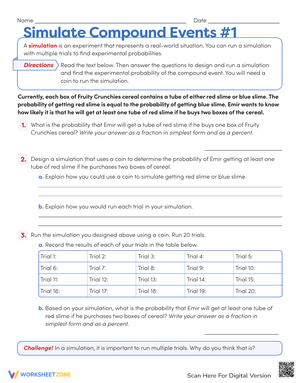
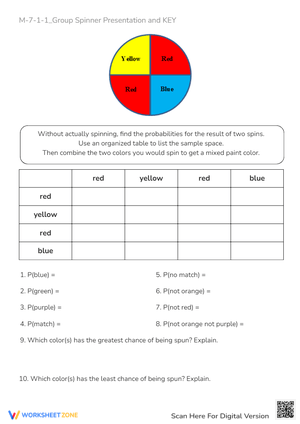
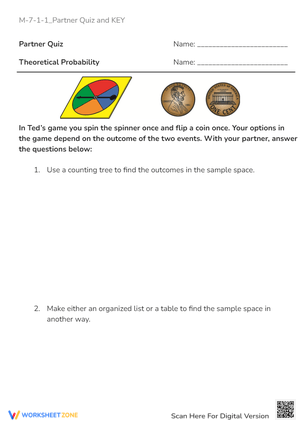
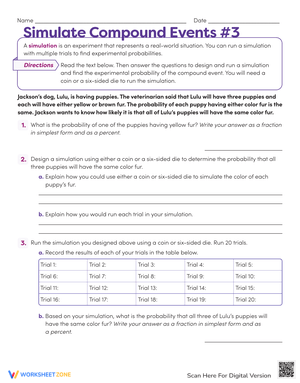
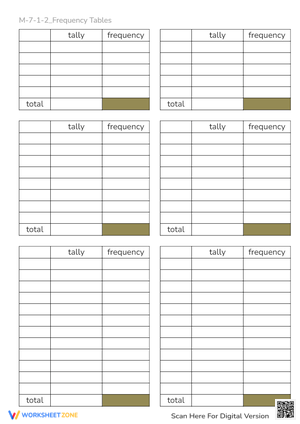
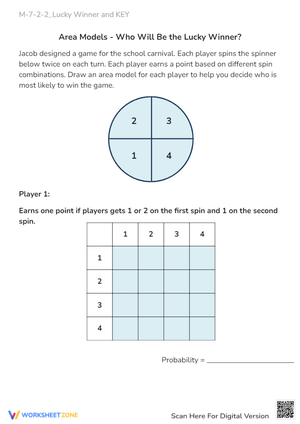
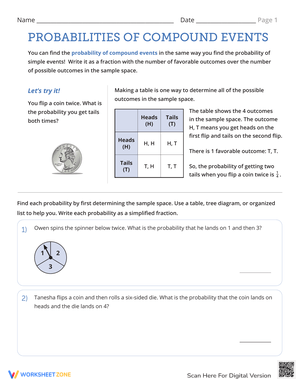
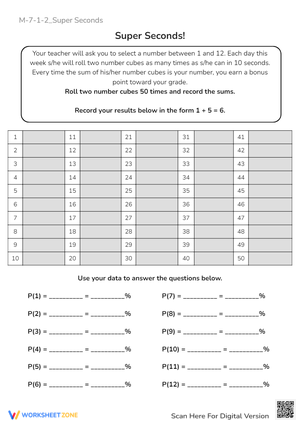
These 7th grade of compound events printable worksheets resources give teachers focused, classroom-ready probability practice at exactly the point where 7th grade math gets conceptually harder. When students move from single-event probability to compound events, they're no longer just computing one fraction — they're building sample spaces, organizing outcomes in tables and tree diagrams, and reasoning about how two or more events interact. That cognitive shift is where most gaps appear, and these worksheets address it directly.
The Skills Each Worksheet Targets
Compound events in 7th grade require students to do several things simultaneously: identify all possible outcomes, represent them in an organized model, and then calculate a probability from that model. Each worksheet in this set isolates or combines those demands in ways that match the actual sequence of instruction.
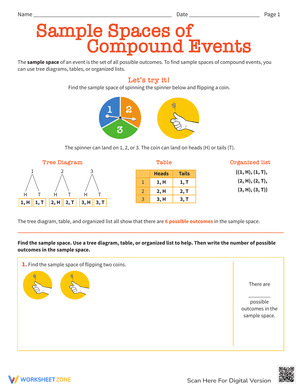
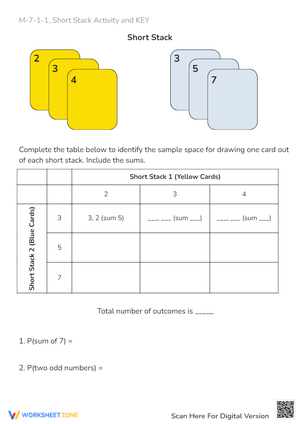
- Building sample spaces for two-step experiments using organized lists
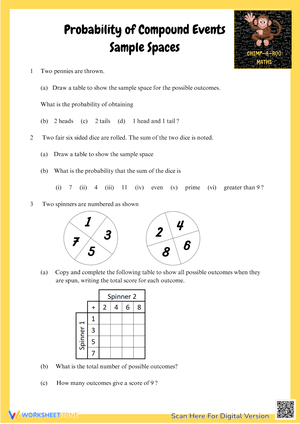
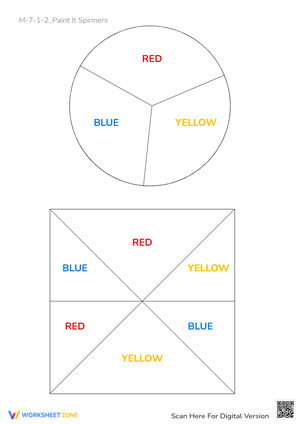
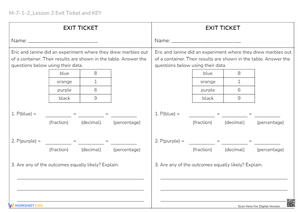
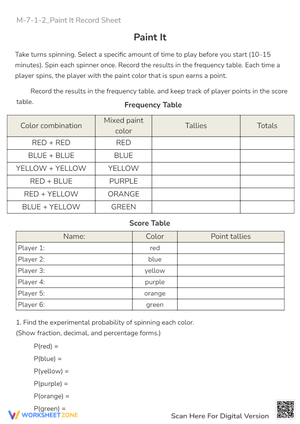
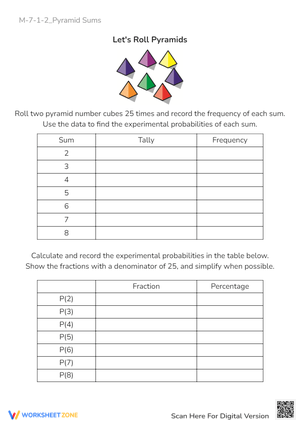
- Constructing outcome tables for events like rolling two number cubes or spinning two spinners
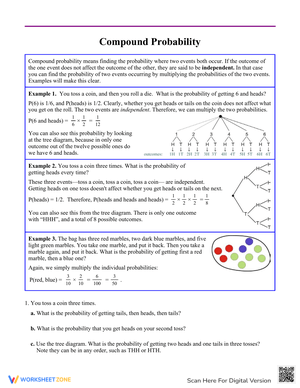
- Drawing and interpreting tree diagrams that branch across multiple stages
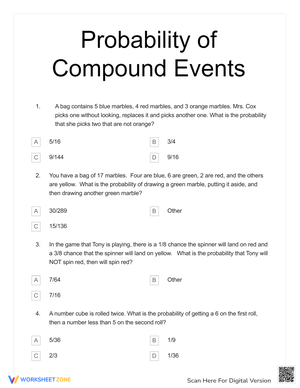
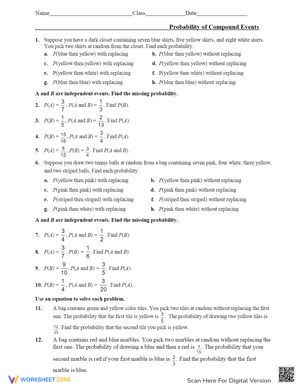
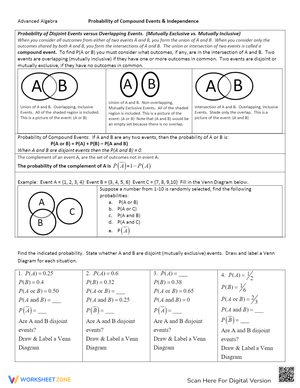
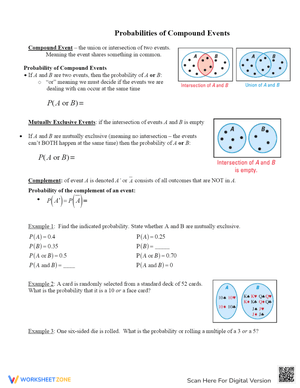
- Calculating probabilities of independent events where the first outcome doesn't affect the second
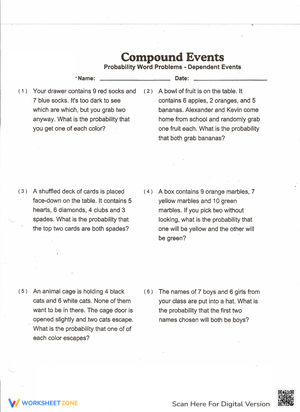
- Working through dependent event problems that involve selection without replacement
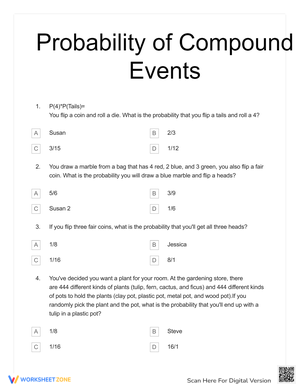
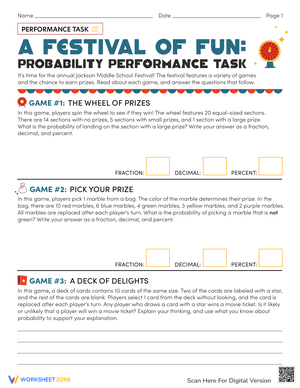
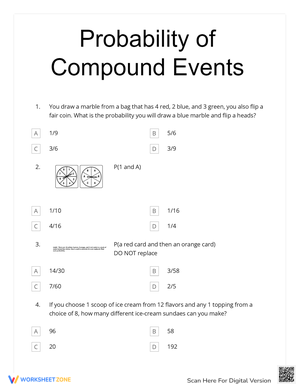
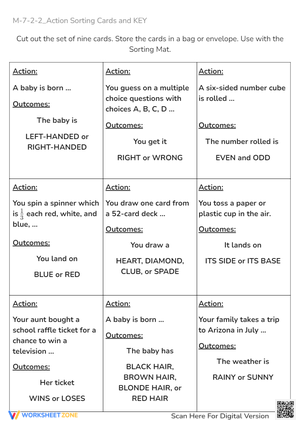
- Solving word problems set in contexts like card games, lunch selections, and marble draws
Teachers selecting 7th grade of compound events printable worksheets resources for this unit should also look for error-analysis items — tasks that ask students to examine an incorrect sample space or a flawed calculation and identify what went wrong. That task type surfaces a level of understanding that computation practice alone can't reach: it shows whether a student understands what the model is for, not just how to produce one.
Frequent Student Errors Worth Watching For and Correcting
The most persistent error in compound probability at this grade level is collapsing the sample space — treating outcomes like heads-tails and tails-heads as identical when they're actually distinct. A student who lists only 3 outcomes for two coin flips instead of 4 will produce incorrect probabilities from that point forward, and the mistake doesn't always surface until the denominator looks wrong on a final answer. These worksheets build in explicit sample-space construction tasks early in each progression, which means that collapse shows up on paper where it can be addressed before students move to calculation.
The other major error involves with-replacement and without-replacement scenarios. Students consistently carry with-replacement logic — keeping the denominator constant — into problems where an item is removed before the second draw. A student who selects a red marble from a bag of 10 and then calculates the second probability as still out of 10 is applying a rule that made sense in a previous context. The worksheets separate these two types before mixing them, and the without-replacement tasks require students to annotate what changes after the first selection, making the conceptual distinction visible on each worksheet rather than implicit in classroom instruction.
How to Build These Worksheets Into Your Lesson Plans
The most practical approach to using 7th grade of compound events printable worksheets materials is to sequence them alongside the unit rather than saving them for review at the end. A short sample-space listing task as a bell-ringer — 5 to 7 problems in 6 to 8 minutes — surfaces enough student reasoning to guide the day's instruction before you've put a single example on the board. On days when you've just introduced tree diagrams, assigning the corresponding worksheet as structured partner practice, where pairs build the diagram together before calculating individually, produces better first attempts than solo work from the start.
For intervention blocks, pull the foundational worksheets that include partially completed tables or starter diagram branches. Students who struggled with whole-class instruction often engage more readily when the organizational work is partially done and their task is to complete and interpret rather than build from scratch. For early finishers, the dependent events and error-analysis worksheets extend the same lesson without requiring separate materials.
These worksheets also work well in the last 8 to 10 minutes of class before students pack up. Assign 3 to 4 problems from a mixed compound probability worksheet and use the exit responses to sort students into reteach and extension groups for the following day. The visual nature of sample-space and tree-diagram items makes quick teacher scanning faster than reading paragraph-length written responses.
Standard Alignment
These worksheets align directly to CCSS 7.SP.C.8, which asks students to find probabilities of compound events using organized lists, tables, tree diagrams, and simulation. Two sub-standards are addressed: 7.SP.C.8a, which asks students to understand that the probability of a compound event is the fraction of outcomes in the sample space for which the event occurs, and 7.SP.C.8b, which asks students to represent sample spaces using organized lists, tables, and tree diagrams. Representation tasks in the set address 7.SP.C.8b; calculation and interpretation tasks address 7.SP.C.8a. In practice, a student who completes these worksheets accurately has demonstrated both skills — not just the ability to produce a fraction at the end of a word problem.
Adjusting the Worksheets for a Range of Learners
The 7th grade of compound events printable worksheets set naturally supports differentiation because compound probability spans a wide range of task complexity. The same topic — two-event experiments — can be practiced at the level of counting outcomes in a pre-filled table or at the level of constructing a full tree diagram for a three-stage event and explaining how the probabilities shift if one condition changes.
For students still consolidating fraction skills or who find word problems overwhelming, start with worksheets where the sample space is provided and the task is to identify favorable outcomes and write the probability. Familiar contexts — coin flips, a single die, two-color spinners — keep the cognitive demand on the probability structure rather than the reading. Reducing the number of items per worksheet can also help: 6 focused problems often produce more usable assessment data than 12 hurried ones.
For students ready to move beyond on-level practice, the dependent events worksheets and error-analysis items provide genuine challenge without requiring separate materials. Asking a strong student to write a two-sentence justification for why the probability changed between selection 1 and selection 2 reveals understanding that a correct fraction alone does not show.
Frequently Asked Questions
What exactly is a compound event, and when do students encounter it in a 7th grade probability unit?
A compound event combines two or more simple events — rolling a die and flipping a coin, or drawing two cards in sequence. In most 7th grade math sequences, compound events appear in the second half of a probability unit, after students have practiced single-event probability and can reliably write a basic probability ratio. These worksheets assume that prior knowledge and build from there.
How do the worksheets handle independent versus dependent events?
The set sequences these separately. Worksheets on independent events come first, covering situations where the first outcome doesn't change the available options for the second selection. Dependent event worksheets — which involve without-replacement scenarios — follow once students can reliably build sample spaces for simpler two-step experiments. Mixed worksheets that include both types appear later in the set and work well as unit review or quiz preparation.
Can the foundational worksheets work for students who still need support with single-event probability?
The foundational worksheets in the set — those focused on listing sample spaces and reading simple tables — are accessible to students still building confidence with probability basics. The set focuses specifically on compound events and won't replace dedicated single-event practice for students who need it, but the early worksheets serve as a solid bridge once a student can write a simple probability ratio accurately.
Do the worksheets include answer keys?
Yes. Each worksheet includes a complete answer key showing the expected sample space, table, or tree diagram alongside the final probability. For compound probability specifically, that detail matters: a correct final answer can come from an incorrect or incomplete model, and the answer key lets teachers check both the process and the result.













 Interactive Worksheet Maker
 Quiz Maker
 Word Search Maker
 Crossword Puzzle Maker
 Word Scramble Generator
 Sentence Scramble Generator
 Handwriting Worksheet Generator
 Name Tracing Generator
 Fill In The Blank Generator