


























Views
Downloads

Essential Probability of Numbers Worksheet | Grade 7 Math
Paste this activity's link or code into your existing LMS (Google Classroom, Canvas, Teams, Schoology, Moodle, etc.).
Students can open and work on the activity right away, with no student login required.
You'll still be able to track student progress and results from your teacher account.
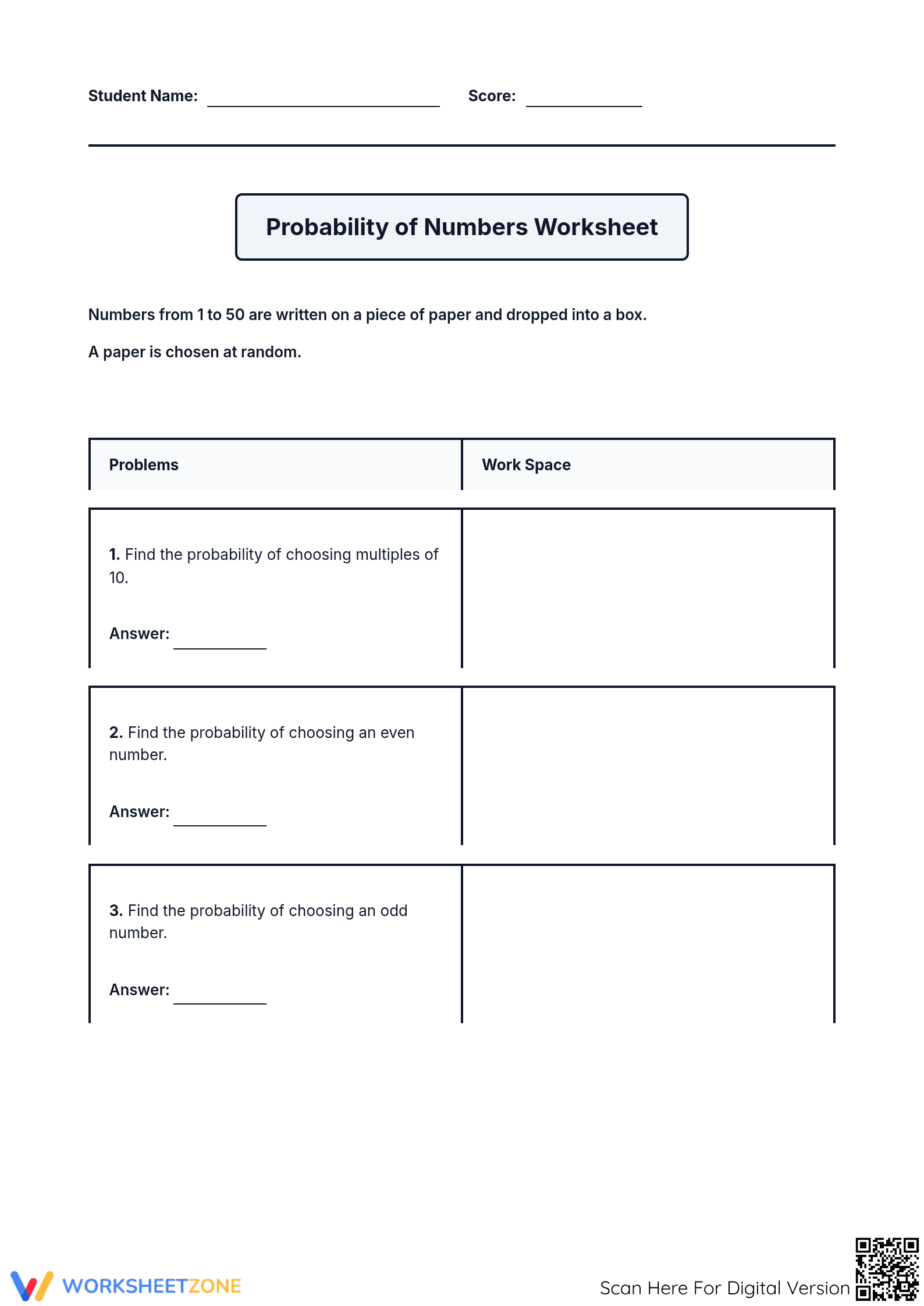
Probability is a foundational middle school math skill that bridges basic arithmetic with data science. This Grade 7 Probability of Numbers worksheet provides students with targeted practice in calculating the likelihood of random events using a set of numbers from 1 to 50. By analyzing various number properties, students develop a deeper understanding of theoretical probability outcomes.
At a Glance
- Grade: 7 · Subject: Math
- Standard:
CCSS.MATH.CONTENT.7.SP.C.5— Understand that probability of a chance event is a number between 0 and 1- Skill Focus: Simple probability with number properties
- Format: 4 pages · 15 problems · Answer key included · PDF
- Best For: Independent practice or formative assessment
- Time: 25–35 minutes
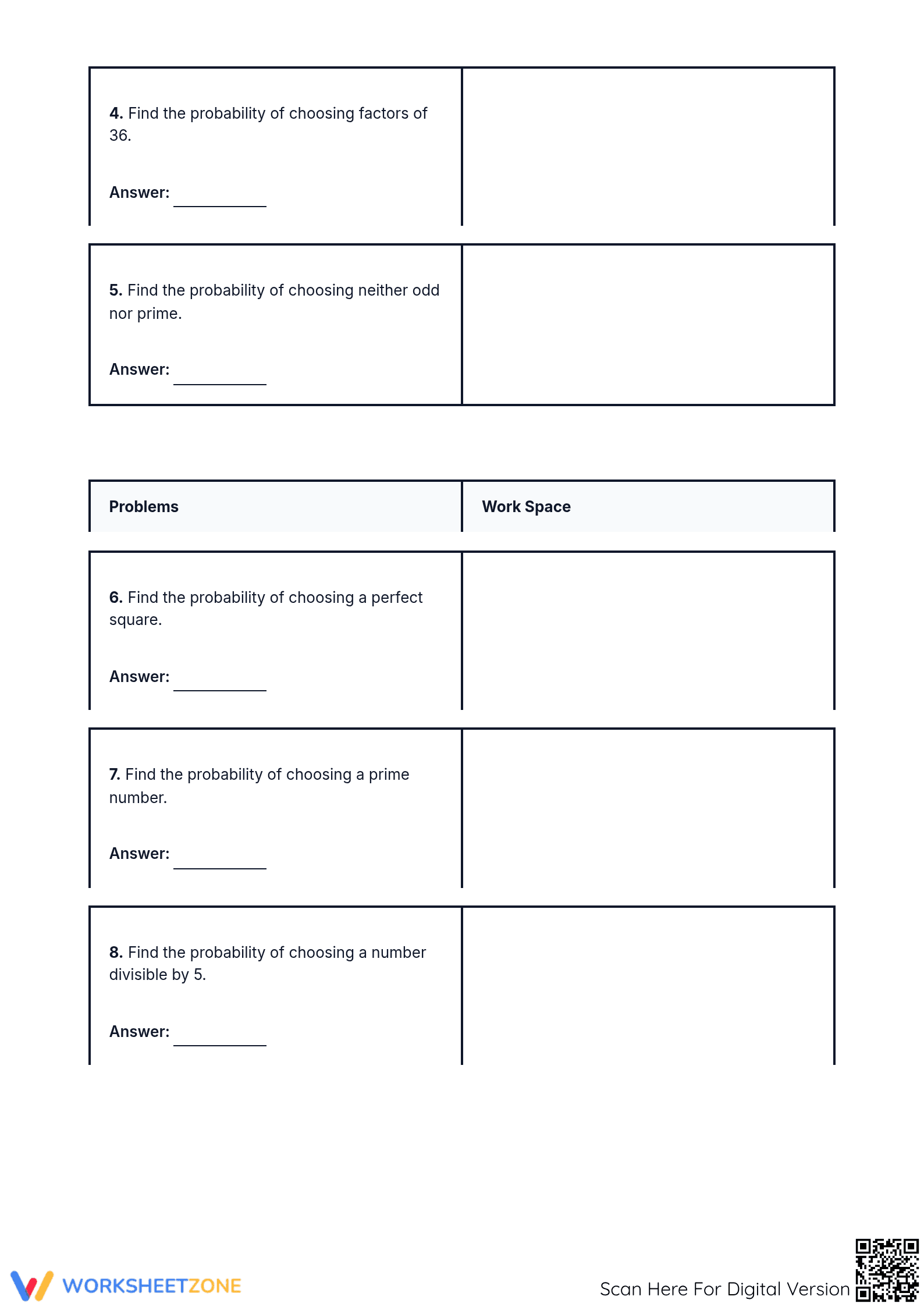
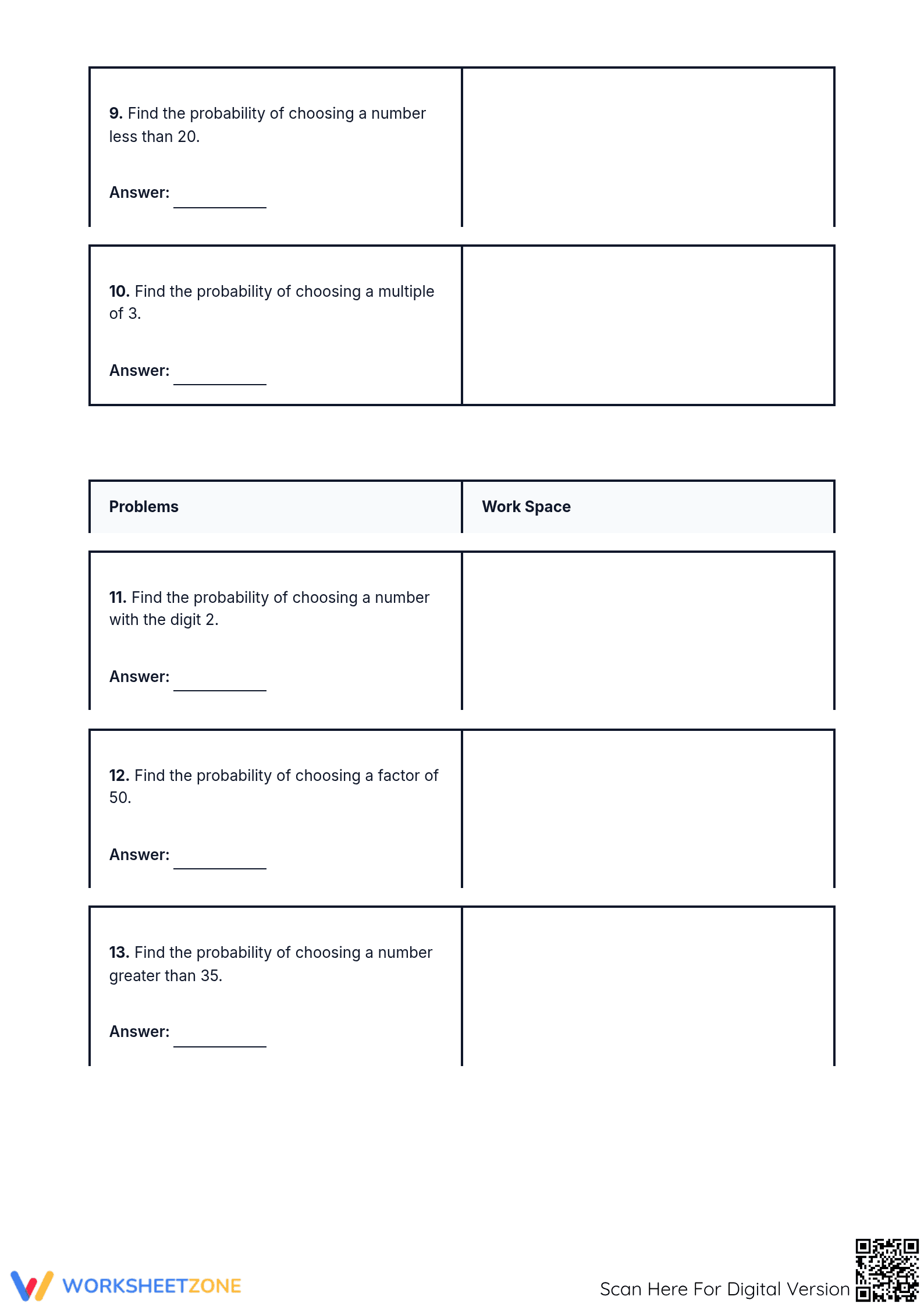
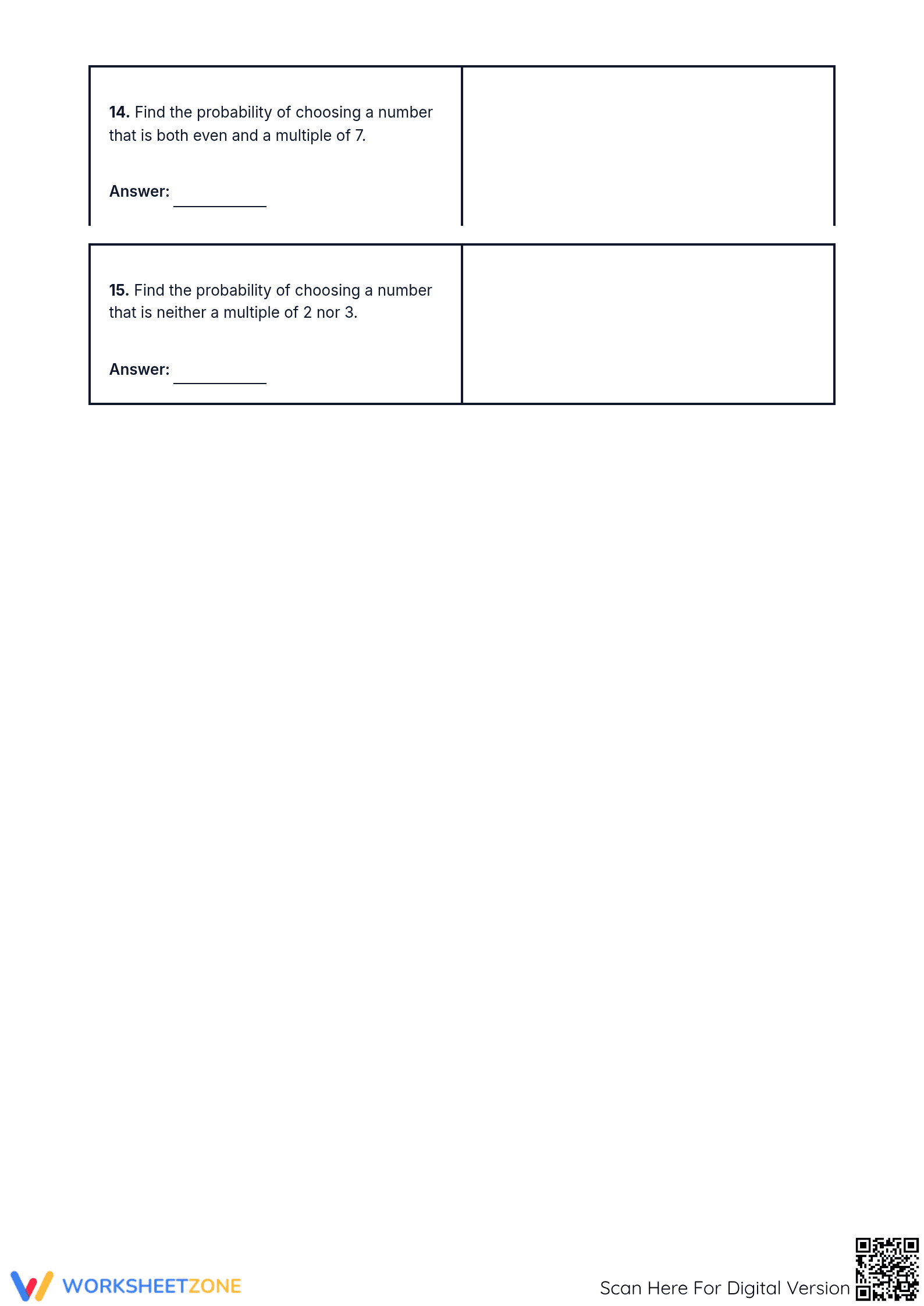
This 4-page worksheet contains 15 unique probability problems centered on a collection of numbers from 1 to 50. Each task requires students to identify a specific subset of numbers—such as primes, factors, multiples, or square numbers—and determine the probability of selecting one at random. The layout includes generous workspace for calculations and clear answer lines. Answer key included to facilitate quick grading and self-correction.
Skill Progression
- Guided practice: The initial problems focus on basic number sets like multiples and even/odd parity, allowing students to establish the denominator and numerator relationship.
- Supported practice: Middle tasks introduce more complex properties such as factors of 36 and perfect squares, requiring students to list elements before calculating.
- Independent practice: Final problems challenge students with combined logic, such as numbers that are both even and multiples of 7, ensuring mastery of intersection events.
This gradual-release approach ensures that students master the foundational part-over-whole logic before tackling multi-step probability reasoning.
Standards Alignment
Aligned to CCSS.MATH.CONTENT.7.SP.C.5: "Understand that the probability of a chance event is a number between 0 and 1 that expresses the likelihood of the event occurring. Larger numbers indicate greater likelihood. A probability near 0 indicates an unlikely event, a probability around 1/2 indicates an event that is neither unlikely nor likely, and a probability near 1 indicates a likely event." Both standard codes can be copied directly into lesson plans, IEP goals, or district curriculum mapping tools.
How to Use It
Use this worksheet as a primary practice tool after introducing the concept of theoretical probability. It is particularly effective for during-instruction practice to check for misconceptions regarding number properties like prime vs. composite. For a formative assessment tip, observe students as they list factors for problem 4; those who miss factors may need a quick refresher on divisibility rules. Takes 30 minutes.
Who It's For
This resource is designed for 7th-grade students beginning their probability unit, though it serves as excellent review for Grade 8 or intervention for high schoolers. It supports diverse learners through clear, repetitive formatting. Pair with a probability anchor chart or a "Sieve of Eratosthenes" prime number reference sheet to assist students with number identification.
Structured practice, as supported by educational research, significantly improves retention of abstract concepts like probability. This Grade 7 worksheet effectively integrates number sense and statistics, requiring students to apply knowledge of factors, multiples, and primes within chance events. Aligned to CCSS 7.SP.C.5, it guides students from intuitive likelihood guesses to precise mathematical ratios. The gradual release of responsibility in its 15 tasks is crucial for internalizing the part-over-whole logic essential for higher-level math. This printable PDF is a robust tool for educators to meet rigorous standards and scaffold student success in theoretical probability.


