


























Views
Downloads

Essential Probability Worksheet | Grade 5-7 Data & Math
Paste this activity's link or code into your existing LMS (Google Classroom, Canvas, Teams, Schoology, Moodle, etc.).
Students can open and work on the activity right away, with no student login required.
You'll still be able to track student progress and results from your teacher account.
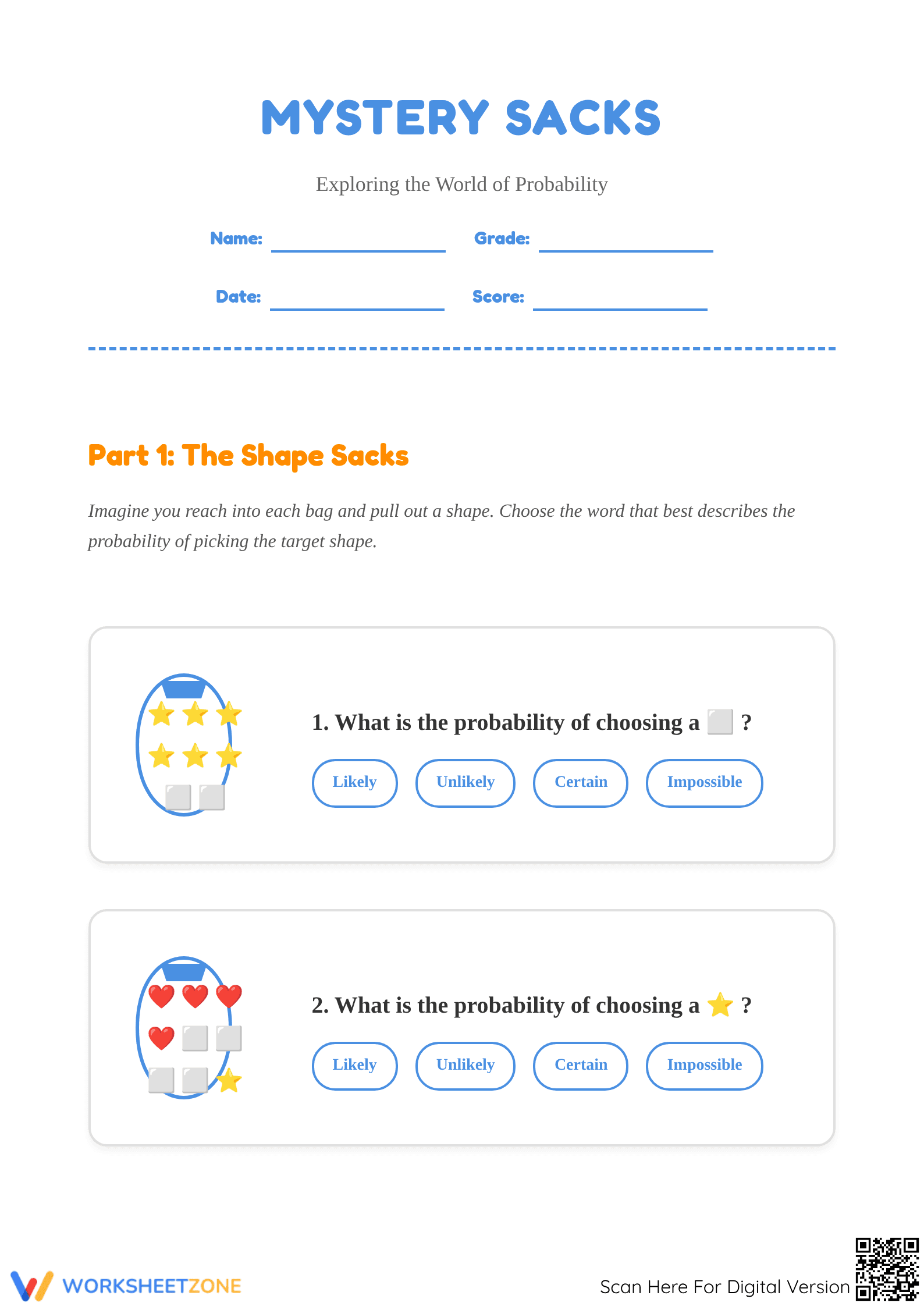
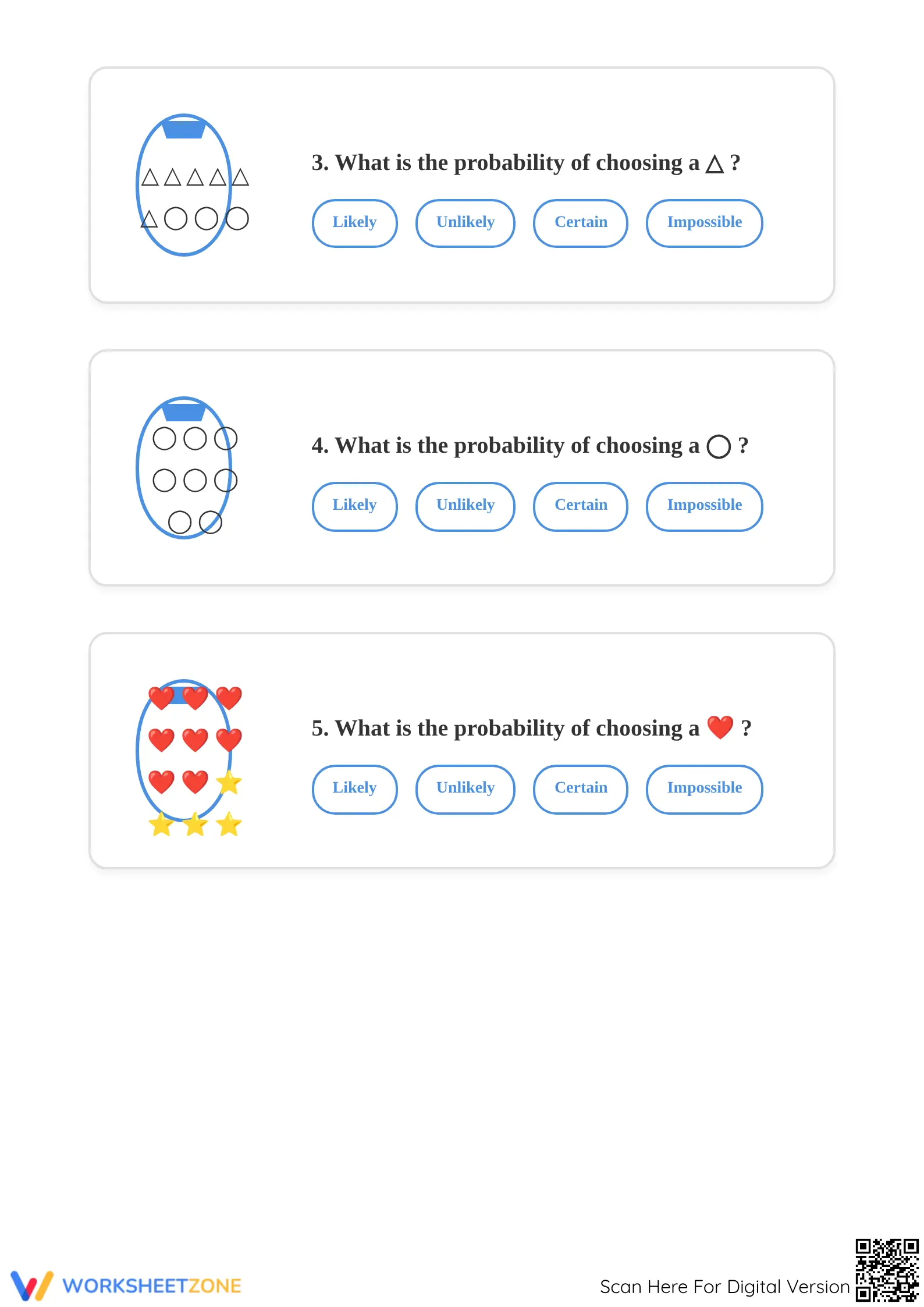
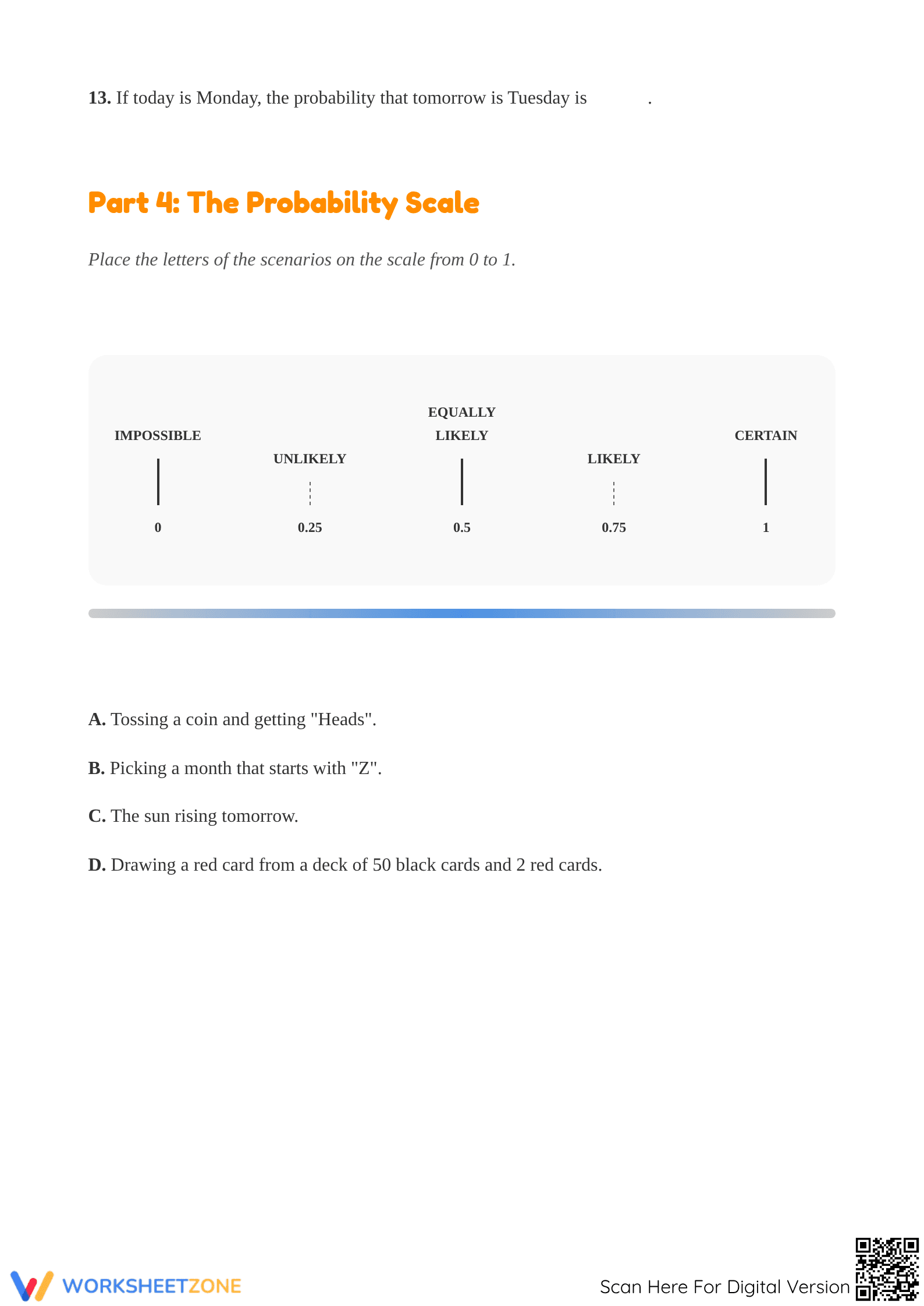
This comprehensive 4-page worksheet guides students through the fundamental concepts of probability, helping them quantify the likelihood of various events. By working through realistic scenarios involving cards, spinners, dice, and marbles, learners build the critical thinking skills necessary to calculate and compare mathematical probabilities in everyday contexts and standardized testing environments.
At a Glance
- Grade: 5-7 · Subject: Data & Math
- Standard:
CCSS.MATH.CONTENT.7.SP.C.5— Understand likelihood of chance events as numbers between 0 and 1- Skill Focus: Calculating and comparing probabilities
- Format: 4 pages · 38 problems · Answer key included · PDF
- Best For: Middle school data and probability units
- Time: 45–60 minutes
What's Inside
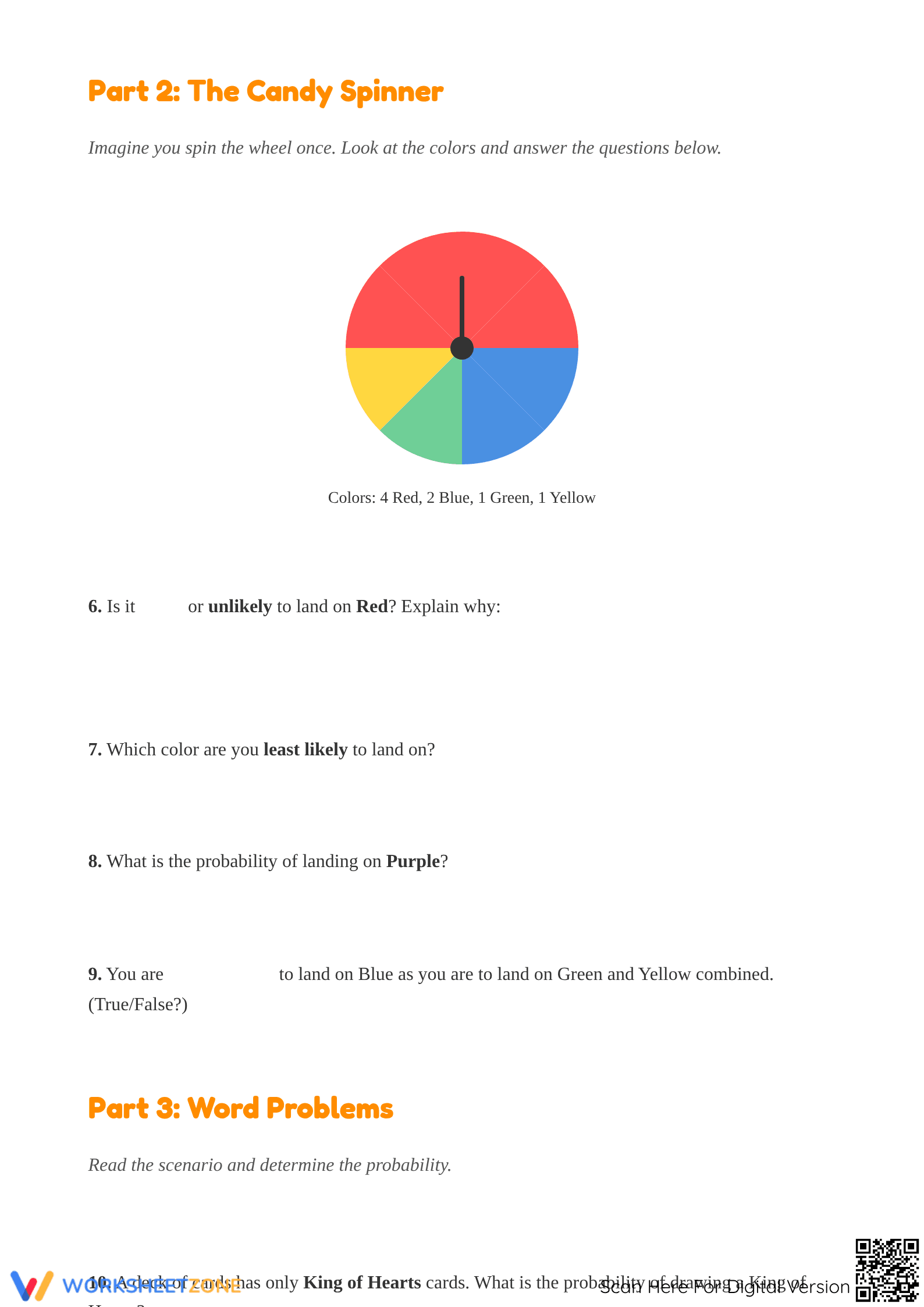
Inside this printable pack, you will find four distinct pages of structured practice. The initial page introduces vocabulary like "impossible" and "certain" using a card-picking model. Subsequent pages increase complexity by introducing spinners, standard six-sided dice, and marble jars. Each section includes clear visual aids and a variety of problem types, including multiple-choice and short-answer questions, supported by a full answer key for easy grading.
Skill Progression
- Guided Practice: Students start by identifying qualitative descriptors (impossible to certain) across 10 card-based problems with visual cues.
- Supported Practice: The middle pages use spinners and dice to transition into quantitative ratios, providing 18 problems with varying denominators.
- Independent Practice: The final jar-based marble tasks require students to calculate complex probabilities and compare outcomes independently across 10 final questions.
This sequence ensures that students build confidence before tackling multi-step probability calculations.
Standards Alignment
This resource is directly aligned to `CCSS.MATH.CONTENT.7.SP.C.5`. This standard requires students to understand that the probability of a chance event is a number between 0 and 1 that expresses the likelihood of the event occurring. It also supports `CCSS.MATH.CONTENT.6.SP.B.5` regarding data summarization. Both standard codes can be copied directly into lesson plans, IEP goals, or district curriculum mapping tools.
How to Use It
Use this worksheet as a summative assessment at the end of a data unit to gauge student mastery of probability ratios. During instruction, teachers can observe students working through the spinner section to identify those struggling with fraction reduction or ratio comparisons. It serves as an excellent 50-minute activity for individual seatwork or collaborative math centers.
Who It's For
This pack is ideal for Grade 5, 6, and 7 students who are moving from intuitive understanding to formal mathematical probability. It includes scaffolds like visual models for marbles and dice, making it accessible for English Language Learners and students with IEPs. Pair this with a physical set of dice or a "probability jar" demonstration for a high-impact, hands-on lesson.
According to the RAND AIRS 2024 report on mathematics instructional materials, resources that integrate multiple visual models—such as spinners and marble jars—significantly improve conceptual retention for middle-grade students. This worksheet targets standard `CCSS.MATH.CONTENT.7.SP.C.5` by requiring students to calculate the probability of specific chance events. By providing 38 unique tasks, the material ensures sufficient repetition to solidify the understanding of probability as a ratio of desired outcomes to total possibilities. Research suggests that students who engage with varied representations of probability are better equipped to apply these concepts to real-world data analysis and statistical reasoning. The inclusion of an answer key further supports the gradual release of responsibility, allowing for immediate feedback and self-correction. This structured approach is essential for meeting the rigorous demands of state and national mathematics frameworks while fostering mathematical literacy across diverse learner populations in the classroom today.


