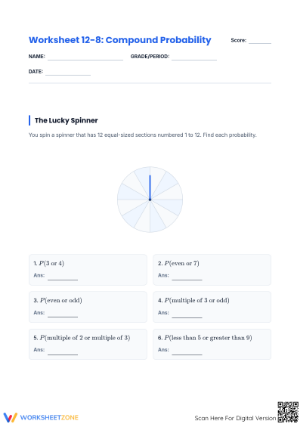
These compound probability pdf worksheets for 7th grade give teachers a focused set of practice tools for the moment students move from single-event probability into multi-event reasoning. Each worksheet targets a distinct skill — independent events, dependent events, sample space construction, tree diagrams, or the logical work of "and" versus "or" — so the practice stays purposeful rather than spreading attention across too many ideas at once. The set is print-ready, answer-keyed, and prints cleanly in black and white.
The Specific Skills Targeted Across the Set
Compound probability lands in 7th grade because it sits at the overlap of fraction fluency and logical reasoning. Students who multiply fractions without difficulty will still hit walls here — the harder challenge is reading a situation and deciding what kind of compound event it describes before any arithmetic starts.
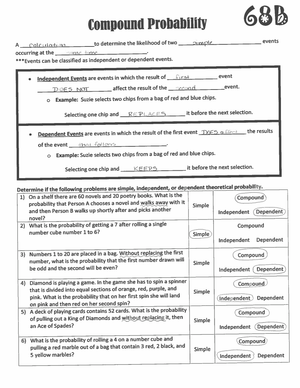
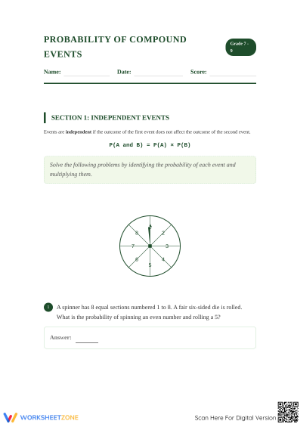
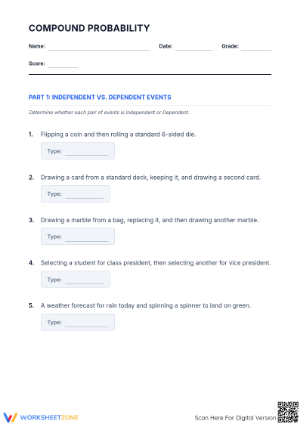
- Independent events: Students multiply probabilities for two events that don't affect each other, such as rolling a number cube while flipping a coin or drawing a card and replacing it before drawing again.
- Dependent events: Students work through situations where the first event changes what's available for the second — drawing chips from a bag without putting them back is the standard entry point.
- Sample space construction: Students build organized lists or tables to account for all possible outcomes before calculating anything. Skipping this step is where most errors originate.
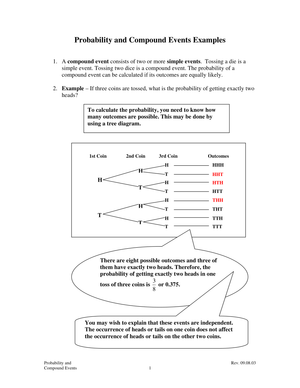
- Tree diagrams: Students map multi-step experiments branch by branch, labeling each node and counting terminal outcomes before writing any fractions.
- "And" vs. "or" situations: Students identify which conjunction the problem uses and decide whether to multiply, add, or account for overlap between events.
Where 7th Graders Go Wrong on These Problems
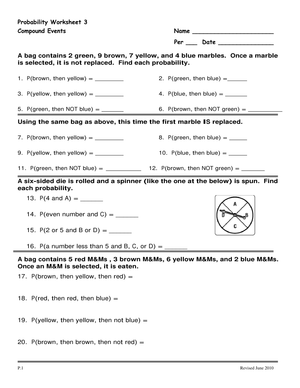
Dependent event problems generate one consistent, specific error: students correctly identify the first probability but copy the original denominator for the second event. A student finding the probability of drawing two red marbles from a bag of 4 red and 6 blue will write (4/10) × (3/10) instead of (4/10) × (3/9). The arithmetic is close enough that the mistake survives a quick scan. That second denominator has to reflect a bag with one marble already gone — students who don't picture that removal treat the second draw as if the first never happened.
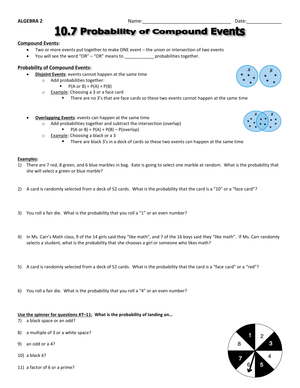
"Or" problems surface a different pattern. Most 7th graders carry into class a conversational sense of "or" that means exactly one thing but not both. In probability, "or" means at least one, which includes the overlap. A student asked for the probability of rolling an even number or a number greater than 4 on a standard die will often list {2, 4, 6} and {5, 6} and then either double-count the 6 or silently drop it from one set. Because these worksheets include several "or" items in sequence rather than a single isolated example, students encounter the rule often enough to articulate it — not just apply it once by accident.
Fitting These Worksheets Into Daily and Weekly Instruction
Compound probability pdf worksheets for 7th grade work best immediately after instruction rather than as delayed homework. After demonstrating one tree diagram on the board, handing out the corresponding worksheet gives students a ten-minute practice window while the method is still in working memory. That immediate follow-up is more effective than a longer assignment attempted hours later without support.
Bell ringers are a strong use case for the fluency-style items. Three independent-event multiplication problems at the start of class, done in five minutes, maintain fluency before the unit moves into dependent events — which require that multiplication to be automatic. Running those warm-ups Monday through Wednesday of the dependent-events week means students arrive at Thursday's harder problems without needing to relearn fraction multiplication at the same time.
The word-problem worksheets carry enough context to work without teacher facilitation, which makes them reliable for sub days. Directions are written directly to students, problems use familiar objects (coins, dice, bags of colored marbles), and the answer key ships as a separate sheet to clip alongside — no additional lesson plan required.
Adapting the Set Across Different Learner Levels
Students who are uncertain about single-event probability need a narrower entry point. Have those students complete only the listing or table portion of the sample-space worksheets and hold off on the fraction column. The goal for that group in the first session is building the habit of accounting for all outcomes — not computing from them. Once that habit is stable, the fraction layer adds without confusion.
Students who move through computation tasks quickly benefit from the "or" problems done in more depth, particularly items that require identifying whether two events share outcomes. Those students also gain something real from writing a word problem that produces the same probability expression they just solved — a reversal task that exposes whether they understand the structure or only the calculation method.
For English learners, vocabulary is the primary obstacle, not arithmetic. Phrases like "without replacement" and "at least one" don't carry their mathematical meaning from everyday usage. A short reference strip — four or five terms, each with a visual — clipped to each worksheet keeps language from obscuring what a student actually understands about probability.
Standard Alignment
The set aligns to CCSS 7.SP.C.8, which covers finding probabilities of compound events using organized lists, tables, tree diagrams, and simulation. The most directly targeted piece is 7.SP.C.8b: representing the sample space for a compound event and using that representation to determine probabilities. The visual model — the table, the tree diagram — is the mathematical work, not a warm-up to it. That's why compound probability pdf worksheets for 7th grade that require students to construct a sample space before they calculate are better aligned to this standard than those that jump straight to multiplication. Teachers pacing a 7th grade statistics unit typically place this work after 7.SP.C.7, which addresses single-event probability models. Students who arrive without that foundation are missing the vocabulary to explain why one method applies and another doesn't — something that shows up quickly in how they read word problems.
Frequently Asked Questions
How do these worksheets treat independent and dependent events differently?
Each type gets its own worksheet before the two are mixed. Independent-event worksheets use scenarios where replacement is explicit in the problem language, reinforcing the concept through context rather than just labeling it. Dependent-event worksheets include a prompt asking students to identify what changed in the sample space after the first event — not just apply a formula. Mixed-practice worksheets come after students have worked each type separately and can distinguish between them reliably.
How long does each worksheet take to complete?
Most students finish in 15 to 20 minutes under normal classroom conditions. Intervention groups typically need closer to 25 to 30 minutes on the tree diagram and dependent-event worksheets, where the multi-step reasoning takes longer. Fluency worksheets focused on independent event multiplication generally run 10 to 12 minutes.
Can these be used for reteaching students who struggled with single-event probability earlier in the year?
The sample-space and independent-event worksheets work well for reteaching. The dependent-event and "or" worksheets assume fraction multiplication is already solid, so students who are still uncertain about 7.SP.C.7 content need that gap addressed first. A short pre-check — three or four single-event probability problems — tells you within minutes whether a student is ready. When compound probability pdf worksheets for 7th grade are used for reteaching, starting with sample-space construction rather than computation tasks keeps the entry point manageable for students who struggled the first time through.













 Interactive Worksheet Maker
 Quiz Maker
 Word Search Maker
 Crossword Puzzle Maker
 Word Scramble Generator
 Sentence Scramble Generator
 Handwriting Worksheet Generator
 Name Tracing Generator
 Fill In The Blank Generator