


























Views
Downloads


Essential Probability Worksheet | Grades 4-8 Printable
Paste this activity's link or code into your existing LMS (Google Classroom, Canvas, Teams, Schoology, Moodle, etc.).
Students can open and work on the activity right away, with no student login required.
You'll still be able to track student progress and results from your teacher account.
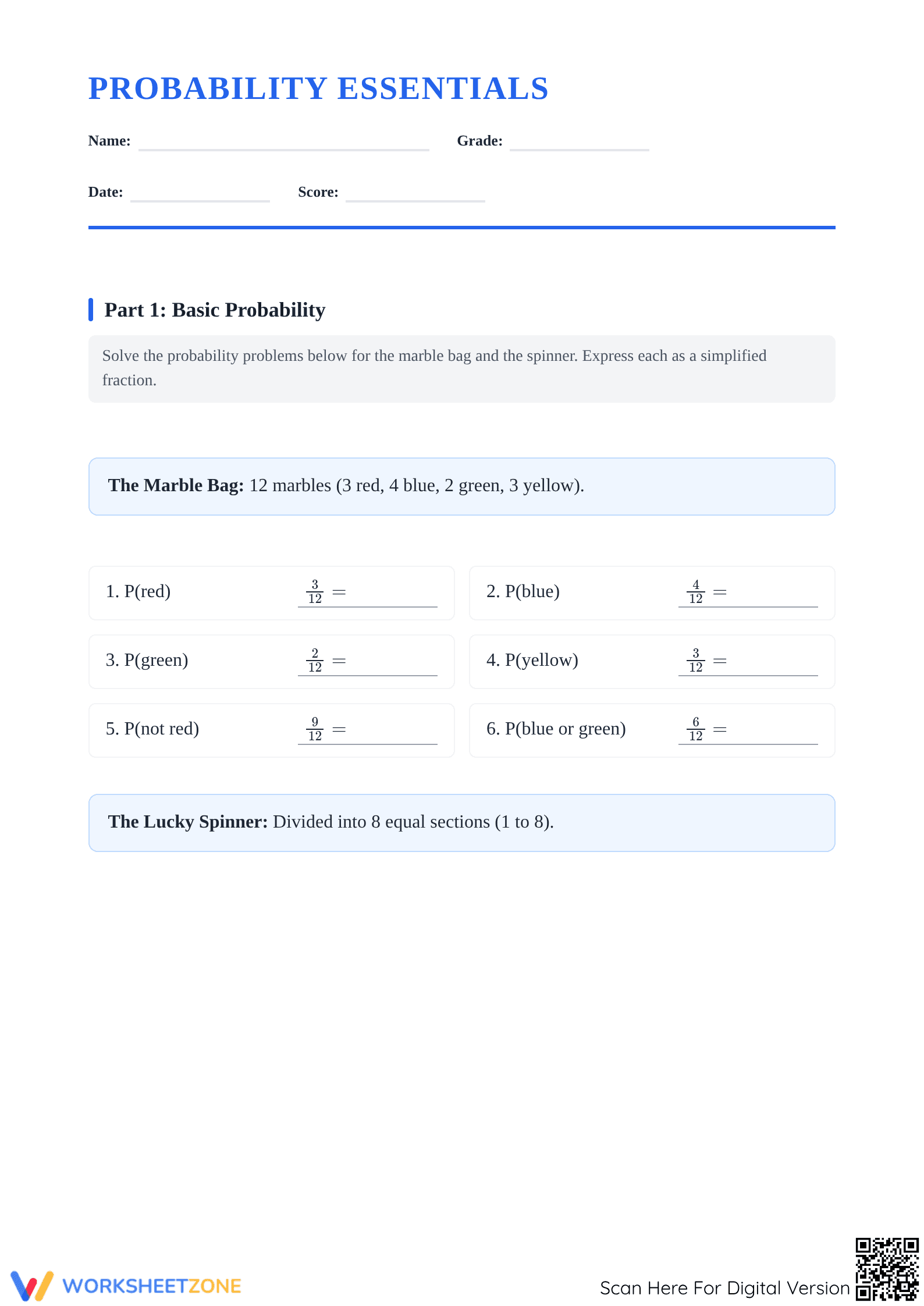
This comprehensive worksheet helps students master the core concepts of probability through 32 scaffolded problems. Students will calculate likelihoods across four distinct domains, including set models, geometric spinners, independent events, and complex word problems. By the end of this activity, learners will confidently express probability as simplified fractions, decimals, and percentages.
At a Glance
- Grade: 4–8 · Subject: Math
- Standard:
7.SP.C.5— Understand that the probability of a chance event is a number between 0 and 1- Skill Focus: Theoretical and Experimental Probability
- Format: 4 pages · 32 problems · Answer key included · PDF
- Best For: Comprehensive unit review or sub plans
- Time: 45–60 minutes
What's Inside
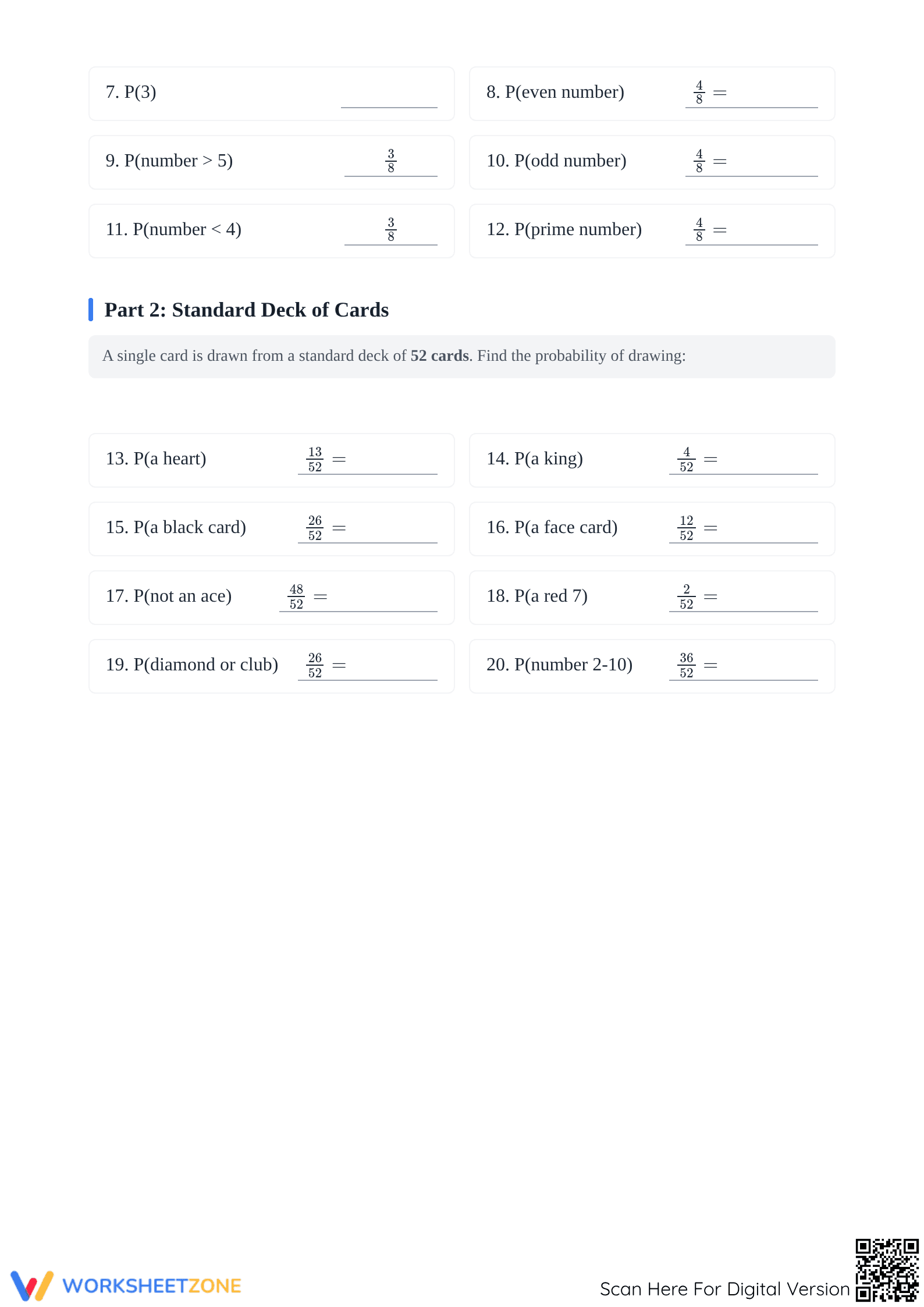
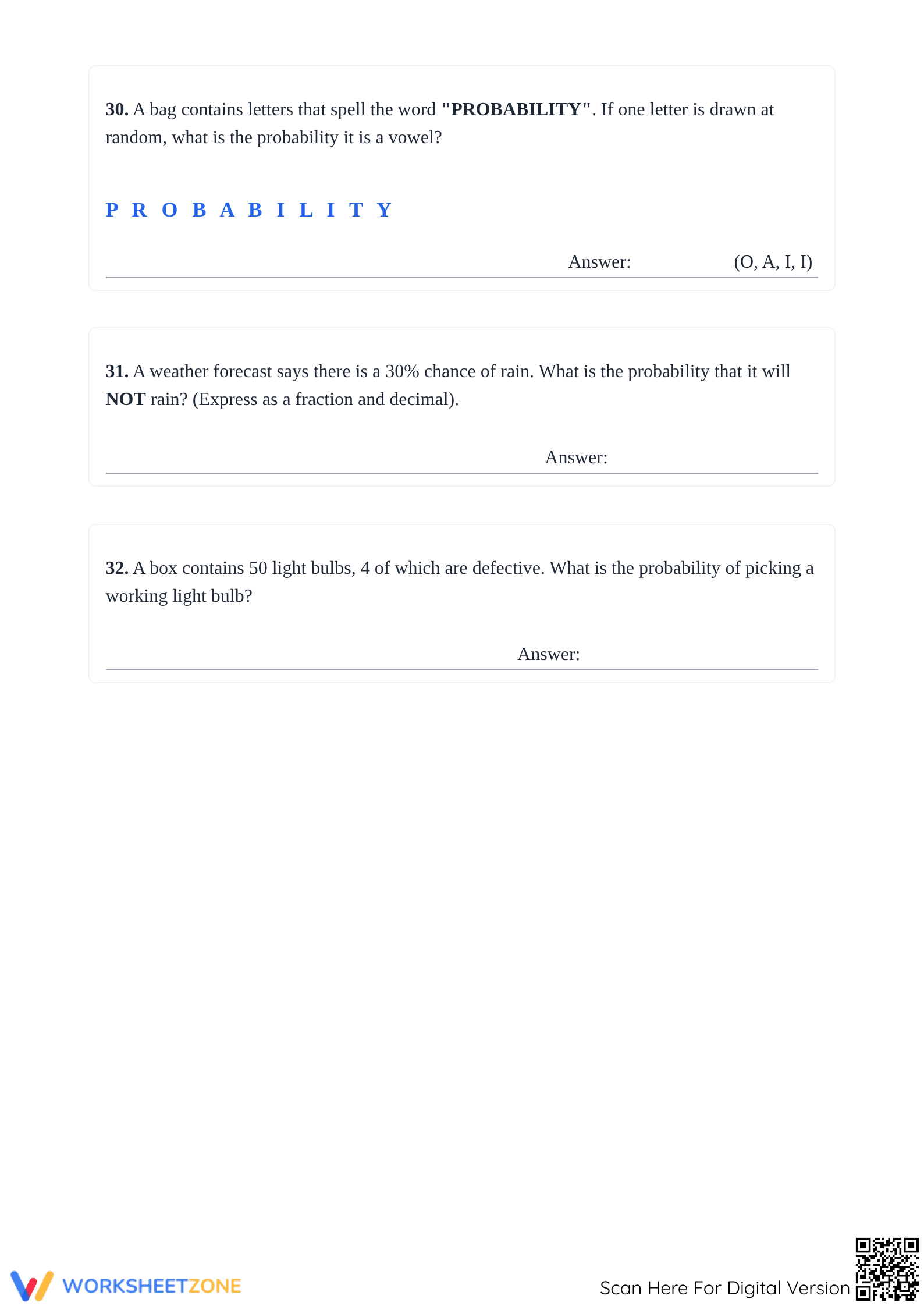
The resource spans four high-quality pages designed for maximum student engagement. Part 1 focuses on marble sets and spinner models to establish foundational ratios. Part 2 utilizes a standard deck of 52 cards to introduce larger sample spaces. Part 3 applies logic to six-sided dice, while Part 4 provides six real-world word problems ranging from weather forecasts to manufacturing quality control. A complete answer key is provided for immediate grading and feedback.
Zero-Prep Workflow
- Print: Generate the four-page packet in less than 30 seconds.
- Distribute: Pass out the materials to students with no additional manipulatives required.
- Review: Utilize the provided answer key for a 5-minute whole-class review session.
This streamlined workflow ensures that teacher preparation time remains under two minutes, making it an ideal choice for emergency sub plans or spontaneous review sessions.
Standards Alignment
The primary alignment is CCSS.MATH.CONTENT.7.SP.C.5. This standard requires students to understand that the probability of a chance event is a number between 0 and 1 that expresses the likelihood of the event occurring. The worksheet also supports 7.SP.C.7 by asking students to develop probability models and use them to find probabilities of events. Both standard codes can be copied directly into lesson plans, IEP goals, or district curriculum mapping tools.
How to Use It
Use this as a summative assessment at the end of a probability unit to gauge mastery across different representations. Alternatively, assign individual pages as targeted bell-ringers over a week of instruction. During the activity, observe if students are properly simplifying their fractions; this provides a secondary formative check on their arithmetic fluency. Expect a completion time of approximately 15 minutes per page for average learners.
Who It's For
This set is ideal for general education students in Grades 4 through 8. It provides enough visual scaffolding for lower-middle schoolers while the word problems in the final section offer sufficient rigor for 8th-grade pre-algebra review. It pairs naturally with a probability anchor chart or a hands-on lab involving physical dice and marble bags to reinforce the connection between theory and practice.
Research from RAND AIRS 2024 emphasizes that structured, multi-domain practice in probability is essential for developing the mathematical reasoning required for higher-level statistics. By utilizing familiar models like marble bags and standard card decks, students can bridge the gap between concrete observations and abstract numerical representations. This worksheet adheres to the CCSS.MATH.CONTENT.7.SP.C.5 standard, focusing on the plain-English skill of determining the likelihood of events and expressing them as precise mathematical ratios. Educational studies such as those highlighted by Fisher & Frey (2014) suggest that scaffolded transitions from simple models to real-world word problems significantly increase long-term retention of statistical concepts. This 32-task set provides the repetitive, high-frequency practice needed to solidify these skills before students advance to compound probability. The inclusion of an answer key ensures that learners receive immediate feedback, a critical component of the gradual-release model.


