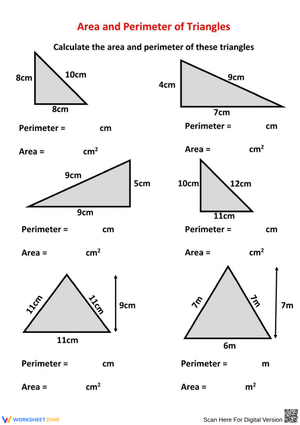
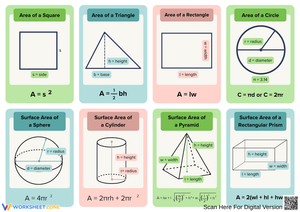
These 6th grade area of a triangle pdf worksheets address the central difficulty of this unit: most students can recite A = 1/2 × base × height within a day, but a significant portion still grab the slant side instead of the altitude when faced with an unlabeled triangle. The set moves students from labeled whole-number diagrams through missing-dimension problems and short application tasks — the sequence teachers typically need across an introductory unit. Answer keys are included with every worksheet.
What's Inside the Set
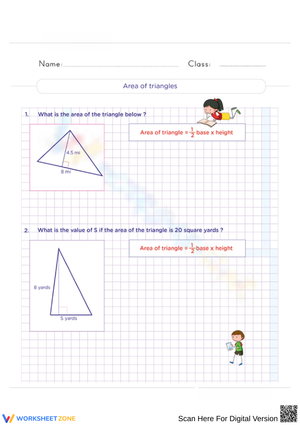
The 6th grade area of a triangle pdf worksheets in this set cover the full range of triangle area tasks a sixth-grade teacher needs, from initial formula work to the problem types that show up on unit assessments.
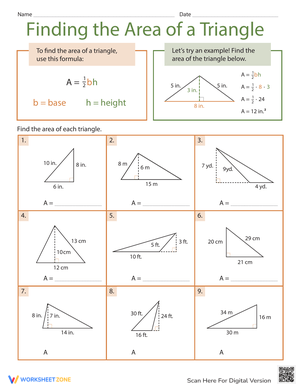
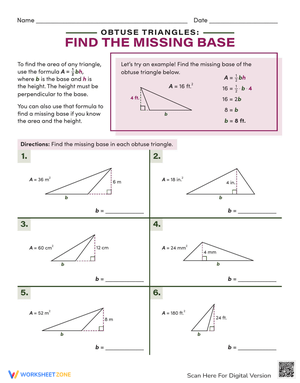
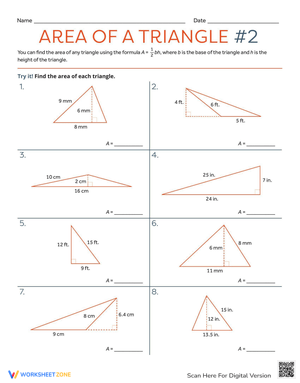
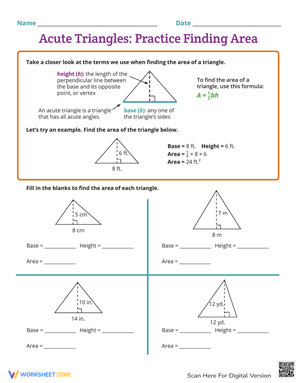
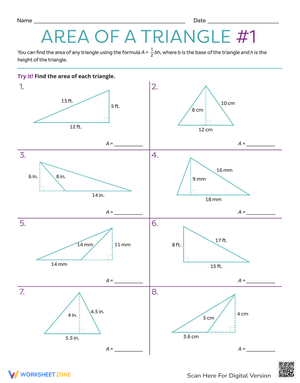
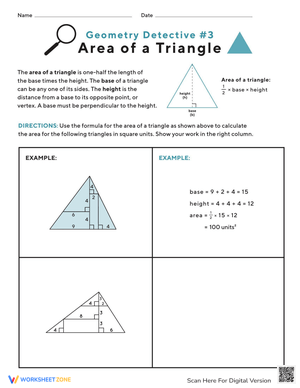
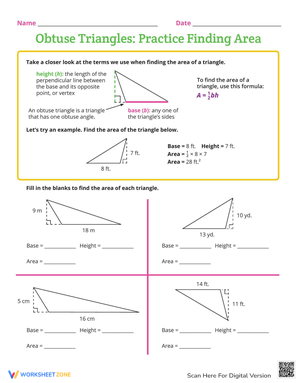
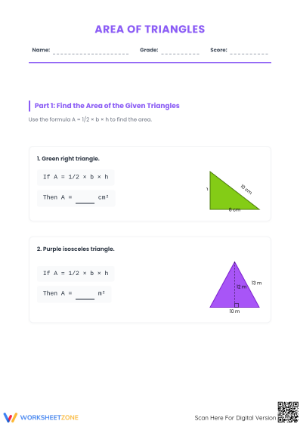
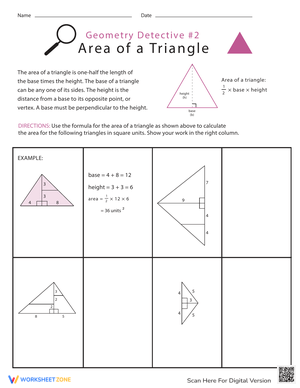
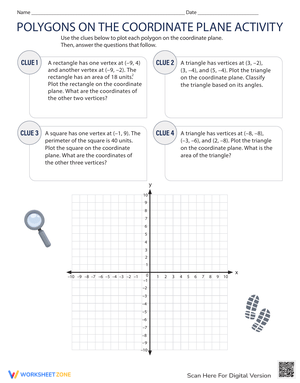
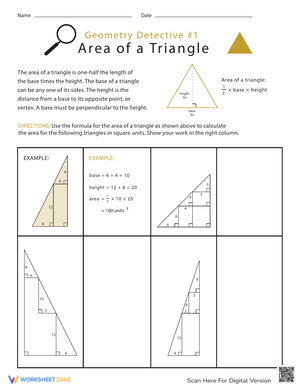
- Base and height identification: Students mark the altitude on labeled diagrams, including obtuse triangles where the height falls outside the figure — the case that trips up most students at this level.
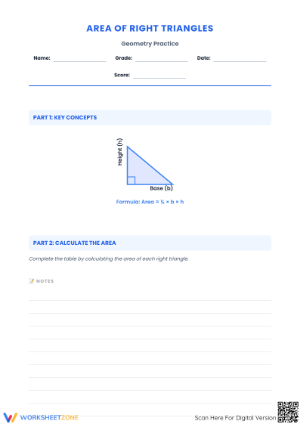
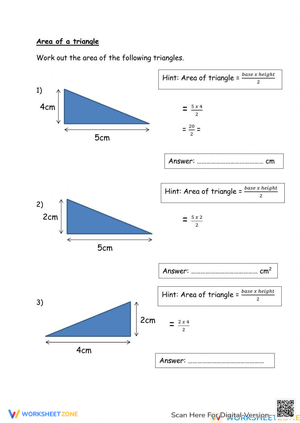
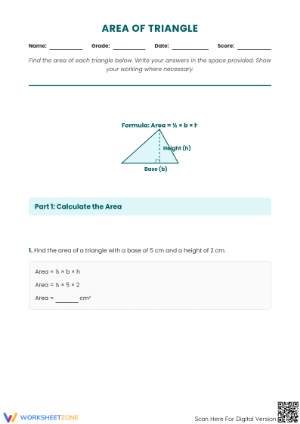
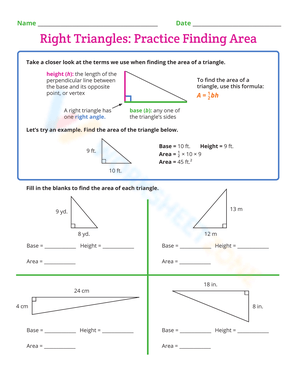
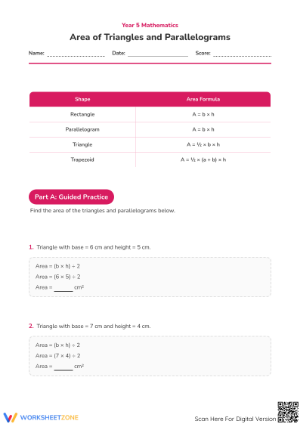
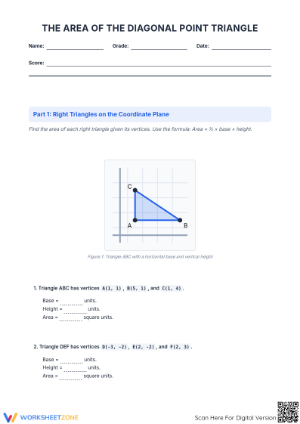
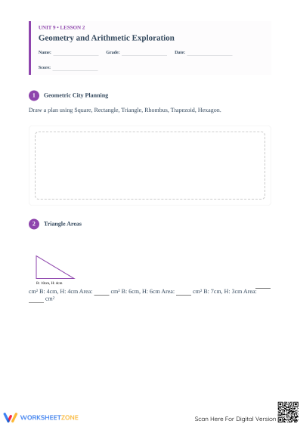
- Whole-number area computation: Straightforward A = 1/2 × b × h problems using integer dimensions, the entry point for students meeting the formula for the first time.
- Decimal and fraction dimensions: Problems that require students to apply the formula when the base or height involves a decimal or a unit fraction, testing whether formula fluency holds up across number types.
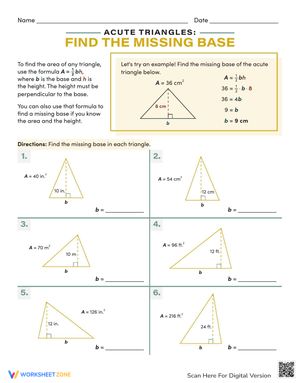
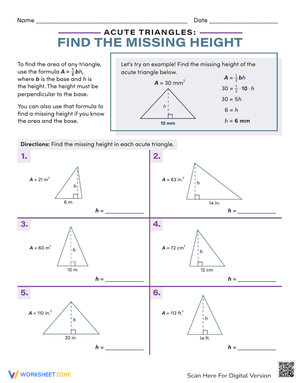
- Missing-dimension problems: Area is given and students solve for the unknown base or height — a genuine algebraic application that connects to 7th-grade variable work.
- Triangle-rectangle comparisons: Items where students connect a triangle's area to a rectangle or parallelogram with the same base and height, reinforcing where the one-half factor originates rather than treating it as a rule to memorize.
- Word problems: Multi-sentence tasks where students identify which given measurements correspond to base and height before calculating anything.
The Errors That Show Up in Triangle Area Work, and How to Address Them
The slant-side error dominates student work at this grade level. On an acute triangle with a clearly labeled altitude, most students identify the height correctly. On an obtuse triangle — particularly one where the altitude is drawn as a dashed line falling outside the figure — the majority of sixth graders will circle a leg of the triangle instead. This is not careless; it reflects a genuine confusion between how tall something appears visually and the geometric definition of height as a perpendicular distance. Including both acute and obtuse examples, with consistent altitude notation, gives teachers a direct way to surface this misconception before it calcifies.
The second most predictable error is skipping the division by 2. Students moving through problems quickly treat the formula as base × height and arrive at double the correct area. A diagnostic sign: a pattern of answers that are exactly double the correct value across several problems in a row. The triangle-rectangle comparison worksheets address this more durably than a formula reminder at the top of the page, because students can see that the triangle occupies half the rectangle rather than just reading that it does.
One honest limitation worth noting: on worksheets where the altitude is shown with the standard dashed-line convention, students who have never seen that notation may spend time decoding the diagram rather than thinking about area. A brief 2-minute introduction to the dashed-altitude symbol before distributing those worksheets prevents that confusion entirely.
Lesson-Planning Moves That Work With This Set
Teachers can use 6th grade area of a triangle pdf worksheets across an entire introductory unit without repeating the same format. Early in the unit, a base-and-height identification worksheet runs well as a 5- to 7-minute opening activity — students mark the altitude on a series of triangles before the lesson shifts to formula application. Mid-unit, a whole-number computation worksheet works for guided practice, projected and solved as a class while students explain why the marked height is perpendicular to the base. Late in the unit, a mixed-skill worksheet that combines computation, missing-dimension problems, and a word problem or two gives teachers a solid review activity without building one from scratch.
A specific classroom move worth building into the routine: before students calculate, have them lightly shade the full rectangle they imagine around the triangle. This slows the work down at exactly the right moment — right before the arithmetic — and embeds the one-half relationship in a way that reduces repeated formula errors. It takes 20 to 30 extra seconds per problem and replaces the habit of diving straight into multiplication before confirming which measurements to use.
The last 10 to 12 minutes of a period — after the main lesson but before cleanup — is a natural slot for a shorter computation worksheet. Students finish without feeling rushed, the exit activity gives teachers a quick read on where the class landed, and anyone who doesn't complete it has a clear homework assignment without extra explanation needed.
Tiering the Practice for Mixed-Readiness Classes
Within a set of 6th grade area of a triangle pdf worksheets, there is a built-in sequence that handles differentiation without creating separate materials for every readiness level. Students who are still solidifying their understanding of fractions or who need more time with the formula start with the whole-number computation worksheets and stay there until their work is consistently accurate. Students who are already calculating fluently move directly to the missing-dimension and word problem worksheets, which ask them to work backward from a given area or decide which measurements correspond to base and height.
For students who freeze when an obtuse triangle shows the altitude as a dashed line outside the figure, a useful intermediate step is to have them redraw the triangle in a more familiar orientation before attempting any calculation. That move doesn't change the math, but it removes the visual disruption that causes students to stall at step one. For students who need additional challenge, the comparison problems — where they arrive at triangle area by first computing the enclosing rectangle — push the reasoning further than computation alone and give teachers a clear picture of who understands why the formula works, not just how to apply it.
Standard Alignment
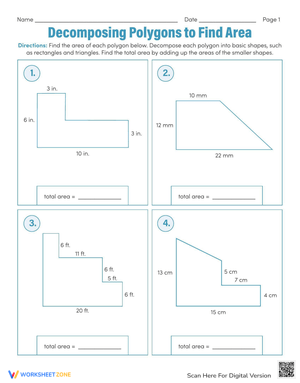
CCSS 6.G.A.1 asks students to find areas of triangles and other polygons by composing into rectangles or decomposing figures — language that makes the triangle-rectangle connection an instructional requirement, not just a teaching preference. These worksheets address that standard directly: the comparison problems require students to compose a rectangle around the triangle and reason from there, while the computation problems build the formula fluency the standard assumes. Teachers working through a 6.G.A.1 unit can match each worksheet type to a specific lesson goal — identification on day one, formula application mid-unit, and multi-step problems toward the end — without improvising additional materials to fill the gaps.
Frequently Asked Questions
Why do sixth graders struggle with triangle area more than with rectangle area?
In rectangle work — which anchors most 5th-grade area instruction — every side is either a base or a height, and those measurements are always visible as sides of the figure. In a triangle, the height is a perpendicular distance that often does not align with any visible side, especially in obtuse triangles. That shift in what "height" means is genuinely new conceptual territory for most sixth graders and is the single largest driver of early errors in this unit.
Can these worksheets work for intervention students who missed earlier geometry instruction?
Yes. The whole-number identification and computation worksheets are accessible entry points for students who need to build understanding from the ground up. Starting with clearly labeled acute triangles keeps the focus on the geometric concept and the formula before any number-type complexity is introduced. Once students are consistent on those, the decimal and fraction worksheets are the natural next step, and the progression is visible enough that teachers can track exactly where each student's understanding breaks down.
Do the worksheets include diagrams, or do students work from written descriptions alone?
Each worksheet includes diagrams. At the sixth-grade level, students need to see the triangle to correctly identify the perpendicular height — particularly in the early stages of the unit, when the altitude notation is still new. Word problems include either a labeled diagram or enough measurement information for students to set up the formula without guessing which numbers represent base and height.













 Interactive Worksheet Maker
 Quiz Maker
 Word Search Maker
 Crossword Puzzle Maker
 Word Scramble Generator
 Sentence Scramble Generator
 Handwriting Worksheet Generator
 Name Tracing Generator
 Fill In The Blank Generator