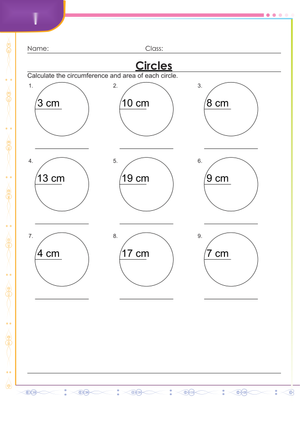
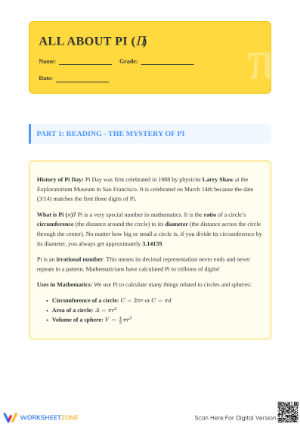
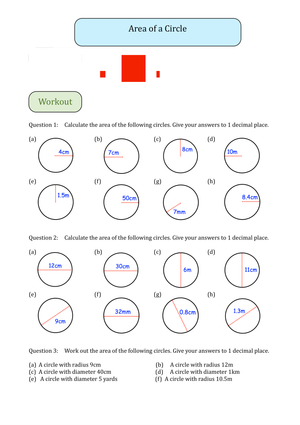
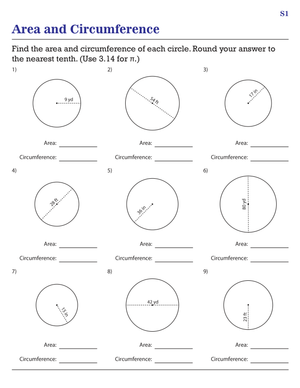
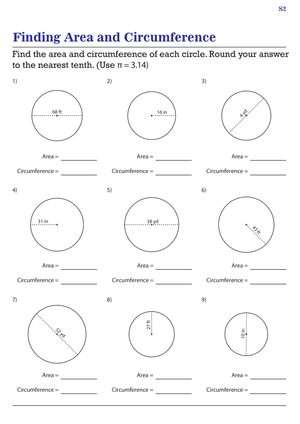
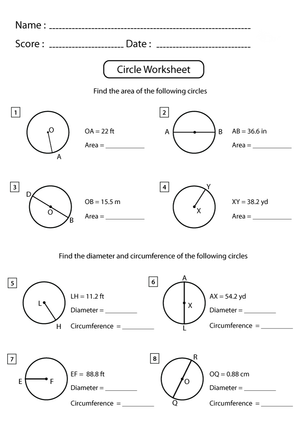
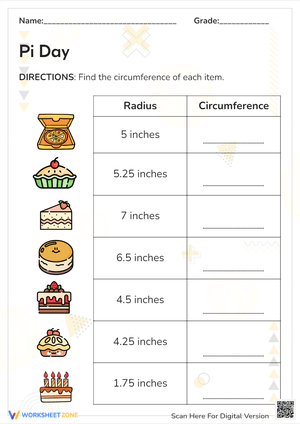
These 6th grade area and circumference of a circle worksheets give teachers a ready-to-print set of standalone resources covering every major decision point in circle measurement — from correctly identifying radius versus diameter to selecting the right formula when problems stop announcing which measure they've provided. At this grade level, C = 2πr and A = πr² arrive close together in most curricula, and the gap between what each formula measures creates more persistent confusion than the formulas themselves.
Skills Each Worksheet in the Set Addresses
Three formulas organize the work: C = 2πr, C = πd, and A = πr². Each one demands a specific decision from students before any numbers get substituted. When diameter is given, students can use πd directly for circumference — but they still need to halve it before finding area. That conversion step is where a surprising number of errors begin, and a well-sequenced set of worksheets builds deliberate practice around it rather than assuming students handle it automatically.
Across the set, students work through:
- Circle part identification — labeling radius, diameter, and center from diagrams before any formula is introduced
- Formula selection — writing the applicable formula before substituting values, which forces students to declare their approach rather than guess mid-calculation
- Computation with whole numbers and simple decimals, producing both exact answers in terms of π and decimal approximations using 3.14
- Word problems involving real circular objects — wheels, table surfaces, garden borders — where students must identify the relevant measure from context
- Mixed review that requires formula selection without a category label signaling which one applies
That last category is the most revealing. Students often complete eight consecutive circumference problems without error and still reach for the area formula the moment problem types mix. Mixed review is where surface fluency and actual understanding stop looking the same.
Error Patterns That Surface Every Time This Unit Runs
The most consistent mistake — and the one with the largest effect on answers — is squaring the diameter instead of the radius in area problems. A student given a circle with d = 10 will frequently write A = π(10)² = 100π rather than first converting to r = 5 and computing A = π(5)² = 25π. The answer is off by a factor of four, and because the student's work looks organized on paper, they rarely self-correct without a prompt that forces them to record the radius separately before writing the formula.
Other patterns worth tracking in student work:
- Unit label errors — attaching cm² to a circumference answer or cm to an area answer. Students know a superscript belongs somewhere; they just misplace it.
- Premature rounding — multiplying by 3.14 in the middle of a multi-step problem, which compounds decimal error by the final line.
- Formula drift — starting a problem with the correct formula and then substituting a diameter value into the radius position partway through the work.
- Formula confusion on mixed review — switching formulas under time pressure when problems appear in quick succession without category labels.
Worksheets that include a printed setup line — "Identify the given measure: ___. Write the formula: ___." — narrow the error window considerably. That small structural addition shifts student attention to the decision before the calculation begins, rather than letting students rush past it.
How to Build These Worksheets Into Your Geometry Unit
A reliable sequence starts with one identification worksheet at the unit's opening — just diagrams, labeling tasks, and the relationship d = 2r before any formula appears. This groundwork takes about ten to twelve minutes and prevents the radius-versus-diameter confusion that consistently shows up in calculation work a day or two later. After that, separate worksheets targeting circumference and then area give students time with each formula individually before a mixed-review worksheet demands they choose between them.
Pulling two or three problems from a 6th grade area and circumference of a circle worksheets for an end-of-class exit check takes minimal preparation and gives a fast read on where students stand. A three-problem exit ticket — one radius-to-circumference problem, one diameter-to-area problem, and one written explanation of why area uses square units — separates students who can execute the formulas from those who understand what the formulas measure. Sorting those responses into formula errors versus computation errors before the next day's lesson makes reteaching far more targeted than re-teaching the entire section.
For math stations, one worksheet on circumference, one on area, and one on mixed review creates a natural rotation with increasing demand. For homework, a worksheet that begins with direct substitution and ends with two word problems preserves the momentum students build early in the assignment before asking them to apply that fluency in context.
Adjusting the Set for Different Student Readiness Levels
The range of problem types across a 6th grade area and circumference of a circle worksheets makes it possible to assign different worksheets to different groups without building two separate lesson plans. Students who need extra support benefit from worksheets that include a labeled diagram with each problem, a formula reference box at the top, and a prompted setup line to identify the given measure and the appropriate formula before solving. That level of step-by-step guidance keeps attention on the mathematical relationship rather than on procedural recall under pressure.
On-level students are ready for worksheets where the given measure alternates between radius and diameter without announcement. For extension, the most productive tasks ask students to work backward — finding radius from a known circumference, or explaining in writing why doubling the radius quadruples the area rather than simply doubling it. A problem about resizing a circular garden bed makes this concrete: students who can reason through why A = π(2r)² = 4πr² have moved past formula fluency into proportional thinking about geometric change. That understanding transfers directly to how area-versus-perimeter relationships appear on standardized assessments.
Standard Alignment
In the Common Core State Standards, area and circumference of a circle are formally addressed in 7.G.B.4: "Know the formulas for the area and circumference of a circle and use them to solve problems; give an informal derivation of the relationship between the circumference and area of a circle." Many widely used curricula — including several state-adopted programs and integrated 6th grade math courses — introduce circle measurement a year earlier as an extension of the area and perimeter work students began with polygons. The 6th grade area and circumference of a circle worksheets in this set are built for those programs, and they work equally well as preview material for teachers whose formal sequence places circles in 7th grade.
These worksheets follow the same instructional order regardless of grade placement: part identification first, then isolated circumference practice, then isolated area practice, then mixed tasks that require formula selection without signaling labels. That order prevents new conceptual demands from stacking on top of unresolved procedural ones — a pattern that makes circle measurement feel harder than it actually is.
Frequently Asked Questions
What prior knowledge do students need before starting these worksheets?
Students should be able to identify radius and diameter and state the relationship between them. They also need to understand that circumference measures the distance around a circle while area measures the space inside it. Multiplication fluency with decimals is necessary for 3.14-based problems; students still building that fluency benefit from starting with worksheets that allow exact answers in terms of π before moving to decimal approximations.
Should worksheets ask for exact answers or decimal approximations?
Both formats belong in the unit. Exact answers — leaving results in terms of π — preserve the formula's structure and make algebraic checking easier. Decimal approximations connect to practical measurement and calculator practice. The most useful worksheets specify the expected form in the directions for each section, so students aren't deciding that independently on every problem.
How do these worksheets support formative assessment?
Mixed-review worksheets surface the errors that isolated-skill worksheets hide. When a student handles circumference problems accurately but area answers are consistently inflated by a factor of four, the pattern almost always points to the diameter-as-radius squaring error rather than general arithmetic weakness. That diagnosis changes what reteaching looks like. A quick scan of where student errors cluster — formula selection, computation, or unit labeling — turns a returned worksheet set into a planning document for the next day's instruction.
What real-world contexts work best for circle problems at this level?
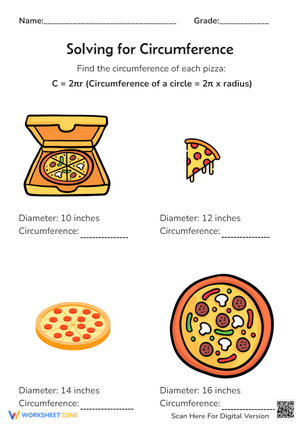
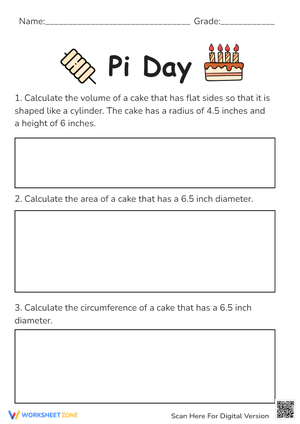
For circumference, problems involving circular objects with a clear boundary meaning work well: the edge of a wheel, the border of a circular track, the crust of a pizza. For area, objects where the interior surface matters make more sense: covering a circular table, seeding a garden plot, cutting a circular fabric piece. Pairing context to formula type builds the habit of asking what a problem is actually measuring before selecting the formula — a habit that transfers directly to standardized test items that deliberately blur that distinction.













 Interactive Worksheet Maker
 Quiz Maker
 Word Search Maker
 Crossword Puzzle Maker
 Word Scramble Generator
 Sentence Scramble Generator
 Handwriting Worksheet Generator
 Name Tracing Generator
 Fill In The Blank Generator