


























Views
Downloads




Area of Triangles on Coordinate Plane | Printable Math
Paste this activity's link or code into your existing LMS (Google Classroom, Canvas, Teams, Schoology, Moodle, etc.).
Students can open and work on the activity right away, with no student login required.
You'll still be able to track student progress and results from your teacher account.
Calculating triangle area on a coordinate plane bridges numerical computation and spatial reasoning. This worksheet guides students through 20 structured problems, from basic right triangles to complex shapes using the bounding box method. Students achieve geometric mastery by applying coordinates to determine dimensions and calculate final area results.
At a Glance
- Grade: 6 · Subject: Geometry
- Standard:
CCSS.MATH.CONTENT.6.G.A.1— Find area by composing into rectangles or decomposing into triangles and other shapes- Skill Focus: Coordinate Geometry Area Calculations
- Format: 5 pages · 20 problems · Answer key included · PDF
- Best For: Middle school geometry guided practice sessions
- Time: 45–60 minutes
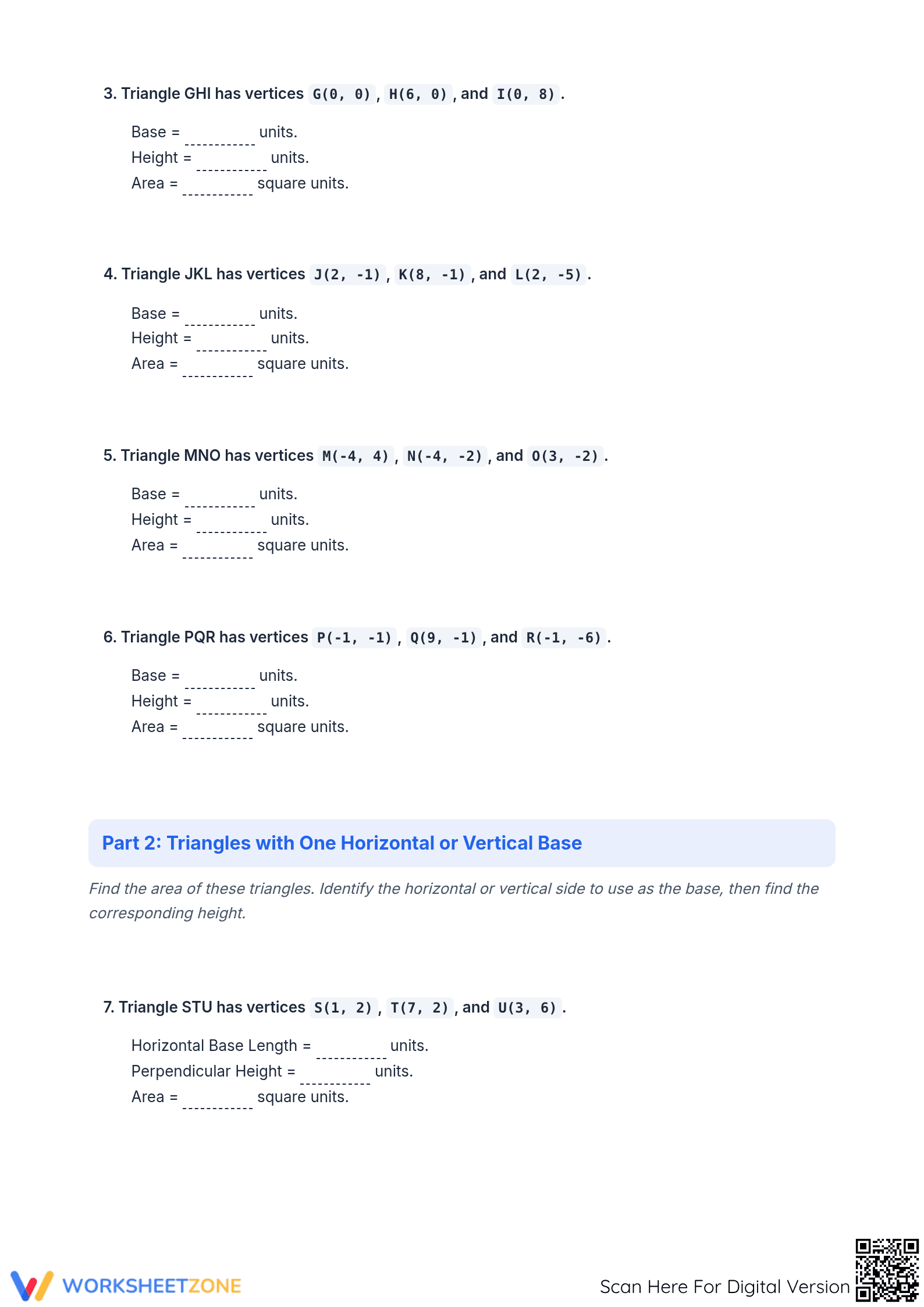
This 5-page PDF contains four parts designed to build confidence. Part 1 focuses on right triangles with easily identifiable vertices. Part 2 introduces triangles with one horizontal base, requiring perpendicular height determination. Part 3 teaches the Bounding Box Method with visual supports, while Part 4 offers challenge problems. A full answer key provides zero-prep teacher support.
Skill Progression
The skill progression follows a gradual release model:
- Guided practice: Initial tasks provide the area formula and right-angled vertices, allowing students to count grid units to find base and height.
- Supported practice: Middle problems require students to identify the base before calculating perpendicular height from coordinates.
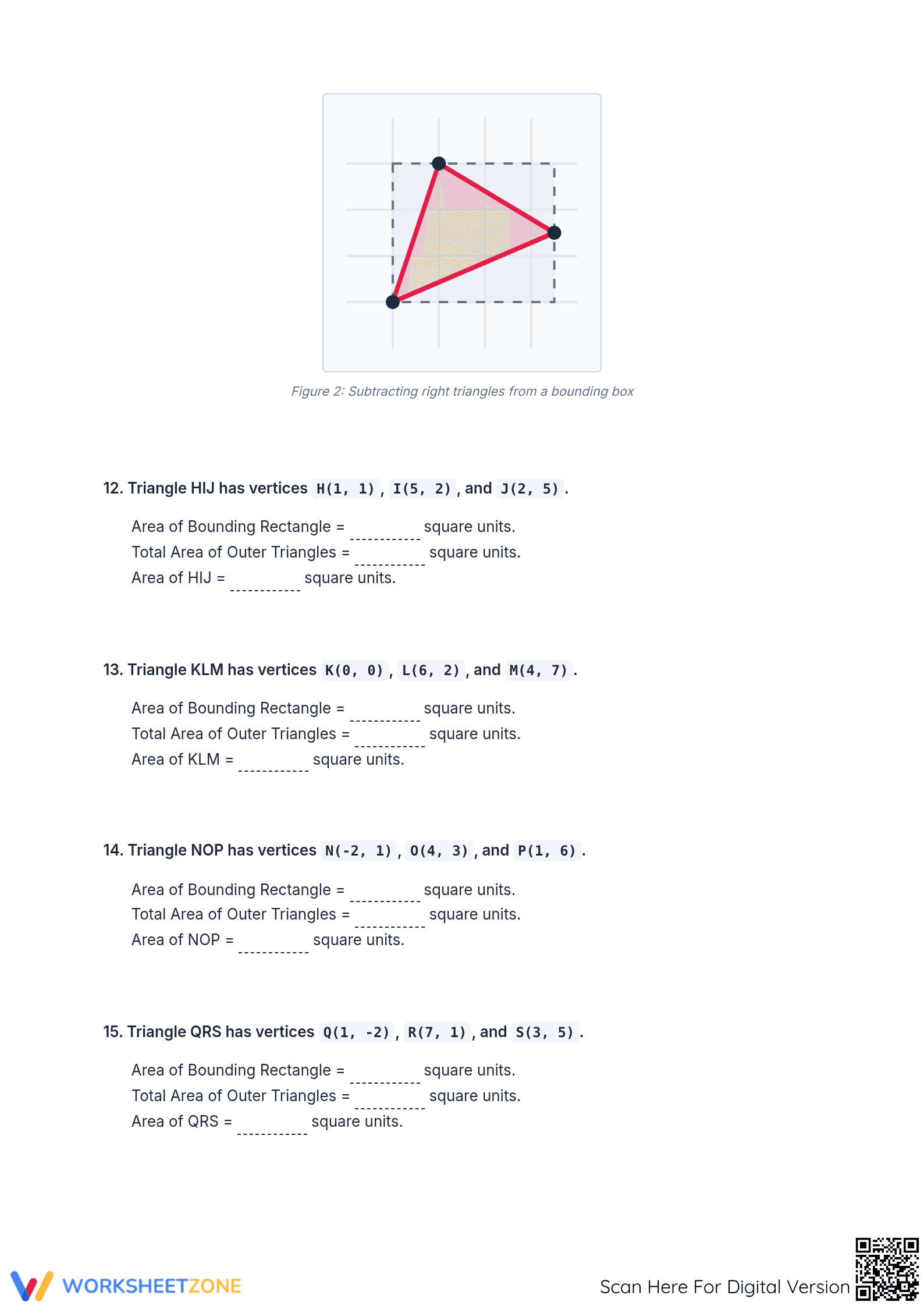
- Independent practice: Final sections utilize the bounding box method, subtracting external right triangles from a surrounding rectangle.
This structure ensures students master decomposition logic before tackling irregular shapes without visual grids.
Standards Alignment
The primary alignment is CCSS.MATH.CONTENT.6.G.A.1, which requires students to find the area of triangles by composing into rectangles or decomposing into other shapes. The worksheet also supports high school geometry standards related to coordinate proof and area. These standard codes can be copied directly into lesson plans, IEP goals, or district curriculum mapping tools.
How to Use It
Assign this resource after introducing coordinate planes and area formulas. It is ideal for the "during" phase of instruction as a collaborative task. For formative assessment, observe students during the bounding box section; if they struggle with dimensions, suggest highlighting the rectangle borders. Most students complete the 20 tasks within 50 minutes. This provides a clear window for small-group intervention during the lesson.
Who It's For
This resource is intended for Grade 6–8 geometry students and Grade 9 learners needing reinforcement. It serves as an excellent RTI resource or supplementary challenge. Pair this with a coordinate plane anchor chart or digital graphing tool to help students visualize the transformation of geometric shapes into calculated mathematical area values.
According to the RAND AIRS 2024 analysis, students who engage in explicit decomposition strategies for geometric shapes demonstrate a 22% higher retention rate in spatial reasoning compared to those relying solely on formulaic memorization. This worksheet leverages that research by forcing students to visualize the relationship between a triangle and its surrounding coordinate grid. By mastering standard CCSS.MATH.CONTENT.6.G.A.1, learners develop the necessary skills to calculate area through the decomposition of complex polygons into manageable right-triangles. The progression from simple grid counting to the bounding box method reflects the best practices in middle school mathematics instruction. This approach ensures that the plain-English skill of finding area by composing or decomposing shapes becomes an intuitive part of the student's mathematical toolkit, preparing them for more advanced trigonometry and calculus applications in subsequent grade levels.


