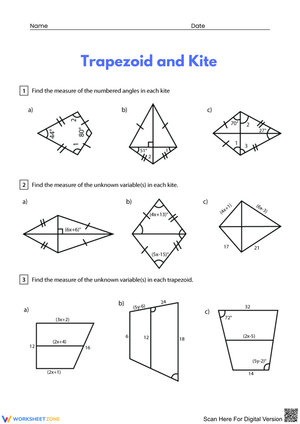
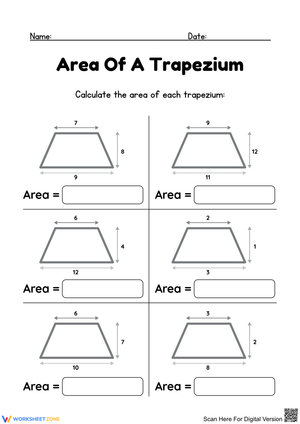
6th Grade Area of Trapezoids PDF Worksheets
These 6th grade area of trapezoids worksheets give teachers a sequenced set of practice problems that moves students from first contact with the formula to fluent, flexible application — including problems where dimensions are missing, measurements are non-integer, and the trapezoid appears in an unfamiliar orientation. Each worksheet is a standalone PDF with an answer key, ready to drop into a lesson without modification.
What Students Practice Across the Set
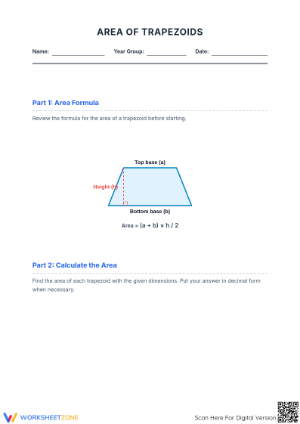
The formula students work with is A = ½ × (b₁ + b₂) × h, where b₁ and b₂ are the parallel bases and h is the perpendicular height. That formula looks deceptively clean on paper, but applying it correctly requires students to do several things at once: identify the parallel sides, locate the true height rather than the slant leg, substitute correctly, and carry the ½ through the multiplication. The worksheets build each of those sub-skills before combining them.
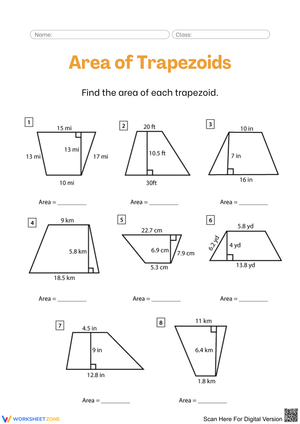
- Labeled diagram problems: All measurements are marked on the figure. Students practice clean formula substitution before any other demand is added.
- Decomposition exercises: Students divide a trapezoid into a rectangle and one or two right triangles, find each partial area, and verify the total matches what the formula produces. This is the conceptual anchor for the whole unit.
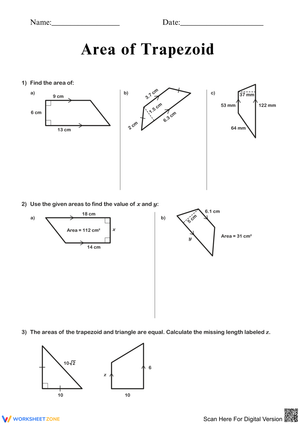
- Missing-dimension problems: Given the area and one base, students solve for the unknown base or height. This introduces inverse operations in a geometry context, which many 6th graders encounter here for the first time.
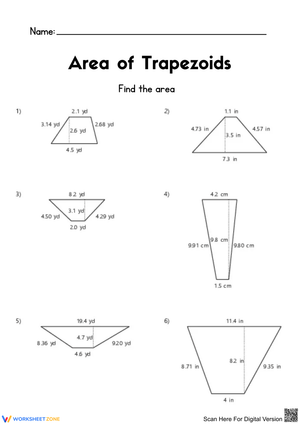
- Decimal and fraction problems: Dimensions involve tenths, hundredths, or simple fractions, connecting the geometry directly to 6th grade number sense work students are doing in parallel.
- Real-world word problems: Scenarios like trapezoidal garden plots and cross-sections of drainage channels require students to extract measurements from a written description before applying the formula — the move that separates procedural from applied understanding.
Standard Alignment
These worksheets address CCSS.Math.Content.6.G.A.1, which requires students to find the area of special quadrilaterals by composing and decomposing them into triangles and rectangles. Trapezoids are the canonical example of a quadrilateral that rewards decomposition: the derivation of the formula maps directly onto the standard's language, making it possible to teach procedural fluency and conceptual understanding in the same lesson sequence rather than treating them as separate phases. The decomposition and labeled-diagram worksheets together cover both dimensions of the standard.
How to Build These Worksheets Into Your Lesson Plans
The decomposition worksheet belongs early, ideally on day one or two of the trapezoid unit, before students have memorized the formula. Have them cut a paper trapezoid, slice it into a rectangle and a triangle, and calculate the total area from parts. Then show them that ½ × (b₁ + b₂) × h produces the same number. When the formula arrives through that experience, students treat it as a shortcut they understand rather than a rule they've been handed.
The labeled diagram sheets work well as guided practice during initial instruction — walk through the first problem as a class under the document camera, then release students to finish independently. This is a straightforward gradual release structure, but it's worth being deliberate about it: cognitive load on these early problems should stay on the formula itself, not on reading a complex figure. Once students score consistently on labeled problems, the missing-dimension sheet makes a strong follow-up on day three or four. Save the decimal and word-problem worksheets for the back half of the unit or as extension work. A single real-world problem from the word-problem sheet also functions well as a Friday exit ticket — the answer reveals immediately whether students can transfer the formula when a diagram isn't handed to them.
Mistakes Students Make That These Worksheets Help You Catch
The slant-height error is the one worth addressing explicitly before students ever touch a worksheet. Trapezoids drawn in standard orientation have a slant leg that is visually prominent — it's the longest-looking side on the figure — and a significant number of 6th graders substitute it for h without hesitating. The correct height is the perpendicular distance between the two bases, often shown as a dashed interior segment. Drawing that dashed line on every figure you model, and labeling it with a small right-angle square, builds a visual habit students eventually apply on their own.
The other consistent error is omitting the ½. Students add the two bases, multiply by h, and stop — producing an answer that equals the area of a parallelogram with the same dimensions. A useful in-class check is to ask whether the area of the trapezoid should be larger or smaller than a rectangle drawn around it. Students who internalize that comparison catch oversized answers before they record them. A third error, less discussed but common on the decimal worksheets, is misaligning place values when adding b₁ and b₂. Encouraging students to write that addition step vertically and separately — before substituting into the formula — almost eliminates this mistake.
Adjusting the Worksheets for a Range of Learners
Students who are shaky on fraction multiplication should stay on the whole-number worksheets longer than you might expect. Assigning the decimal sheet before a student has solid fraction sense shifts their cognitive load entirely to arithmetic and away from geometry — they stop thinking about trapezoids and start struggling with ½ × 3.4. For those students, the labeled whole-number sheets remain productive practice even while other students have moved on.
On the other end, students who move through the labeled problems quickly benefit most from the missing-dimension sheet, which introduces a meaningful challenge without changing the topic. The real-world word problems add another layer of difficulty because the parallel sides are described in text, not drawn — students have to decide which measurements are the bases, which is height, and whether any of the given numbers are irrelevant. That filtering task is where advanced students in a mixed-ability class can spend time productively while others are still building fluency with the formula.
Frequently Asked Questions
Which worksheet should I use first if students have never seen the trapezoid area formula?
Start with the decomposition worksheet. Students split the trapezoid into a rectangle and one or two triangles, calculate each partial area, and add them together. Once they've done that two or three times, introduce the formula as a condensed version of the same calculation. Students who see the formula emerge from the decomposition are far less likely to forget the ½ or confuse b₁ + b₂ with multiplication.
How do I help students reliably identify the height versus the slant side?
Always draw a dashed perpendicular segment inside the figure when you model problems, and mark it with a right-angle symbol. Then present at least one figure where the slant leg is labeled and ask students to identify which measurement they would use for h. Letting students make and then correct that choice in a low-stakes moment — before a graded worksheet — is more effective than telling them the rule in the abstract.
Do the worksheets work for students who are also learning to multiply fractions?
The whole-number and labeled diagram worksheets are appropriate for students who are still developing fraction fluency. The decimal and mixed-number worksheets assume that students can multiply and add non-integer values without breaking down — those are better used once fraction operations are secure, or as a deliberate integration task when both topics have been introduced.
Can I use these for test prep as well as unit instruction?
Yes, with some selection. The missing-dimension problems and word problems reflect the format that appears on most state assessments at this grade level — students are expected to work backward from area or extract measurements from a context, not just apply the formula to a labeled diagram. Using one or two of those problems as review in the weeks before testing, rather than clustering all test prep together, takes advantage of spaced retrieval without requiring a dedicated prep block.
Clear All