


























Views
Downloads

Printable Age of Exploration Worksheet | Grade 5 History
Paste this activity's link or code into your existing LMS (Google Classroom, Canvas, Teams, Schoology, Moodle, etc.).
Students can open and work on the activity right away, with no student login required.
You'll still be able to track student progress and results from your teacher account.
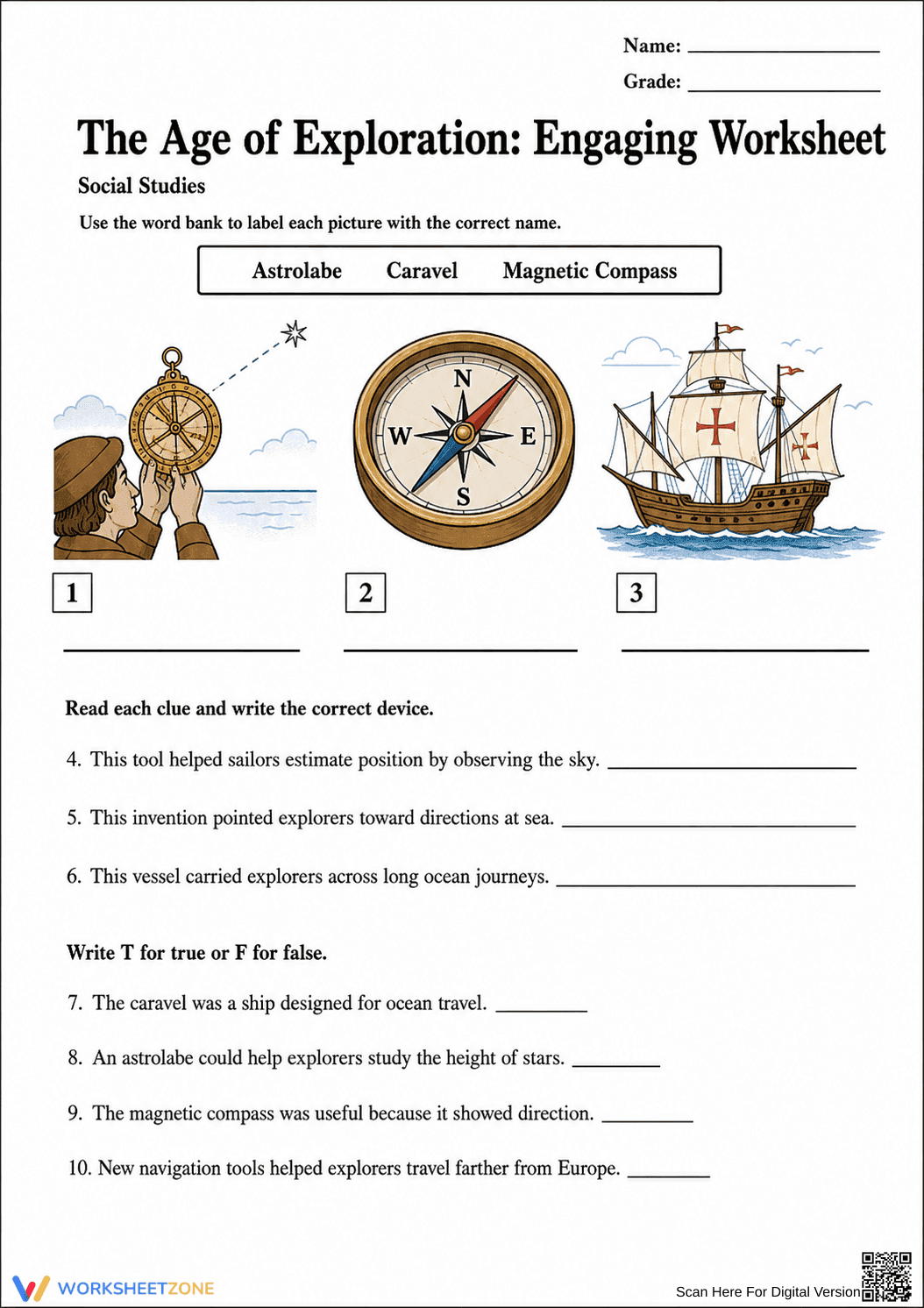
This Grade 5 social studies worksheet introduces students to essential navigational technology used during the Age of Exploration. By identifying tools like the astrolabe, caravel, and magnetic compass, students build domain-specific vocabulary and reinforce their understanding of how these inventions made ocean travel possible.
At a Glance
- Grade: 5 · Subject: Social Studies
- Standard:
CCSS.ELA-LITERACY.RI.5.4— Determine the meaning of domain-specific words- Skill Focus: Historical Vocabulary & Technology
- Format: 1 page · 10 problems · Answer key included · PDF
- Best For: Independent practice or sub plans
- Time: 15–20 minutes
This single-page resource features three task types to engage students. It begins with a visual labeling activity where students use a word bank to identify an astrolabe, compass, and caravel. Next, a matching section requires learners to connect clues to the correct device. Finally, a true/false section tests their understanding of how these tools impacted historical exploration. An answer key is included.
Designed for immediate use, this worksheet requires virtually no teacher preparation:
- Print (1 minute): Print the single-page PDF and answer key.
- Distribute (1 minute): Hand out after a lesson on early explorers.
- Review (3 minutes): Use the key to quickly check work.
With prep time under two minutes, this is an excellent addition to any sub plan.
This activity is aligned to CCSS.ELA-LITERACY.RI.5.4: Determine the meaning of general academic and domain-specific words and phrases in a text relevant to a grade 5 topic or subject area. It also supports broader social studies frameworks by helping students analyze the technological developments that facilitated global interactions. Both standard codes can be copied directly into lesson plans, IEP goals, or district curriculum mapping tools.
This worksheet is highly versatile and fits easily into various instructional moments. Use it as an independent practice assignment immediately following direct instruction on the Age of Exploration to solidify new vocabulary. Alternatively, it serves as an effective formative assessment tool; teachers can observe how quickly students match the clues to the devices to gauge their retention of historical facts. Expected completion time ranges from 15 to 20 minutes, making it a perfect warm-up or wrap-up activity.
This resource is primarily designed for fifth-grade students, though it is easily adaptable for middle school learners reviewing early global exploration. The inclusion of clear illustrations and a word bank provides built-in scaffolding, making it accessible for English Language Learners and students needing additional vocabulary support. It pairs perfectly with an anchor chart detailing early navigational tools or a textbook passage about 15th-century European explorers.
Integrating domain-specific vocabulary practice into social studies instruction is critical for developing historical literacy. This worksheet targets CCSS.ELA-LITERACY.RI.5.4 by requiring students to determine the meaning of domain-specific words related to early navigation. According to Fisher & Frey (2014), explicit vocabulary instruction combined with visual representations significantly improves reading comprehension and content retention in the content areas. By combining visual labeling with descriptive matching and true/false statements, this resource provides multiple exposures to essential historical terms like astrolabe and caravel. This multi-modal approach ensures that students do not merely memorize definitions but actively apply their understanding of how these technological advancements facilitated the Age of Exploration. Providing structured, independent practice with these concepts allows educators to accurately assess student mastery of historical vocabulary while supporting broader literacy goals across the curriculum.


