


























Views
Downloads
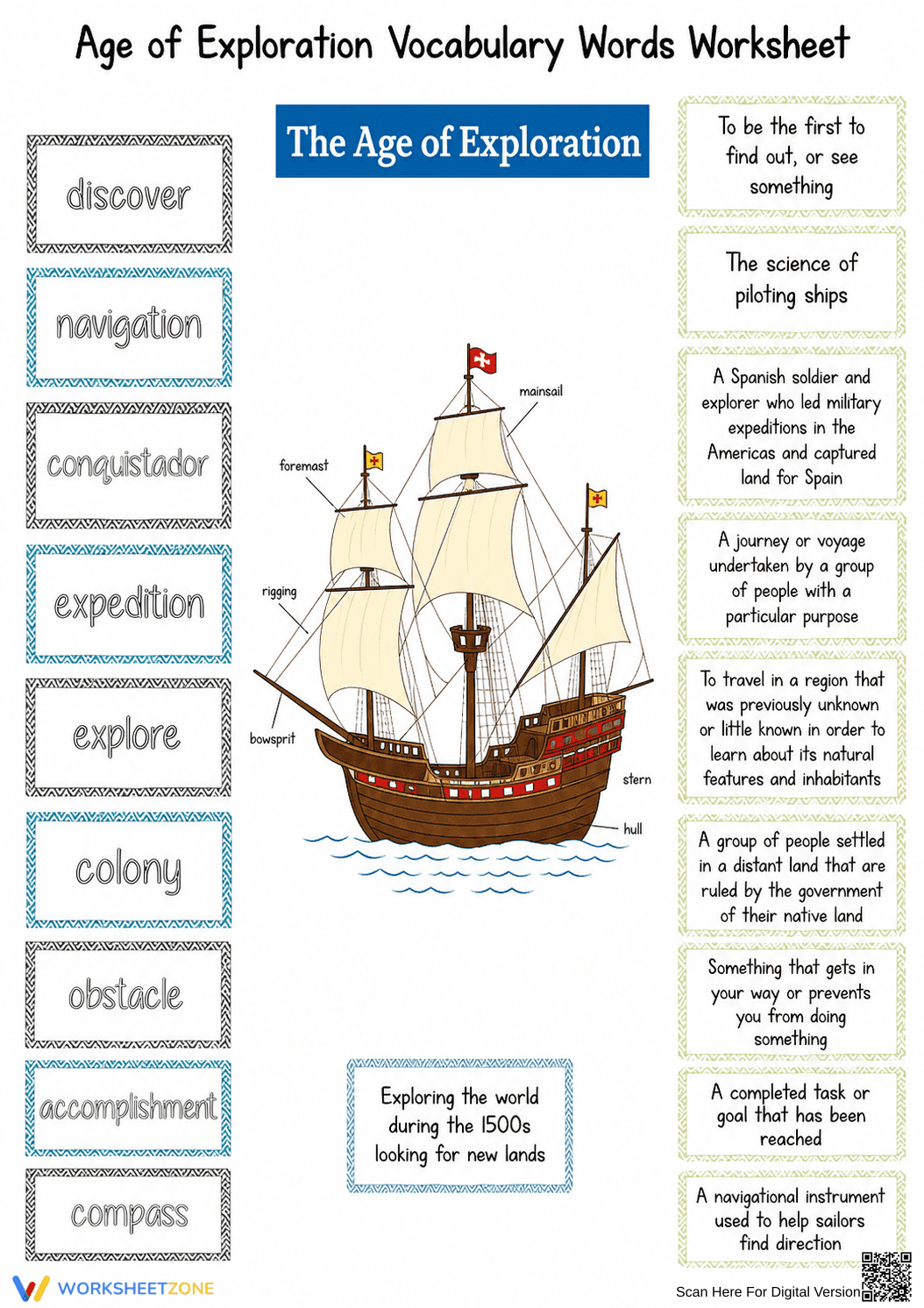

Grade 5 Age of Exploration — Printable No-Prep Worksheet
Paste this activity's link or code into your existing LMS (Google Classroom, Canvas, Teams, Schoology, Moodle, etc.).
Students can open and work on the activity right away, with no student login required.
You'll still be able to track student progress and results from your teacher account.
This Grade 5 vocabulary worksheet equips students to master essential historical terminology related to the Age of Exploration. By connecting domain-specific words to their precise definitions, learners build the foundational background knowledge required to comprehend complex informational texts about early global expeditions and colonization.
At a Glance
- Grade: 5 · Subject: Social Studies
- Standard:
CCSS.ELA-LITERACY.RI.5.4— Determine the meaning of domain-specific words- Skill Focus: Historical Vocabulary
- Format: 1 page · 9 problems · Answer key included · PDF
- Best For: Independent practice
- Time: 10–15 minutes
This single-page resource features a matching activity containing nine critical vocabulary terms, including conquistador, expedition, and navigation. Students draw lines connecting each term to its definition. The center includes a labeled diagram of a 1500s sailing ship, highlighting parts like the hull and bowsprit to provide visual context. A complete answer key is provided.
Designed for maximum efficiency, this resource requires virtually zero teacher setup:
- Print (1 minute): Simply print the PDF and the accompanying answer key. No special materials or cutting required.
- Distribute (1 minute): Hand out the copies as a warm-up, center activity, or independent assignment.
- Review (3 minutes): Use the included key to quickly check student matches or project it for self-correction.
With a total prep time of under two minutes, this activity is an ideal, stress-free addition to any emergency sub plan.
This activity is directly aligned to CCSS.ELA-LITERACY.RI.5.4: Determine the meaning of general academic and domain-specific words and phrases in a text relevant to a grade 5 topic or subject area. It also supports broader historical comprehension goals by reinforcing the specific language used to describe 16th-century global exploration. Both standard codes can be copied directly into lesson plans, IEP goals, or district curriculum mapping tools.
Deploy this matching activity before beginning a new unit on early explorers to pre-teach essential terminology. Alternatively, use it as a quick formative assessment after direct instruction to verify that students have internalized the vocabulary. While students work, observe which terms cause the most hesitation; confusion between words like colony and expedition can indicate a need for brief reteaching. Most students will complete this task within a 10 to 15-minute timeframe.
This worksheet is primarily designed for fifth-grade students studying early American history or global exploration. The clear, uncluttered layout and visual ship diagram offer helpful scaffolding for English Language Learners and students requiring modified reading materials. It pairs perfectly with an introductory reading passage about European explorers or a classroom anchor chart detailing 16th-century navigational tools.
Mastering domain-specific vocabulary is a critical component of reading comprehension in content areas like social studies. Aligned with CCSS.ELA-LITERACY.RI.5.4, this resource requires students to determine the meaning of domain-specific words, supporting their ability to process historical texts. According to Fisher & Frey (2014), explicit vocabulary instruction combined with multiple exposures significantly improves academic language acquisition and reading proficiency. By isolating key terms such as conquistador and navigation in a focused matching format, this worksheet provides the structured repetition necessary for retention. This targeted approach ensures learners build the conceptual frameworks required to engage meaningfully with subsequent historical narratives.


