




























Views
Downloads
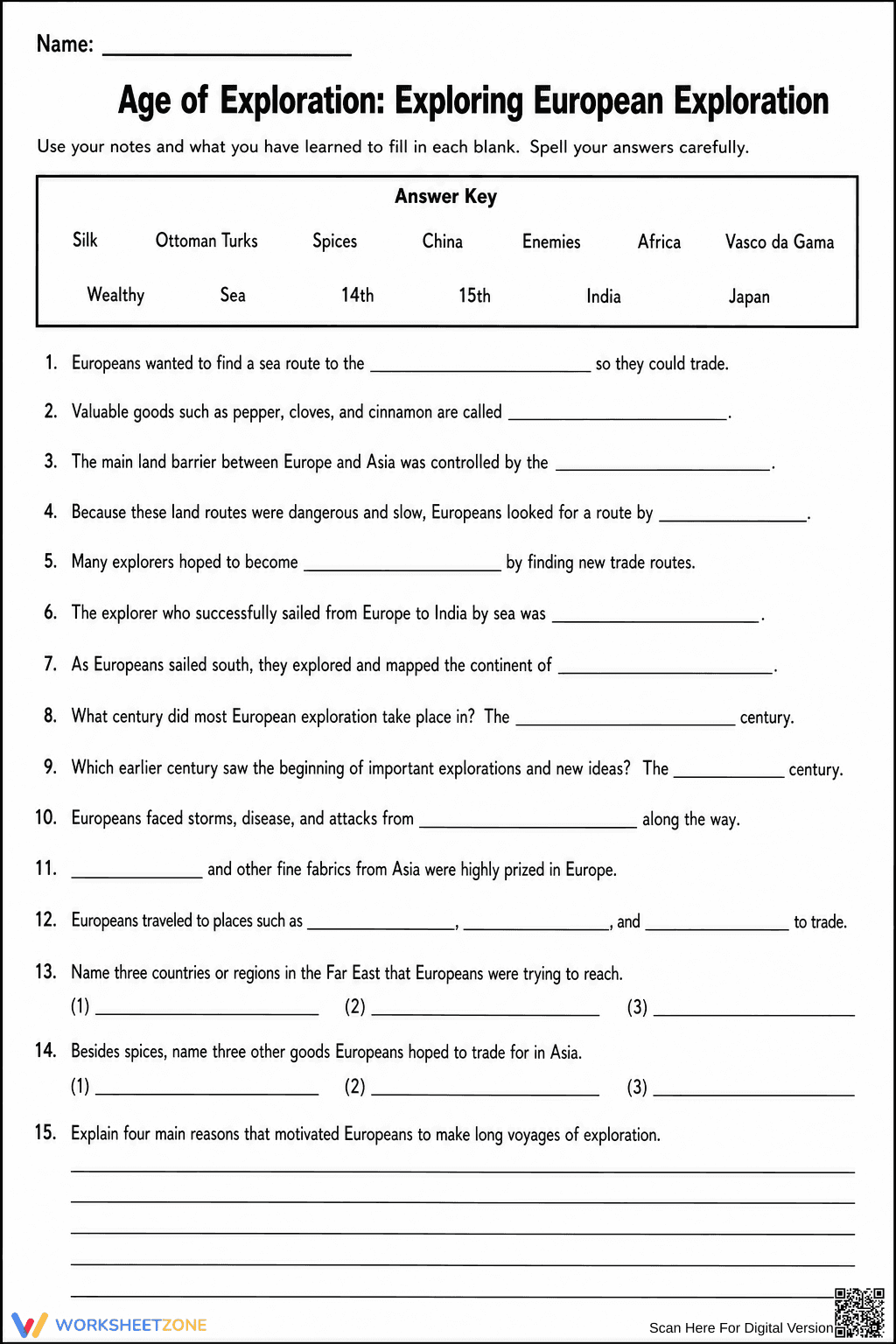

Age of Exploration Worksheet | Grade 7 Printable

Paste this activity's link or code into your existing LMS (Google Classroom, Canvas, Teams, Schoology, Moodle, etc.).
Students can open and work on the activity right away, with no student login required.
You'll still be able to track student progress and results from your teacher account.
This Grade 7 history worksheet helps students consolidate knowledge of the Age of Exploration by recalling key motivations, routes, and figures. By completing targeted fill-in-the-blank and short-answer questions, learners demonstrate understanding of European voyages and the economic drivers behind global trade.
At a Glance
- Grade: 7 · Subject: Social Studies
- Standard:
CCSS.ELA-LITERACY.RI.7.4— Determine the meaning of domain-specific words and phrases- Skill Focus: European exploration motivations and routes
- Format: 1 page · 15 problems · Answer key included · PDF
- Best For: Independent review or sub plans
- Time: 15–20 minutes
This single-page resource features 15 structured tasks, including 12 fill-in-the-blank sentences supported by a comprehensive word bank, two listing questions, and one short-answer explanation. The built-in word bank acts as a scaffold, helping students confidently identify terms like "Ottoman Turks," "Vasco da Gama," and "spices." A complete teacher answer key is provided to ensure fast and accurate grading.
This worksheet requires virtually no teacher preparation:
- Print (1 minute): The single-page PDF format minimizes copy time and saves paper.
- Distribute (1 minute): Hand out the worksheet alongside student notes or textbooks. The clear instructions and word bank allow students to begin immediately.
- Review (3 minutes): Use the included answer key to quickly check responses or guide a whole-class review session.
With under two minutes of total setup time, this activity is an ideal, stress-free option for emergency sub plans or quick formative assessments.
This resource is aligned to CCSS.ELA-LITERACY.RI.7.4: "Determine the meaning of words and phrases as they are used in a text, including figurative, connotative, and technical meanings." It also supports general social studies frameworks by reinforcing historical vocabulary and cause-and-effect relationships. Both standard codes can be copied directly into lesson plans, IEP goals, or district curriculum mapping tools.
Deploy this worksheet as independent practice after direct instruction on early European explorers. Students can use class notes to complete the 15 tasks, reinforcing newly acquired vocabulary. Alternatively, assign it as a focused activity for a substitute teacher. As students work, observe their responses to question 15; this short-answer prompt serves as a quick formative assessment to verify they understand the broader reasons for exploration, rather than just memorizing names. Expect completion in 15 to 20 minutes.
This activity is primarily designed for seventh-grade social studies or world history students. The included word bank provides built-in differentiation, making the vocabulary recall accessible for English Language Learners and students needing additional reading support. It pairs perfectly with an introductory textbook chapter or a slide presentation on the Age of Discovery.
Integrating structured vocabulary practice into history instruction significantly enhances reading comprehension and content retention. According to Fisher & Frey (2014), providing students with targeted opportunities to interact with domain-specific terminology improves their ability to construct historical narratives and understand complex cause-and-effect relationships. This worksheet supports that pedagogical framework by requiring learners to actively apply terms related to European exploration in context. By aligning with CCSS.ELA-LITERACY.RI.7.4 to determine the meaning of domain-specific words and phrases, the activity ensures students move beyond rote memorization to functional understanding. The combination of scaffolded fill-in-the-blank tasks and a culminating explanatory prompt allows educators to efficiently measure both vocabulary acquisition and conceptual grasp. Utilizing resources that blend literacy skills with historical content is a proven strategy for building robust academic foundations in middle school social studies classrooms.


