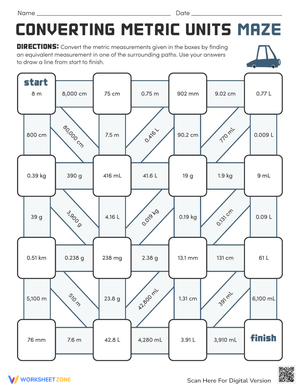
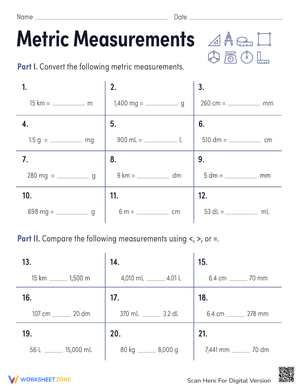
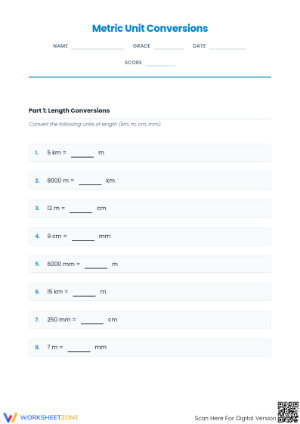
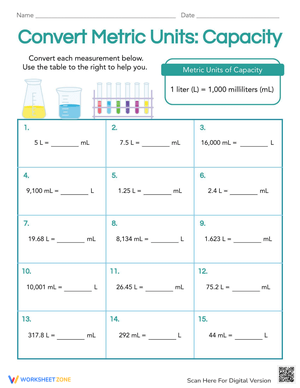
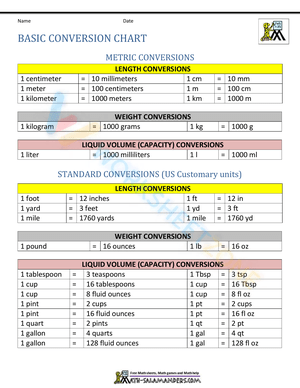
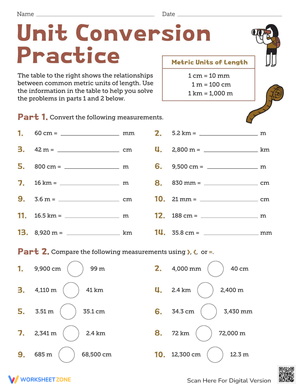
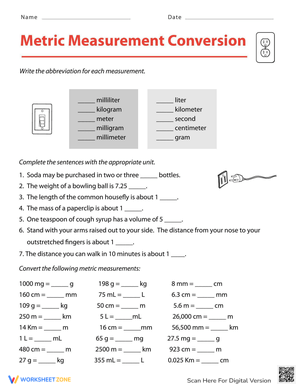
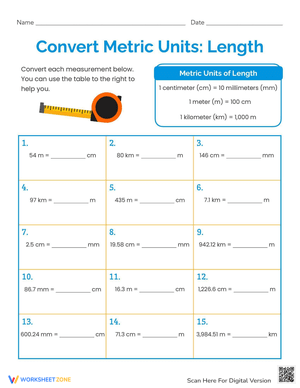
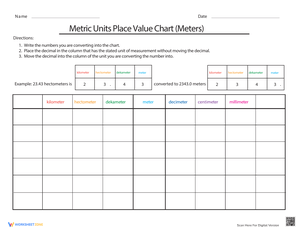
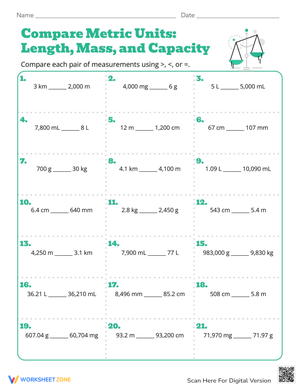
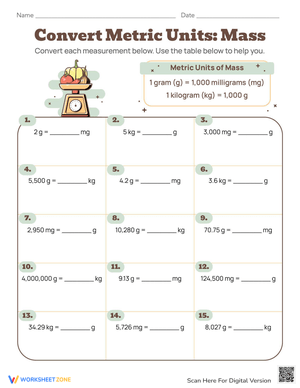
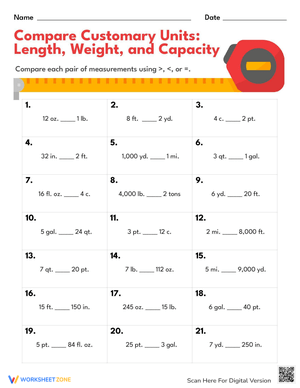
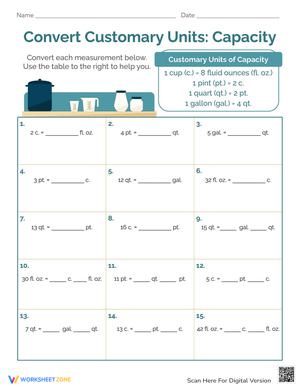
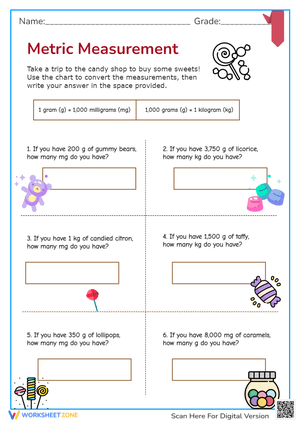
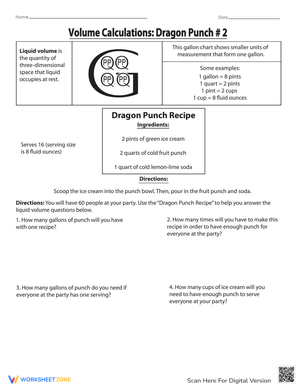
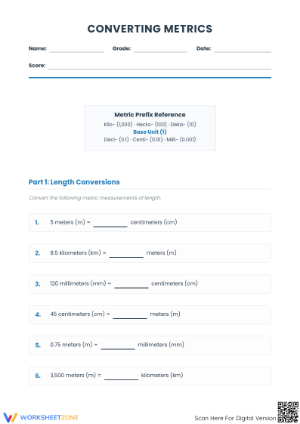
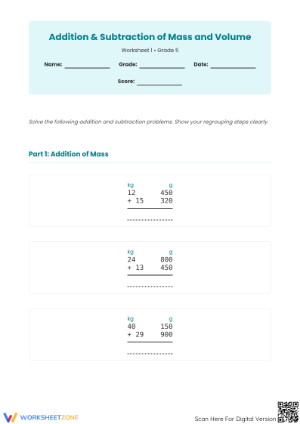
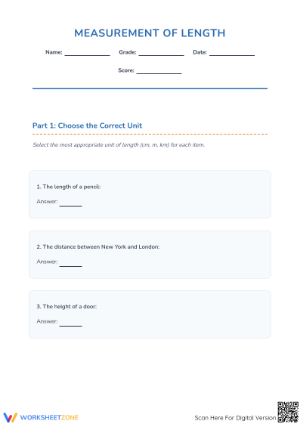
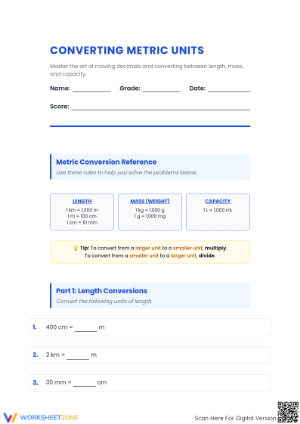
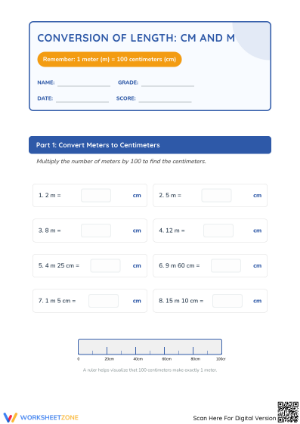
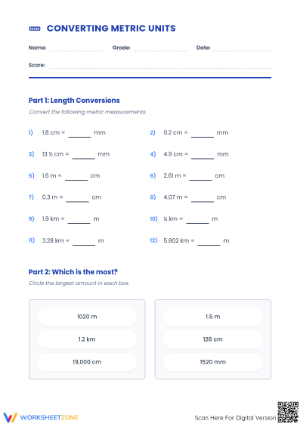
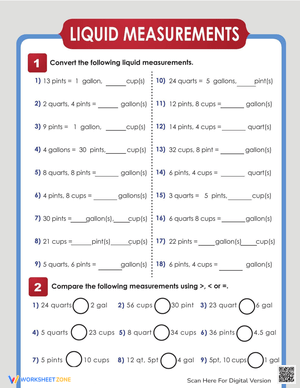
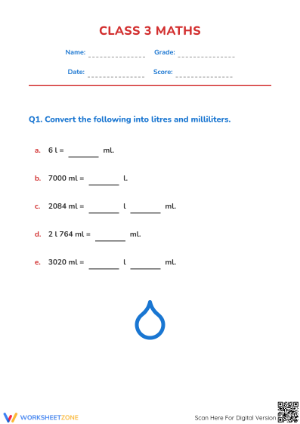
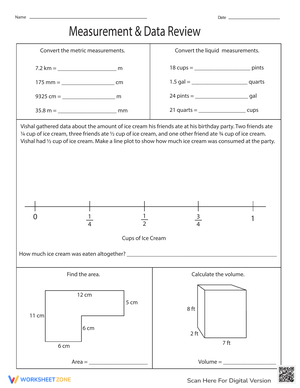
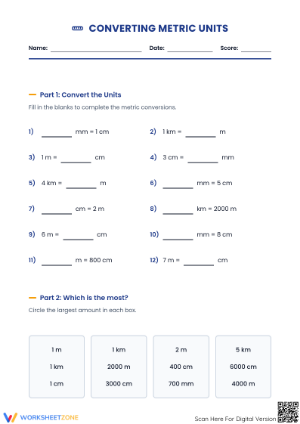
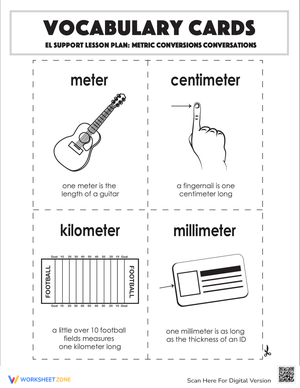
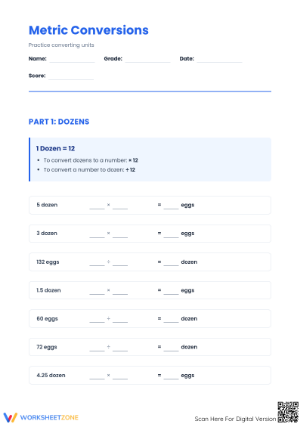
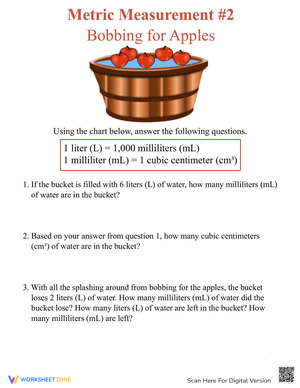
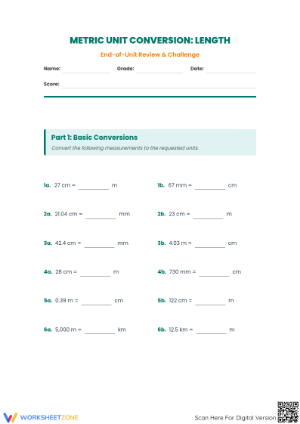
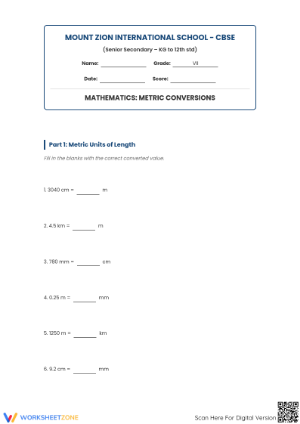
These scale and conversions printable worksheets for 5th grade give teachers measurement practice that reaches further than unit-conversion charts and single-step fill-in problems. The set covers direct conversions within the metric and U.S. customary systems, scale-reading tasks built around rulers and number lines, and multi-step word problems that ask students to apply a conversion inside a realistic context. Teachers can draw from the full set during a measurement unit, pull individual worksheets for intervention, or use specific pieces as quick checks after direct instruction.
The Specific Skills Targeted
Fifth grade measurement work sits at a critical transition point. Students move from recognizing units and their approximate sizes — work that happens in grades 3 and 4 — toward treating unit relationships as multiplicative. Converting 4.5 meters to centimeters is not the same cognitive task as counting up inches on a ruler; the reasoning is proportional, and this is precisely why 5th grade is the first year the standards formally require students to apply conversions inside multi-step problems. These worksheets reflect that shift by pairing conversion fluency with applied tasks throughout the set, rather than treating the two as separate practice blocks.
Across the set, students practice:
- One-step conversions within metric length, mass, and capacity
- One-step conversions within customary length, weight, capacity, and time
- Reading labeled and unlabeled intervals on rulers, number lines, and measurement diagrams
- Multi-step problems requiring students to convert a value and then use the result to compare, compute, or evaluate reasonableness
- Deciding which unit or conversion fits a given context — not just executing the conversion the problem hands them
Scale reading runs through the set as a connected skill. Several worksheets ask students to read a value from a number line, record it in one unit, and immediately express it in another. That sequence shows whether errors originate in the reading, the conversion, or the application — three distinct places where 5th graders lose points on what looks like the same type of problem.
Mistakes Students Make That These Worksheets Help You Catch
The most consistent error in this topic is not the arithmetic. It is the interval misread that happens before any calculation begins. When a number line runs from 0 to 1 meter with four internal tick marks, students routinely assume each interval represents 0.1 rather than 0.2. They count marks, not spaces. A student who makes that mistake arrives at the conversion step with an incorrect value but applies the correct procedure to it — so the work looks partially right, and the error disappears on a quick scan of homework or a warm-up check.
A second pattern surfaces with conversion direction. Students who correctly multiply to convert a larger unit to a smaller one will, in the same class period, multiply again when the problem presents the smaller unit first. This is not a random slip. It reflects a procedural memory that was never grounded in the actual relationship between the units — they remember "times 12" without understanding why. Including both directions within the same worksheet forces that gap into the open before it reaches the unit assessment.
Standard Alignment
The set targets CCSS 5.MD.A.1, which requires students to convert among different-sized standard measurement units within a given measurement system and use those conversions in solving multi-step, real-world problems. The two-part structure of that standard matters for how teachers select worksheets. A worksheet focused solely on filling in conversion tables addresses the first expectation but leaves the second untested. Using both types — conversion fluency worksheets and applied problem-solving worksheets — across the measurement unit gives teachers clearer evidence of where understanding holds and where it breaks down.
In most Grade 5 pacing guides, 5.MD.A.1 falls mid-year, after students have revisited U.S. customary units from earlier grades and are being introduced to the metric system more formally. Teachers running a two-week measurement block often use direct conversion practice in the first several days, shift to scale-reading tasks as bridge work, and reach applied word-problem worksheets once fluency is in place. That sequence matches the natural arc of the standard and avoids placing students in multi-step problems before they can reliably execute a single conversion.
How to Build These Worksheets Into Your Lesson Plans
For teachers searching for scale and conversions printable worksheets for 5th grade that cover both metric and customary content, having the full skill range in one set removes a significant prep burden. Rather than tracking down separate resources for each unit pair, teachers can draw from one organized collection — assigning direct conversion worksheets early, scale-reading worksheets once students are ready for visual tasks, and multi-step problem worksheets as independent work during the back half of the unit.
During a typical lesson, four to six conversion problems work well as a warm-up before instruction. Students attempt them independently and compare briefly before the lesson opens. That short task surfaces what students already know and tells the teacher which unit relationships still need explicit attention. Later in the same period, a mixed-practice worksheet holds up well as independent work while the teacher pulls a small group for additional hands-on time with rulers or measuring containers.
Centers work cleanly with skill-sorted distribution — one group of worksheets for direct conversions, one for scale reading, one for multi-step problems. Students rotate based on need, and the teacher can reassign categories without reorganizing the entire structure. For homework, a focused eight-to-ten-problem worksheet gives enough evidence of independent accuracy without producing an unmanageable grading load. For test review, selecting one worksheet from each category builds a short mixed-skill packet that covers direct conversion, scale reading, and applied problem solving in a single sitting.
Differentiating the Set Across Ability Levels
Students still building measurement fluency need a clear entry point. Start with worksheets that stay inside one system and use familiar unit pairs — inches and feet, centimeters and meters — with small, friendly numbers. One honest note: these worksheets work best after students have had some concrete experience with the units involved. A student who has never used a ruler or handled a graduated cylinder needs that physical grounding before paper-and-pencil conversion practice fully connects. Once that exposure has happened, asking students to annotate directly on each worksheet — underlining the starting unit, circling the target unit — keeps their reasoning visible and makes errors far easier to spot before they become habits.
Advanced learners generally need a different kind of challenge rather than a greater volume of problems. Present a completed conversion with a deliberate error — a misread interval, a reversed multiplication — and ask the student to find and fix it. Or give a multi-step problem solvable by two different conversion paths and ask which was more efficient and why. Tasks like these require students to hold the entire process in mind simultaneously, which is a much closer match to how measurement appears on standardized assessments than single-step practice is.
Keeping format consistent across difficulty levels pays off during class. When the scale and conversions printable worksheets for 5th grade in this set look structurally similar regardless of complexity, teachers can distribute different worksheets during the same work period without drawing attention to who received which version. Students are doing related work without the visual cue of obviously different materials.
Frequently Asked Questions
What measurement systems do these worksheets cover?
The set includes metric units — length, mass, and capacity — alongside U.S. customary units for length, weight, capacity, and time. Most worksheets focus on one system at a time, making it straightforward to assign targeted practice based on what is being taught that week. A smaller number of worksheets in the set combine both systems for end-of-unit review.
Do the worksheets include scale-reading practice, or only conversion problems?
Both. Several worksheets pair a scale-reading item directly with a conversion question — students read a value from a ruler or number line and then express it in a different unit. That structure helps teachers distinguish between students who misread the scale and students who misapply the conversion, two different errors that call for different instructional responses.
How can teachers use these for differentiation within the same class period?
Because each worksheet in this set stands alone, teachers can hand different worksheets to different students simultaneously. A student working on one-step metric conversions gets that worksheet while a student ready for multi-step word problems gets another — same class period, no parallel lesson plan required. The consistent format means the distribution draws minimal attention. For teachers specifically looking for scale and conversions printable worksheets for 5th grade that support mixed-ability instruction, that flexibility is one of the most practical features of the set.














 Interactive Worksheet Maker
 Quiz Maker
 Word Search Maker
 Crossword Puzzle Maker
 Word Scramble Generator
 Sentence Scramble Generator
 Handwriting Worksheet Generator
 Name Tracing Generator
 Fill In The Blank Generator




 BACK TOSCHOOL