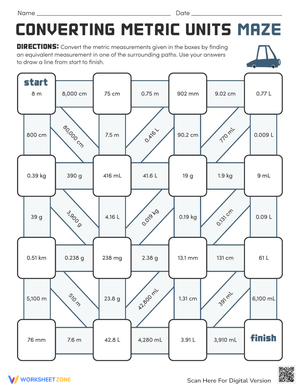
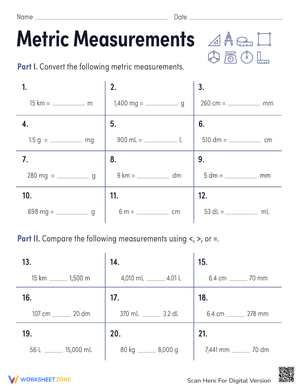
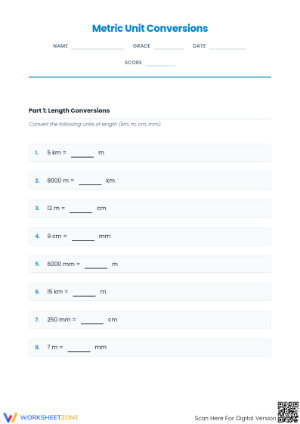
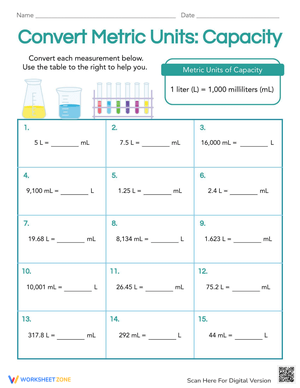
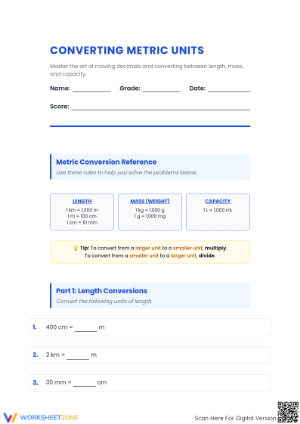
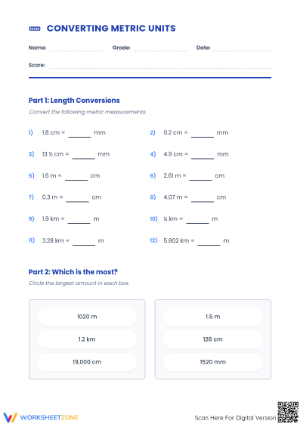
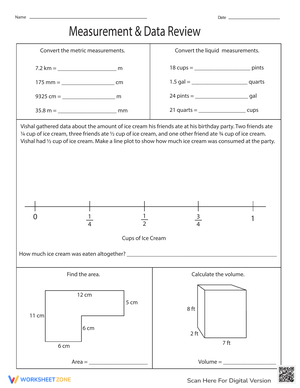
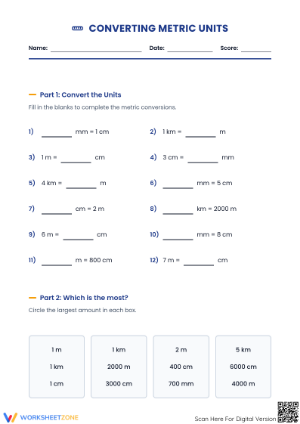
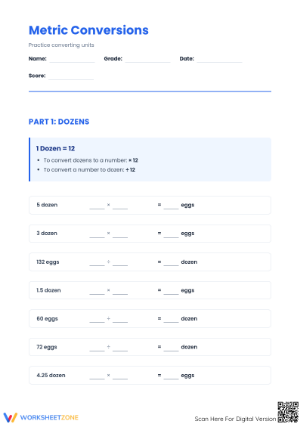
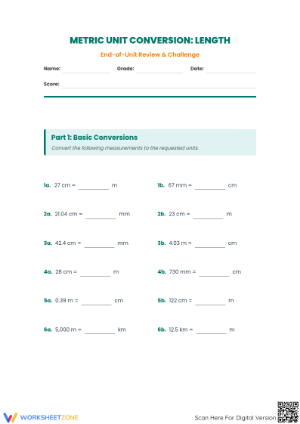
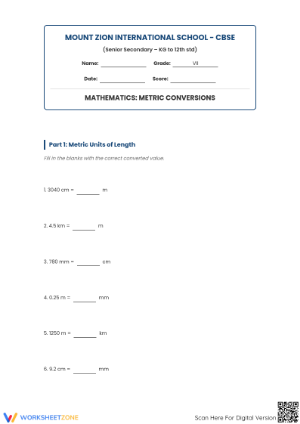
These 5th grade metric conversion worksheets resources give teachers ready-to-use practice for one of the trickiest spots in upper elementary measurement — a skill that looks deceptively simple until students start moving decimal points in the wrong direction. The set covers metric length, mass, and capacity across both direct conversion problems and short application tasks, so the resources serve multiple points across a unit rather than just fluency days.
The Specific Skills Targeted
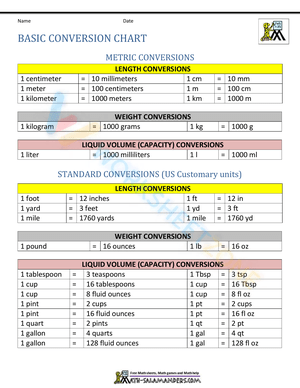
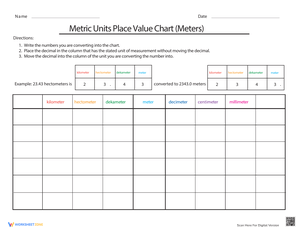
Each worksheet stays within the metric units students encounter most often in grade 5: kilometers, meters, and centimeters for length; kilograms and grams for mass; liters and milliliters for capacity. That scope is deliberate. Pulling in less familiar metric prefixes — hectometers, decigrams — creates unnecessary cognitive load and pulls attention away from the reasoning that the grade-level standard actually targets.
Problems move students from isolated conversions toward applied thinking. A student might rewrite 4.5 kilograms as grams in one problem, then use that same relationship inside a real-world context two problems later. That separation matters because it distinguishes two distinct tasks: understanding the unit relationship and applying it when other information is present. When both appear in the same problem from the start, teachers lose the ability to diagnose which piece a student is missing.
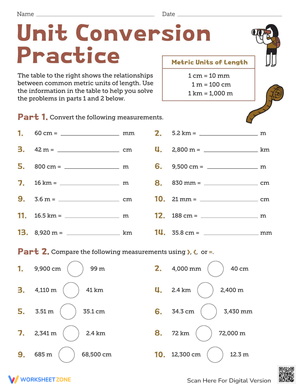
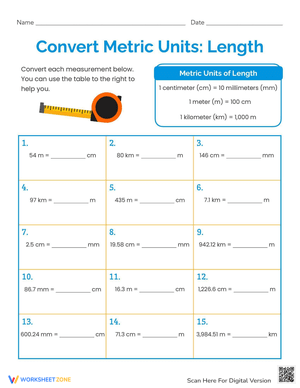
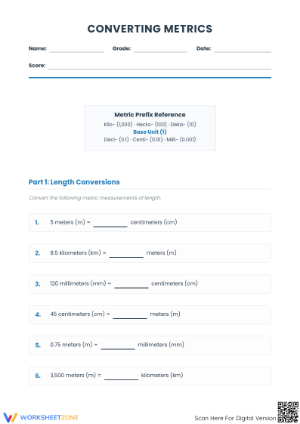
- Length worksheets move between kilometers, meters, and centimeters, with particular attention to the two-step shift between km and cm — a common source of off-by-a-factor-of-ten errors.
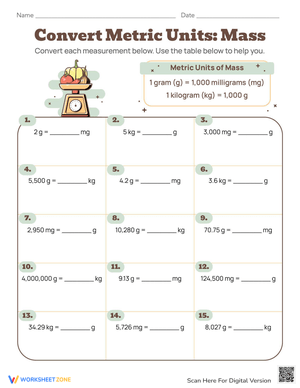
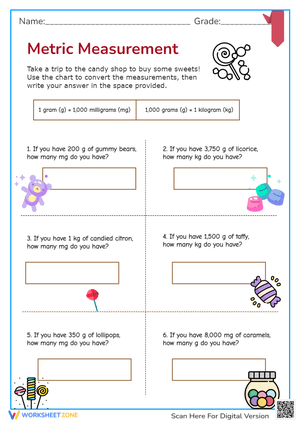
- Mass worksheets reinforce that converting from a larger to a smaller unit means the numeric value increases, a fact students frequently invert.
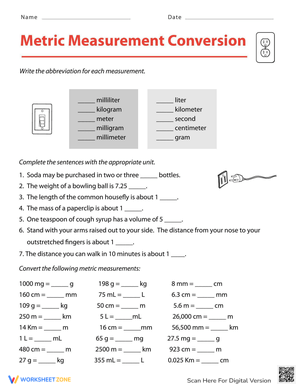
- Capacity worksheets use contexts students recognize: water bottles, measuring cups, science lab equipment.
- Mixed worksheets require students to identify the correct unit relationship before setting up a calculation — the harder skill, and the one 5.MD.A.1 assesses most directly.
Place Value Is the Real Subject
Metric conversion belongs in grade 5 because it extends place value reasoning, not because fifth graders are especially ready for measurement vocabulary. When a student converts 3.2 meters to centimeters, the actual math task is a two-place shift — multiply by 100. The error teachers see most often is a one-place shift instead: the student writes 32 centimeters rather than 320. That mistake has nothing to do with not knowing what a centimeter is. It reflects an incomplete understanding of how multiplying by 100 behaves on a decimal number. Well-structured practice makes this visible, because repeated similar problems allow the error pattern to surface clearly in student work rather than hiding inside a single quiz item.
The base-10 structure of the metric system also means teachers can frame conversion as a reasoning task rather than a memorization task. A student who understands that "kilo-" means 1,000 can reconstruct the kilogram-to-gram relationship without consulting a chart. That reasoning holds up longer — especially in multi-step word problems where unit selection is part of the task, not just unit execution.
Frequent Student Errors Worth Watching For and Correcting
The most consistent error in student work involves direction: students know they need to move a decimal but guess at which way. The deeper issue is that many students lack a reliable mental model for what happens to a measurement's numeric value when the unit changes. If one meter equals 100 centimeters, then any distance stated in centimeters must be a larger number than that same distance in meters. Students who have not internalized that logic write things like 0.35 meters as 0.035 centimeters — moving the decimal left instead of right. It shows up in independent practice and on unit assessments, and it rarely self-corrects without direct instruction.
A second predictable error appears in multi-step problems: students convert correctly but then use the converted measurement inconsistently in the next calculation step, losing track of which unit they are now working in. This tends to surface on word problems that ask for a final answer in a specific unit that differs from the given measurement. When it shows up in student work, it is actually diagnostic — it tells teachers whether confusion lives in the conversion itself or in tracking units through a multi-step calculation.
Standard Alignment
These worksheets address CCSS.MATH.CONTENT.5.MD.A.1, which requires students to convert among different-sized standard measurement units within a given measurement system and use those conversions in solving multi-step real-world problems. In classroom terms, this standard lands partway through the grade 5 measurement and data unit — typically after students have worked through place value with decimals under the 5.NBT cluster. That sequencing matters. Teachers who introduce metric conversion before students are solid on multiplying and dividing decimals by powers of 10 consistently see more direction errors. Running even a brief decimal warm-up before opening the conversion unit reduces that problem noticeably.
How to Work These Worksheets Into Your Lesson Sequence
The resources work best deployed across several days rather than assigned all at once. Start with a single-type worksheet — just length, or just mass — and before anyone solves anything, ask the class to predict the direction of the conversion: if we restate this measurement in a smaller unit, does the number go up or down? That two-minute prediction step interrupts the most common error before it becomes habitual. Then students solve and compare, which gives the teacher immediate formative information about where the reasoning breaks down.
Once students are steady on single-type conversions, a mixed worksheet works well as a center task or partner activity. Two students comparing their unit reasoning before writing answers catches more errors than either student working alone. The 5th grade metric conversion worksheets format makes this practical — teachers print one copy per pair without additional prep. For end-of-unit review, word-problem worksheets function as stronger exit tickets than fluency items alone, because they reveal whether students can select and apply the right conversion or whether they are only executing a practiced procedure on a familiar problem structure.
- Morning warm-up: two or three direct conversion problems, reviewed aloud as a class before instruction begins.
- Center rotation: a mixed worksheet completed with a partner, sorting by measurement type before solving.
- Small-group reteach: students underline the given unit and circle the target unit in each problem before setting up any numbers.
- End-of-unit formative check: a word-problem worksheet collected and scanned for error patterns before the next lesson.
Adjusting the Set for a Range of Learners
For students still building confidence with decimal operations, direct conversion worksheets are the right entry point. Giving them a simple reference card showing just the base-10 relationships — not a full conversion table with every possible unit — lets them focus on the reasoning without the additional load of recall. The goal is correct use of the relationship first; the reference fades as fluency develops over subsequent lessons.
Students who move quickly through fluency items benefit most from word-problem worksheets, particularly those that require two conversions within one question or embed measurement inside a multi-step computation. A 5th grade metric conversion worksheets set that includes those kinds of extension problems saves teachers from improvising challenge tasks on the fly. For students who need the most support, pairing a conversion worksheet with a number line marked in metric units gives a visual anchor for direction — which addresses the most common error type without removing the underlying reasoning task.
Frequently Asked Questions
Which metric units should 5th graders practice most?
The most useful conversions at grade 5 involve kilometers, meters, and centimeters for length; kilograms and grams for mass; and liters and milliliters for capacity. These give students enough variety to practice base-10 relationships across all three measurement categories without extending into metric relationships that fall outside the 5.MD.A.1 scope.
How do these worksheets connect to Common Core standard 5.MD.A.1?
Standard 5.MD.A.1 asks students to convert among different-sized units within one measurement system and apply those conversions in multi-step real-world problems. The worksheets address both components — fluency items build the conversion skill, and word problems require students to use conversions as part of a larger calculation. The 5th grade metric conversion worksheets format makes it straightforward to assign different components at different points in the lesson arc.
Can these worksheets serve students who are still shaky on decimal operations?
Students who have not yet practiced multiplying and dividing decimals by powers of 10 will find metric conversion harder than it needs to be. The set is most productive after those skills have been introduced. If they are still unsteady, a short decimal review session before beginning conversion work makes a real difference — and it helps teachers distinguish errors that come from measurement reasoning versus errors that come from decimal computation.
Are these worksheets appropriate for homework or sub plans?
Direct conversion worksheets work well for homework because the task structure is clear enough that students can attempt them independently. Word-problem worksheets are better suited to class time, where students can ask clarifying questions or compare reasoning with a partner. For sub plans, single-type conversion worksheets are the reliable choice — a substitute can review the answers without needing to know the full arc of the measurement unit.














 Interactive Worksheet Maker
 Quiz Maker
 Word Search Maker
 Crossword Puzzle Maker
 Word Scramble Generator
 Sentence Scramble Generator
 Handwriting Worksheet Generator
 Name Tracing Generator
 Fill In The Blank Generator




 BACK TOSCHOOL